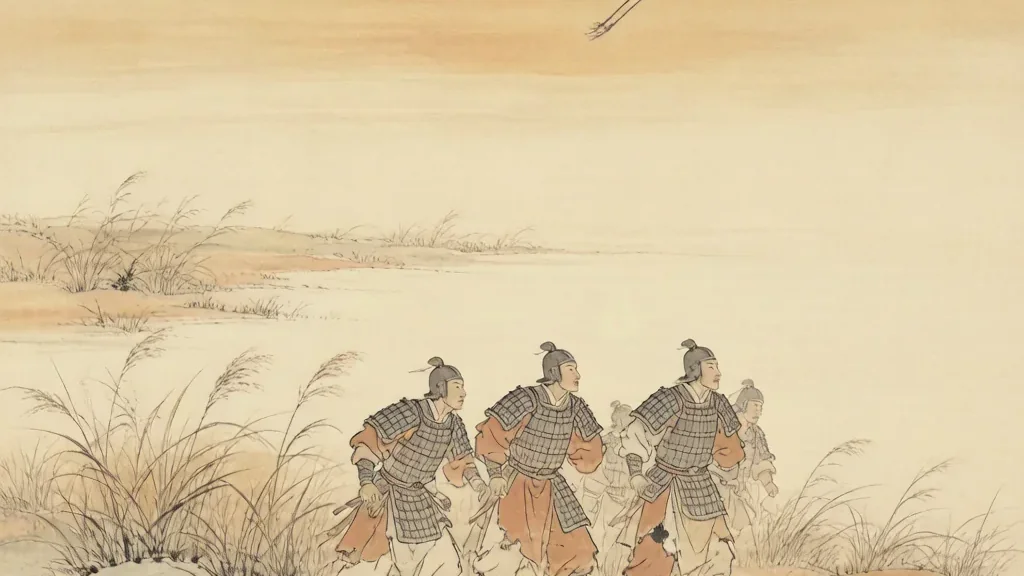
The idiom 风声鹤唳, pronounced , means the sound of the wind and the cry of cranes, and it describes a defeated army so terrified that it mistakes every rustle of nature for an enemy attack. The phrase is inseparable from the Battle of Fei River in the year 383, when the vast host of the Former Qin under Fu Jian collapsed before the smaller army of Eastern Jin. As the routed soldiers fled north, they heard wind in the trees and cranes calling and believed pursuers were upon them. Usually paired with 草木皆兵, the terror that every bush is a soldier, the idiom has become the standard Chinese image of panic and paranoia after defeat. This article examines the battle that birthed it, the psychology of rout, the paired phrase, the historical consequences, and the idiom's long life as a warning against fear.
The Battle of Fei River
The Battle of Fei River was fought in 383 between the Former Qin, a northern state founded by the Fu clan of the Di people, and the Eastern Jin, the Chinese dynasty holding the south. Fu Jian had unified much of northern China and marched south with a huge army, boasting of numbers so great that his troops could bridge the river with whips. The Jin forces were far fewer but better coordinated and led by skilled commanders.
The campaign turned on a risky Jin proposal that the Qin army withdraw slightly to let the Jin cross the river and fight on open ground. Fu Jian agreed, hoping to strike as the enemy was mid-crossing, but his ranks broke in the confusion. Discipline collapsed, rumor spread that the army was beaten, and the mass of troops fled in disorder across the countryside.
It was during this headlong retreat that the idiom was born. Soldiers already convinced of disaster interpreted ordinary sounds as the approach of Jin cavalry. The once-mighty host dissolved not mainly by swords but by fear, a fact the historians recorded with astonishment and used to explain why numbers alone do not win wars.
Fu Jian and the Former Qin
Fu Jian was a remarkable ruler who promoted Chinese learning, employed educated advisors, and briefly knit together the warring north. His ambition to reunify the empire led him to gamble everything on the southern campaign. Contemporary accounts credit him with genuine ability yet also with overconfidence born of earlier success, a flaw that the Fei River disaster exposed.
The composition of his army was a source of weakness. It included conscripted soldiers from many conquered peoples, some of whom felt little loyalty to the Qin cause. When panic began, these diverse troops scattered rather than rally, and defections compounded the rout. A host held together by fear and coercion proved fragile once the spell of invincibility broke.
Fu Jian's defeat reshaped Chinese history. The north fragmented again into rival states, and the Jin survived in the south, preserving Han Chinese culture and administration for another century. The battle is thus a turning point often cited to show how a single misjudged engagement can alter the destiny of nations.
The Sound of Wind and Cranes
The literal image is precise and poetic. As the Qin soldiers fled through open land, the wind moved through grass and trees, and cranes cried overhead. To calm men these would be ordinary autumn sounds, but to men certain they were hunted, each noise became a signal of enemy movement. The phrase captures the moment when perception is hijacked by dread.
Cranes in particular carry a lonely, far-carrying call, and at dusk their cries across a river or marsh could seem like a trumpet of pursuit. The idiom fuses two senses, hearing and fear, into one compact picture of a mind that can no longer tell environment from enemy. Nature itself becomes hostile because the fleeing man projects his terror onto it.
This sensory distortion is not unique to the Qin army; it is a common feature of routs in many wars. But the Chinese phrase fixed it in four characters of haunting beauty, so that the wind and the crane are forever linked with the psychology of the broken army.
Paired with Every Bush a Soldier
风声鹤唳 is almost always spoken with 草木皆兵, the fear that every blade and bush conceals a soldier. Together they describe a consciousness surrounded by phantom threats, where sight and sound alike report enemies that are not there. The pairing is so fixed that one often calls up the other in speech.
The companion phrase also derives from the Fei River campaign, describing how Fu Jian, while still facing the Jin, looked across the river and mistook the vegetation on the opposite bank for hidden troops. Thus the two idioms bracket the battle: one from the tense anticipation before the clash, the other from the panic after it. Both reveal a mind at the mercy of fear.
Used together, they form a complete portrait of military paranoia. The eyes see soldiers in the grass; the ears hear soldiers in the wind. The enemy is everywhere and nowhere, which is precisely the condition of an army that has lost its nerve and with it the battle.
The Psychology of Rout
Military historians study the Fei River collapse as a textbook case of how morale, not mere numbers, decides outcomes. Once a critical mass of soldiers believes the cause is lost, self-preservation overrides orders, and the movement of one runner triggers a cascade. Fear is contagious, spreading faster than any commander's voice.
The idiom names the auditory dimension of this contagion. In the noise of retreat, ambiguous stimuli are interpreted as threats because the cost of assuming safety feels higher than the cost of assuming danger. A brain primed for peril will falsify the world rather than risk surprise, and the result is the hallucinated pursuit of wind and cranes.
Modern psychology would describe this as hypervigilance and threat bias, common in trauma and extreme stress. The ancient anecdote anticipated the insight that perception is shaped by expectation, and that a frightened group can collectively manufacture the danger it fears.
Historical Consequences of the Defeat
The immediate consequence was the disintegration of Former Qin power. Fu Jian's empire, built quickly, unraveled almost as fast, and the north returned to fragmentation among short-lived regimes. The southern Jin, against the odds, preserved its state and with it the continuity of classical Chinese institutions during a turbulent century.
The battle also entered the canon of examples used by later strategists. Texts on warfare cite Fei River to argue that unity of command, morale, and terrain outweigh raw numbers. A confident but divided giant can lose to a smaller force that knows its ground and its purpose, a lesson repeated in many later campaigns.
For Chinese historical memory, the episode became a parable about the limits of force. The ruler who boasted that whips could dam the river was humbled by wind and birds, a poetic justice that storytellers relished and moralists used to caution against arrogance.
Use in Literature and Daily Speech
The phrase appears in histories, novels, and essays as the definitive image of post-defeat panic. When a writer wants to show a character undone by fear, mentioning wind and cranes suffices to summon the whole Fei River scene without further explanation.
In daily speech, 风声鹤唳 describes any situation where anxiety makes a person see threat everywhere: a scandalized official hearing rumor in every corridor, an investor flinching at every market dip, a guilty person startled by ordinary noises. The idiom travels easily from battlefield to personal nerves.
It is often used, with the paired phrase, in political commentary to depict a regime or faction gripped by paranoia, arresting on suspicion and trusting no one. The ancient rout becomes a metaphor for the self-destructive fear of insecure power.
Why the Idiom Endures
The endurance comes from the universality of its feeling. Everyone has known the moment when fear lends menace to harmless things, and the wind-and-crane image gives that feeling a name and a story. It is specific enough to be vivid yet broad enough to fit countless situations.
The idiom also endures because it is beautiful. The sounds it names are gentle in themselves, which sharpens the irony: the loveliest noises of nature become instruments of terror when the mind is broken. The contrast between peace and panic is what makes the phrase linger in memory.
Finally, it teaches a durable lesson about confidence. Fu Jian's army failed not because cranes attacked but because it had already decided it was beaten. The idiom warns that the enemy we imagine can defeat us before any real enemy arrives, a truth as relevant to personal life as to war.
❓ Frequently Asked Questions
What does 风声鹤唳 mean?
It means the sound of wind and cry of cranes, describing a defeated force so panicked it fears enemies in every natural sound.
From which battle does it come?
It comes from the Battle of Fei River in 383, where the Former Qin army broke and fled in terror.
Why did the soldiers fear cranes?
Already convinced they were hunted, they interpreted the cranes' far-carrying cries as enemy signals in the dusk.
What idiom pairs with it?
It pairs with 草木皆兵, every bush a soldier, together painting full military paranoia.
What is the historical lesson?
The episode shows that morale and unity decide battles more than numbers, and that fear can manufacture defeat.
How is it used today?
It describes personal or political paranoia, where anxious people read threat into innocent events.