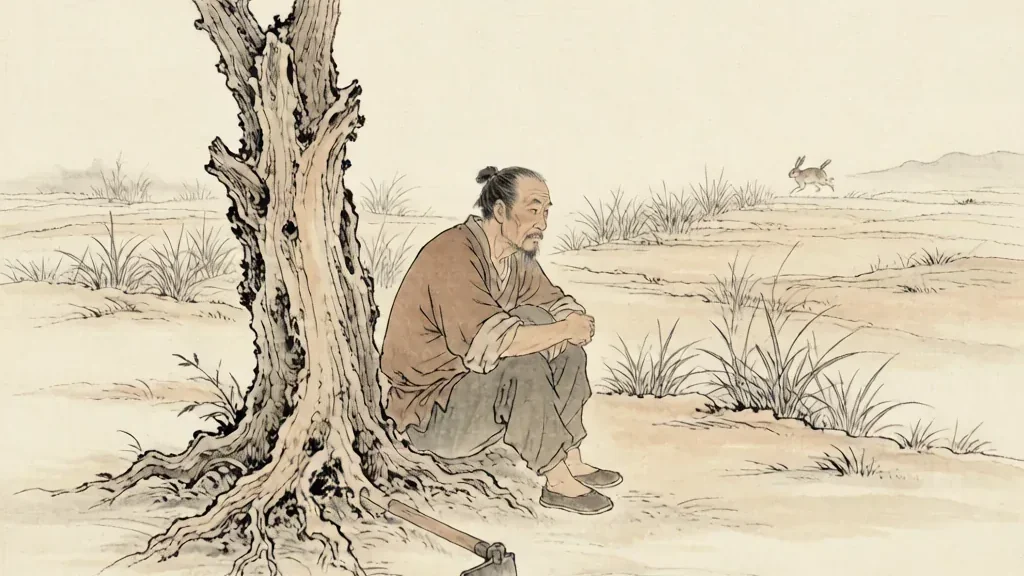
Of all the ways a person can ruin their life, perhaps the most quietly tragic is to mistake a single stroke of luck for a plan. The Chinese have a phrase for this exact mistake, and it has endured for over two thousand years: 守株待兔 (shǒu zhū dài tù), "waiting by the stump for a hare." It is a short, sharp story — almost a joke — and like all the best jokes, it hides a serious truth inside its laughter. The tale comes from the writings of Han Fei, one of the most influential philosophers of the Warring States period, and it was meant as a warning to rulers. But its lesson has proven far too universal to stay confined to politics.
The story is recorded in the "Han Feizi" (韩非子), a foundational text of the Legalist school of Chinese philosophy. Han Fei used parables the way a doctor uses illustrations: to make a diagnosis easier to see. The farmer in this story is not a villain. He is not even particularly foolish, at first. He is simply a man who, for one instant, was offered something for nothing — and could never bring himself to go back to earning his living the hard way.
The Farmer of the Song State
Long ago, in the state of Song (宋国) during the Spring and Autumn period, there lived a farmer who worked a modest plot of land. Song was a small state, often mocked by its larger neighbors, and life for a common farmer was hard. The soil was not especially fertile, the seasons were unforgiving, and every harvest was a quiet victory wrestled from the earth through months of sweat. The farmer plowed in spring, weeded through summer, harvested in autumn, and repaired his tools through winter, year after year, the rhythm of agrarian life as inescapable as the turning of the stars.
One afternoon, while he was working his field under a hot sun, something extraordinary happened. A hare — a wild rabbit, frantic and fleeing from some unseen predator — came barreling out of the undergrowth at full speed. It did not see the farmer. It did not see the stump of an old tree that had been cut down at the edge of the field. The hare ran straight into the stump with a sickening thud, broke its neck, and fell dead at the farmer's feet.
The farmer stood stunned. He had not lifted a finger. He had not drawn a bow or set a snare. A meal — a good one, tender and fat — had simply arrived at his feet, killed by its own foolishness. He picked up the hare, took it home, and that night his family ate better than they had in months. The taste of free meat lingered in his mind long after the meal was over.
The Stump Becomes an Idol
The next morning, the farmer returned to his field. But something had shifted inside him. He looked at his plow, and for the first time in his life, it seemed like an absurd instrument — a heavy, clumsy thing designed for backbreaking labor. Why should he break his back when the stump had already provided? Why should he plow and plant and weed and wait for months, when a hare could simply arrive, killed by its own panic, ready for the pot?
So instead of plowing, he sat down beside the stump. He waited. He told himself that another hare would surely come, just as the first one had. The stump was, after all, the same stump. The hares were, after all, the same hares. The logic seemed airtight. He waited all day, and saw nothing. He came back the next day, and the day after that. He stopped tending his crops. The weeds grew tall. The soil, which he had tended so carefully for years, dried and cracked under the sun.
Days turned to weeks, and weeks turned to months. The farmer came to his field each morning, sat beside the stump, and waited. He scanned the horizon for any flicker of brown fur. He listened for the patter of panicked feet. Nothing ever came. The harvest that year was a disaster. The field that had once fed his family lay fallow and choked with weeds. And still the farmer waited, because the memory of that one free hare had become more real to him than the actual fields dying in front of him.
The Laughingstock of the State
Word of the farmer spread, as word always does in small communities. His neighbors whispered, then chuckled, then openly laughed. Travelers came from other villages just to see the famous fool of Song, the man who had given up farming to stare at a tree stump. The story reached the ears of scholars and officials, and from there it passed into the writings of Han Fei, who used it as a parable for the rulers of his age.
Han Fei's point was political. He was arguing against rulers who clung to the policies of ancient sage-kings, expecting those old methods to solve new problems. Just as the farmer expected a second hare because the first had come, these rulers expected the old ways to keep working simply because they had worked once, long ago. But times change, Han Fei wrote. The world does not repeat itself on command. To govern well, a ruler must respond to the present, not worship a single lucky moment from the past.
Why the Story Endures
What makes this story so enduring is that the farmer is not a monster. He is recognizably human. We have all, at some point, tasted the sweetness of unearned success and then quietly rearranged our lives to chase it again. The student who aces one exam without studying and then never studies again. The gambler who wins once and spends a lifetime trying to repeat the night. The investor who makes one lucky pick and convinces himself he has cracked the market. The writer whose first book succeeds by accident and who then spends a decade trying to recreate the accident instead of doing the work.
The idiom 守株待兔 captures something that more sophisticated words often miss: the seductive power of a single exception. Luck is real. Hares really do crash into stumps sometimes. But the moment we treat the exception as the rule, we have stopped farming and started waiting — and the fields of our lives will quietly go to seed while we sit and stare.
Chinese parents still tell this story to children who slack off after one good grade. Teachers still cite it to students who hope for easy shortcuts. And in a modern economy saturated with lottery tickets, crypto schemes, and "get rich quick" influencers, the old farmer of Song has never felt more contemporary. The stump, it turns out, is always with us — and there is always another hare that will never come.
Han Fei's Political Warning to Rulers
Although the story is told through a bumbling farmer, Han Fei was a political thinker, and the farmer was a stand-in for rulers. His target was kings who clung to the policies of the ancient sage-kings, assuming that methods which had worked centuries earlier would still solve present problems. In his view, the world changes, and a leader who waits for the old success to return, like the farmer waiting for a second hare, governs by superstition rather than observation. The chariot of state rolls on regardless, and the realm that relies on a lucky past will be overrun by rivals who actually adapt. Read this way, the idiom is less a nursery tale than a memo to power: do not confuse what once worked with what will work.
The Cognitive Trap of a Lucky Break
Modern psychology explains why the farmer's error feels so human. When one unlikely good thing happens, the mind leaps to a pattern, a bias that expects the streak to continue. The hare that broke its neck was a random event, but the farmer experienced it as a signal. We do the same when one lucky investment, one easy exam, or one chance meeting seems to promise more of the same. The idiom names this trap two thousand years early. Its wisdom is to separate the accident from the rule, to notice that the world rarely repeats its gifts on command, and to return to the slow, certain work the farmer abandoned.
Sibling Fables From the Land of Song
The state of Song was a favorite punching bag in classical Chinese anecdote, a place whose people were repeatedly cast as well-meaning but foolish. Besides the stump-waiting farmer, Song supplies the man who pulled his seedlings taller to make them grow faster, 揠苗助长, ruining his crop through impatience. Both tales use a Song character to teach a lesson about misguided effort, one through laziness, the other through hurry. This pattern tells us something about how ancient authors used a mocked state the way modern comedy uses a rival town. The farmer by the stump is therefore not alone but one member of a small, affectionately ridiculed family of Song fools, each warning against a different way of spoiling real work.
From Fable to Everyday Verb
Few idioms slip so easily from story into speech. Chinese speakers will say someone is 守株 when they sit back hoping for a break instead of working, and managers warn teams not to 守株待兔 when a one-time tactic stops paying. The phrase shows up in dating, hiring, and investing alike: the person who waits for calls that never come, the applicant who submits one resume and expects offers, the trader who expects last year's luck again. Because the image is so concrete, it needs no explanation; the stump does the arguing. That is why the idiom survives while more abstract warnings fade. It is not a quotation but a verb, a way of naming a posture everyone recognizes in themselves.
❓ Frequently Asked Questions
📝 Chinese Vocabulary
守株待兔 — : "To guard the stump and wait for a hare" — to rely on chance instead of working; to expect easy success that came once by accident.
宋国 — : The State of Song, a small kingdom during the Spring and Autumn and Warring States periods, often featured in classical parables as a place of well-meaning but foolish characters.
农夫 — : "Farmer" or "peasant" — the protagonist of the story, whose name was never recorded, as if to emphasize that he stands for anyone.
树桩 — : "Tree stump" — the object the hare crashed into and the spot where the farmer waited, becoming the symbol of misplaced hope.
韩非子 — : The philosopher Han Fei (c. 280–233 BCE), whose work preserved this story and used it to critique rulers who clung to outdated policies.
揠苗助长 — : To pull seedlings up to help them grow; a companion Song-state parable about impatient, counterproductive effort.
侥幸 — : A windfall or luck arrived by chance, the very thing the farmer mistook for a dependable method.
徒劳 — : Futile labor or effort spent in vain, the final result of waiting by the stump.
🎉 Fun Facts
- The state of Song was so frequently mocked in classical Chinese parables that "a man of Song" (宋人) became a near-synonym for "a fool" in ancient literature — Song also appears in the famous story of the man who tried to help his crops grow by pulling them taller (揠苗助长).
- Han Fei, who recorded the story, was a stutterer who could not speak well in court but wrote with devastating clarity; his essays so impressed the King of Qin that Han Fei was invited to the court — and ultimately imprisoned there by jealous rivals.
- The idiom is one of the most frequently used in modern Chinese education, often appearing on school exams as a warning against laziness and wishful thinking.
- A common modern variant of the phrase is 守株待兔精神 — "the spirit of waiting by the stump" — used sarcastically to describe passive business strategies that wait for the market to come to them.
- Han Fei's real target was not farmers but rulers: he used the tale to mock kings who reused the old policies of ancient sage-kings, expecting methods that worked once long ago to keep working.
- In everyday speech the phrase is sometimes trimmed to just 守株, used as a verb meaning to wait passively for luck instead of making an effort.