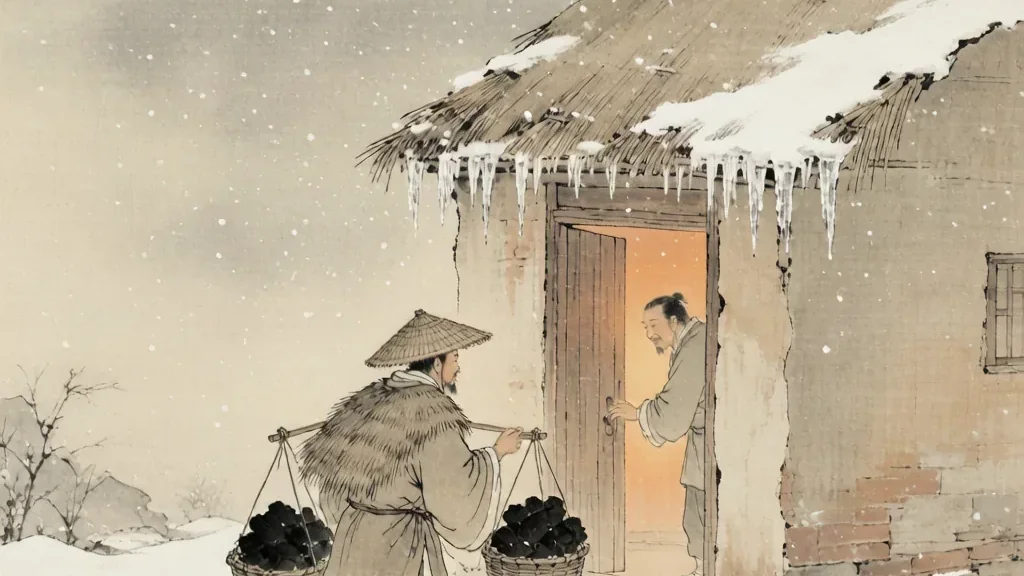
Help is easy to give when it costs nothing; the test of kindness is whether you show up when it matters. The Chinese idiom 雪中送炭 (xuě zhōng sòng tàn) — "sending charcoal in the snow" — captures the perfection of timely aid. In the depths of a freezing winter, when a poor family cannot afford to heat its home, someone arrives with charcoal to fuel the fire. The gift is modest, but the moment makes it precious beyond price. The idiom has become the standard Chinese way to praise assistance that arrives exactly when it is needed most, and to contrast it with help that comes too late to matter.
The Literal Scene and Its Logic
The four characters paint a small, warm picture: 雪中 (xuě zhōng) "in the snow," and 送炭 (sòng tàn) "to deliver charcoal." Charcoal was the fuel of ordinary households for cooking and heating; in a harsh northern winter, running out of it could mean real suffering. To bring charcoal to a freezing home is to bring the means of warmth and survival at the exact hour of need.
The weather is not incidental. Snow stands for extremity — cold, isolation, danger. Aid given in fair weather is welcome; aid given in a storm is heroic. The idiom's power comes from this contrast between the harsh setting and the gentle gift. The charcoal is ordinary, but the timing is extraordinary.
This is why the phrase pairs so naturally with its opposite. Chinese speakers often set 雪中送炭 against 锦上添花 (jǐn shàng tiān huā, "adding flowers to brocade") — beautifying what is already beautiful. One helps the desperate, the other merely decorates the fortunate. The two idioms together form a little ethics of giving: prefer the snow to the brocade.
The Song-Dynasty Origin Stories
The idiom is commonly traced to the Song dynasty. One well-known account concerns Emperor Taizong of Song (宋太宗, reign 976–997), who on an especially bitter, snowy day thought of the poor and elderly shivering in unheated rooms. Moved by their plight, he ordered officials to distribute charcoal, grain, and warming supplies to those who could not afford them, personally extending the court's relief to the neediest.
Another thread points to poetry. The Southern Song poet 范成大 (Fàn Chéngdà) used imagery of sending charcoal in the snow to distinguish genuine, needful kindness from mere decorative gesture. Over time the image crystallized into the fixed four-character idiom we know, carrying both the imperial-benevolence story and the poetic contrast in its wake.
Whether attributed to an emperor's decree or a poet's line, the idiom's origin is squarely about relief for the vulnerable in winter. That grounding in concrete social care — not myth, not war, but fuel for the cold — is part of its quiet dignity. It is an idiom born of compassion, not spectacle.
The Meaning: Timeliness as the Soul of Kindness
At its core, 雪中送炭 teaches that when help arrives can matter as much as what arrives. A ton of coal delivered in summer is clutter; a few pieces delivered in a blizzard is salvation. The idiom elevates responsiveness — the willingness to notice need and act before it is too late — above sheer magnitude of gift.
It also implies discernment. The charcoal-bringer must know the situation: who is cold, who lacks fuel, what would actually help. Thoughtless generosity (sending ice to the freezing, or flowers to the starving) fails the test. True 送炭 requires empathy sharp enough to match the gift to the moment, which is harder than it sounds.
Culturally, the idiom reinforces a valued ideal of 雪中情 (compassion in hardship) and the Confucian concern for the welfare of the common people (the "min" 民). A ruler or neighbor who practices it earns lasting gratitude. The phrase thus sits at the intersection of personal kindness and good governance: both are judged by whether they reach the sufferer in time.
How the Idiom Is Used Today
In contemporary Chinese, 雪中送炭 is used constantly to praise timely help of any kind. A friend who lends money when you are broke, a colleague who covers your shift when you are ill, a nation that sends disaster relief — all may be described as sending charcoal in the snow. The phrase has a warm, deeply approving tone.
It is also a staple of diplomacy and public relations. When one country aids another after an earthquake or flood, Chinese commentary often invokes the idiom to frame the aid as true friendship rather than strategic calculation. The image of urgent, need-based help lends moral weight to the gesture.
Conversely, people use the idiom to gently criticize lateness. To say "this is help, but it is not exactly 雪中送炭" is to note that the assistance, while welcome, came too late to meet the real need. The phrase thus carries a built-in standard against which all help is measured.
The Contrast With "Adding Flowers to Brocade"
No discussion of this idiom is complete without its frequent companion, 锦上添花. Brocade is already rich and beautiful; adding flowers makes it prettier but not necessary. The two phrases are often spoken together as a contrast: one should strive to be the charcoal in the snow rather than merely the flower on the brocade.
This pairing reveals a Chinese intuition about distributive justice. Helping the already-fortunate is pleasant but low-value; helping the desperate is difficult but high-value. The idiom invites the giver to weigh not just the gift but the recipient's condition. It is, in effect, an ancient statement of the principle that aid should flow to where it is needed most.
Yet the contrast need not be absolute. A culture needs both celebration and relief; flowers on brocade have their place at weddings and festivals. The wisdom is one of priority: when snow is falling on someone, that is where the charcoal must go first. The idiom sets the order of compassion.
A Reflection on Showing Up in Time
雪中送炭 is a quiet measure of love. We all know people who are generous in easy moments and absent in hard ones; the idiom names the difference and finds the latter wanting. To send charcoal in the snow is to be present at the inconvenient, uncomfortable hour, when helping is work rather than display.
The lesson for each of us is practical. Watch for the snow in others' lives — the layoff, the illness, the loneliness — and bring what small warmth you can before the storm passes. You may not have much; charcoal is humble fuel. But delivered in the snow, it is remembered for a lifetime. That is the whole of the idiom, and most of what kindness asks.
Charcoal: Fuel That Meant Survival
To modern readers charcoal is a quaint fuel, but in premodern China it was close to life itself. Northern winters are brutal, and a home without fuel could mean illness or death, especially for the old and poor. Charcoal burned steady and clean enough for indoor heating, so a delivery of it was not a polite gesture but a practical rescue. The idiom gains its force from that material reality: the gift is small in status yet enormous in effect. When Emperor Taizong ordered charcoal and grain sent to the shivering poor, he was meeting a need as basic as food. Knowing this background turns the four characters from a pretty metaphor into a record of how fragile warmth once was, and why a neighbor's fuel could be remembered for a lifetime.
A Measure of True Friendship
Beyond emperors and relief campaigns, the idiom works as a quiet test of personal loyalty. We all know people who are generous when life is easy and absent when it is hard; the phrase draws a line between the two and finds the fair-weather friend wanting. To send charcoal in the snow is to show up at the inconvenient hour, when helping costs something and no audience is watching. A friend who brings real support during a layoff, an illness, or a loss is, in this idiom's eyes, the rarest kind. The image thus doubles as a standard for choosing and being a friend: watch for the snow in others' lives and carry what small warmth you can before it passes. The charcoal need not be grand; delivered in the storm, it is unforgettable.
❓ Frequently Asked Questions
📝 Chinese Vocabulary
雪中送炭 — : "Send charcoal in the snow"; timely help to those in need.
雪 — : Snow; stands for hardship and extremity in the idiom.
炭 — : Charcoal; fuel that brings warmth and survival in winter.
宋太宗 — : Song emperor credited with distributing charcoal and food to the cold and poor.
锦上添花 — : "Add flowers to brocade"; its opposite, help that merely decorates the fortunate.
范成大 — : The Southern Song poet whose lines helped fix the image of sending charcoal in the snow as timely kindness.
救济 — : Relief or aid, especially the assistance given to the poor and vulnerable in hard times.
寒 — : Cold; the hardship the snow represents and that the charcoal is meant to answer.
🎉 Fun Facts
- The idiom is almost always contrasted with 锦上添花 ("adding flowers to brocade"), help that merely decorates the already-fortunate.
- Emperor Taizong of Song reportedly ordered charcoal, grain, and wine distributed to the poor on a freezing day.
- Charcoal was the everyday heating fuel of ordinary Chinese homes, making the gift practical, not symbolic.
- The idiom is commonly used in diplomacy to frame disaster relief as true friendship.
- In colder regions of China, delivering coal or charcoal to aging parents before winter is still a real, practical act of filial care, the idiom made literal.
- Young Chinese online jokingly call a friend who brings them coffee during a late shift 'someone sending charcoal in the snow,' keeping the phrase alive in casual chat.