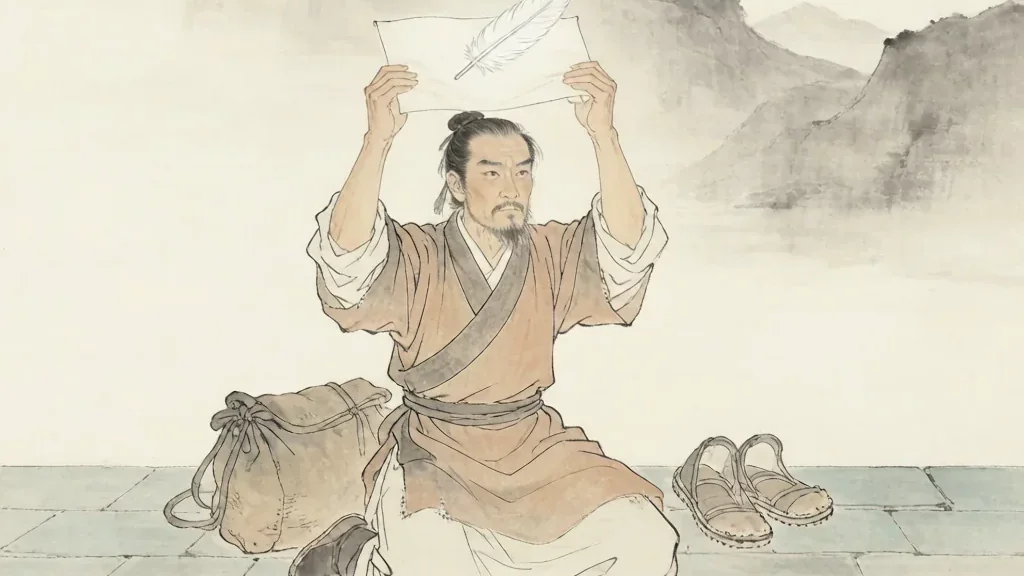
The smallest gift can carry the largest heart. The Chinese idiom 千里送鹅毛 (qiān lǐ sòng é máo) — "sending a goose feather from a thousand li away" — teaches that the value of a present lies not in its price but in the distance traveled and the sincerity behind it. The story behind it is a comic disaster that turns into a lesson about honesty and goodwill, and it remains one of the gentlest, most humane of the common idioms. When you want to say "it's the thought that counts" in Chinese, this is the phrase you reach for.
The Characters and Their Literal Sense
The four characters are almost a postcard: 千里 (qiān lǐ) "a thousand li" (a li being a traditional measure of about a third of a mile, so a great distance), 送 (sòng) "to send" or "to present," 鹅 (é) "goose," and 毛 (máo) "feather." Together they evoke a traveler who has journeyed far to deliver something absurdly light — a single feather. The contrast between the long road and the tiny cargo is the whole joke and the whole point.
Note that the idiom does not say "a goose from a thousand li" but a feather. The gift has shrunk to almost nothing, yet the effort of the journey remains. That asymmetry is deliberate: it forces the listener to weigh the messenger's trouble against the object's worth, and to conclude that the trouble matters more. The feather is a symbol, not a specimen.
In use, people often append the saying "礼轻情意重" (lǐ qīng qíng yì zhòng) — "the gift is light, but the affection is heavy." This couplet is the idiom's natural companion, spelling out the moral so plainly that even a child understands it. Together they form a complete etiquette lesson in eight characters.
The Tang-Dynasty Tribute Mission
The story is usually set in the Tang dynasty. A local or minority king on the empire's frontier wished to pay tribute to the emperor and chose as his gift a rare and magnificent swan (天鹅, tiān'é), a bird of great beauty and symbolic value. He entrusted it to an envoy named 缅伯高 (Miǎn Bó Gāo), who set out on the long journey to the capital with the swan caged and carefully tended.
Along the way, the party stopped at a river. The envoy, wishing to let the swan drink and bathe, loosened it near the water. To his horror, the bird spread its wings and flew off, leaving behind only a single feather drifting in the breeze. The magnificent gift was gone, and the envoy faced the prospect of returning empty-handed, or not returning at all, from a failed mission that could displease the throne.
Rather than flee or substitute a false gift, the envoy made a remarkable choice: he kept the one feather, continued to the capital, and presented it to the emperor with a frank and humble poem explaining exactly what had happened. The poem reportedly admitted the loss and offered the feather as all that remained of a sincere tribute. His honesty, delivered with grace, turned catastrophe into charm.
The Emperor's Generous Response
The emperor, far from punishing the envoy, was pleased — not by the feather, which was worthless, but by the man's integrity and the spirit of the distant king who had sent a splendid gift in goodwill. The long journey undertaken for a token showed respect more eloquently than any swan could. The emperor accepted the feather as a token of friendship and rewarded the envoy for his candor.
This ending is essential to the idiom's meaning. A lesser ruler might have executed the clumsy messenger; the wise one saw through the object to the intention. The story thus celebrates two virtues at once: the envoy's honesty in admitting failure, and the emperor's wisdom in valuing sincerity over splendor. Both are models the culture holds up for imitation.
The feather, once a symbol of failure, is transformed by the ending into a symbol of loyalty. It traveled a thousand li not because it was precious but because the person carrying it refused to give up on the relationship. The object's lightness becomes, paradoxically, proof of the bond's weight.
The Cultural Meaning: Sincerity Over Splendor
Chinese gift culture is famously attentive to face, hierarchy, and appropriate generosity. Yet this idiom injects a democratic counterpoint: a humble offering, given with a true heart and carried with real effort, can outshine an expensive one given carelessly. It protects the poor person's dignity by insisting that devotion counts.
The idiom also sanctions honesty in failure. The envoy could have invented a story or substituted another bird; instead he told the truth and was honored for it. The tale thus reinforces a broader Chinese appreciation for 诚意 (chéngyì, sincerity) — the genuine intent behind an act — as the true measure of its worth.
There is a philosophical echo here of Confucian and Daoist themes alike: that substance matters more than surface, that the journey and the intention reveal character. A gift is not a transaction of objects but a gesture of relationship. The goose feather, light as air, becomes heavier than gold because it carries a person across a thousand li of mountain and plain.
How the Idiom Is Used Today
In modern Chinese, 千里送鹅毛 is invoked whenever someone gives a modest gift and wants to signal that the feeling behind it is what matters. It is common in thank-you notes, at holidays, and especially across distance — a friend mailing a small souvenir from far away might quote it to say the postage and thought count more than the item.
It also softens awkwardness. If you bring a host a tiny trifle, saying "this is just a goose feather from a thousand li" disarms any expectation of lavishness and turns the smallness into a compliment about the relationship. The phrase is socially graceful precisely because it names the unequal exchange and transcends it.
Interestingly, the idiom travels well in cross-cultural gift exchanges, where worries about appropriate value run high. Quoting it lets a giver say, in effect, "I know this is small, but I carried it far in my heart." Few phrases defuse gift anxiety so elegantly.
A Reflection on the Weight of a Feather
千里送鹅毛 is a quiet rebuke to a culture of ever-larger gifts. It asks us to remember that the point of giving is the bond, not the bounty. The envoy's feather, useless as plumage, became priceless as a confession of loyalty — because he did not hide, did not fake, did not quit. He simply arrived, truthfully, with what he had.
We might apply the lesson beyond gifts. What we "send" to others — a visit, a letter, a kind word — is often small in itself. Its worth is the thousand-li effort of showing up, the choice to keep carrying it when the swan has flown. The next time you offer something humble, remember the feather: light in the hand, heavy in the heart, and more than enough.
Tribute and the Frontier
The story is set in the machinery of the Tang tributary system, by which outlying kings and peoples sent rare goods to the emperor to acknowledge his supremacy and secure peaceful relations. A swan was a fitting gift: beautiful, exotic, and symbolically lofty. That such a present could be lost on the road shows the fragility behind the grand ceremony of tribute, where a single mishap could become a diplomatic incident. The envoy's dilemma, return empty-handed or fake success, was real, because failure to deliver could anger the throne. His choice to tell the truth turned a potential crime into a lesson, and the tale quietly humanizes the imperial system by focusing on one anxious messenger rather than the emperor's glory.
The Poem That Saved the Envoy
According to the legend, the envoy did not simply hand over a feather; he accompanied it with a frank poem explaining how the swan had escaped and offering the feather as all that remained. That poem is the pivot of the story. In a culture that prizes literary grace, presenting a failure as verse was itself a form of deference, showing respect even in shame. The poem let the emperor see the man's character, honest, composed, and quick-witted, rather than merely the missing bird. It is the literary frame that transforms a blunder into charm and proves the point the idiom makes: the gesture's worth lies in the sincerity and effort it carries. Without the poem, a feather is just a feather; with it, the feather becomes a token of loyalty.
❓ Frequently Asked Questions
📝 Chinese Vocabulary
千里送鹅毛 — : "Send a goose feather from a thousand li"; a small gift with great sincerity.
千里 — : A thousand li; a great distance emphasizing the journey.
鹅毛 — : Goose feather; the humble token that stands for the whole gift.
礼轻情意重 — : "The gift is light, but the affection is heavy"; the idiom's usual companion line.
诚意 — : Sincerity; the genuine intent the idiom says truly matters.
天鹅 — : The swan, the rare tribute bird the envoy was meant to deliver to the Tang emperor before it flew away.
缅伯高 — : The envoy who lost the swan, kept its feather, and won the emperor's favor through honest candor.
贡 — : Tribute, the goods frontier kings sent to the emperor to show loyalty and submission.
🎉 Fun Facts
- The idiom is usually paired with the saying 礼轻情意重 — "the gift is light, but the affection is heavy."
- The lost swan was a tribute bird for the Tang emperor; the envoy's honesty saved him from punishment.
- A li is about one-third of a mile, so "a thousand li" is roughly 330 miles of travel for one feather.
- The story flips a disaster (losing the gift) into a model of integrity rewarded by a wise ruler.
- The tale is a favorite in Chinese moral education for children, used to teach that telling the truth about a failure can be wiser than hiding it.
- During holidays such as Spring Festival, when family members mail small tokens across the country, people often quote the idiom to say the long journey matters more than the item itself.