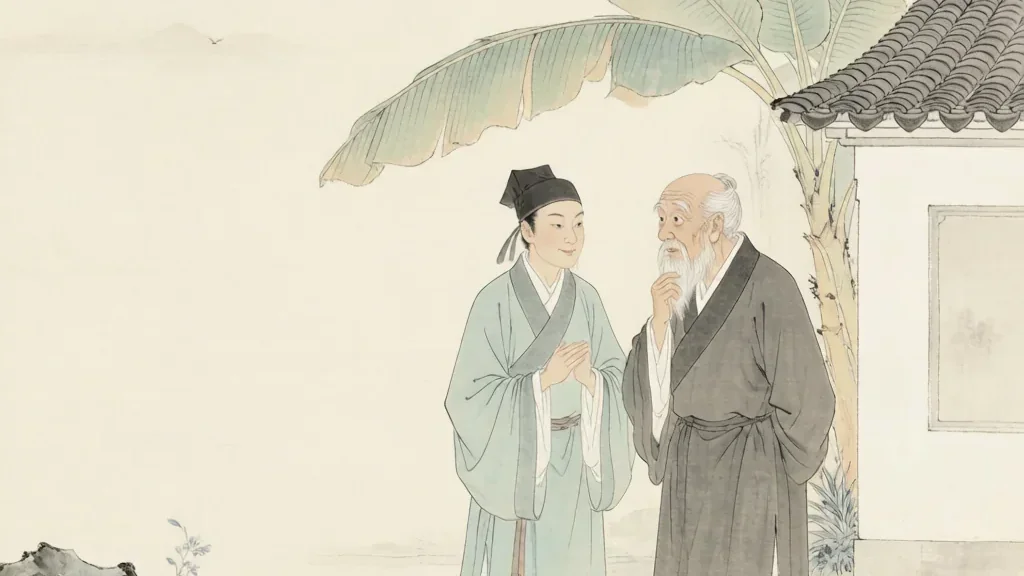
Few human experiences are as universal, or as awkward, as the need to deliver bad news gracefully. Tell someone too directly that they have failed, and you wound them. Tell them too vaguely, and you deny them the truth they need. The Chinese developed an idiom for exactly this delicate situation, and it comes from a story about a man whose name itself became the threshold of disappointment. That idiom is 名落孙山 (míng luò Sūn Shān), "one's name falls behind Sun Shan" — a polite, almost literary way of saying that someone has failed an examination, lost a competition, or fallen short of the cutoff.
The story comes from the Song Dynasty (960–1279 CE), a period when the imperial examination system — the keju (科举) — was the central pathway to power, prestige, and government office in China. The exams were notoriously brutal. Candidates spent years, sometimes decades, memorizing the Confucian classics, mastering the rigid forms of essay composition, and competing against thousands of others for a handful of coveted positions. To pass was to enter the scholar-official class, the elite of Chinese society. To fail was, very often, to spend the rest of one's life as a disappointed tutor or a frustrated poet. The stakes were enormous, and the failure rate was staggering.
The tale is recorded in the "Guo Lao Xian Tan" (过老闲谈), a collection of anecdotes from the Song era, and it has become one of the most beloved stories in the Chinese linguistic tradition — not because it is dramatic, but because it is so quietly, perfectly human.
Two Scholars Go to the Capital
In a certain county, there lived a young scholar named Sun Shan (孙山). His name, fittingly, means "Sun Mountain" — though there was nothing particularly mountainous about his intellect. Sun Shan was, by all accounts, a thoroughly mediocre student. He was not uneducated, but neither was he brilliant. He had studied the classics diligently, learned the proper forms, and done his best to prepare, but he harbored no illusions about his place in the hierarchy of talent. He was, as he would have been the first to admit, an ordinary man.
What set Sun Shan apart was not his learning but his temperament. He was cheerful, self-deprecating, and quick-witted — the kind of man who could turn a humiliation into a joke and make everyone, including himself, laugh. In a culture that placed enormous pressure on scholarly achievement, such a temperament was a gift, and Sun Shan would need it.
When the time came for the imperial examination in the capital, Sun Shan prepared to make the journey. A neighbor approached him with a request: would Sun Shan take the neighbor's son along, so that the two young men could travel together and support each other on the difficult road? The neighbor's son was, by reputation, a more serious student than Sun Shan, and his family had high hopes for his result. Sun Shan agreed, and the two set off together for the capital.
The Results Are Posted
The examination itself was a grueling affair — days of composing essays on Confucian themes, under strict conditions, with every brushstroke scrutinized. When it was over, the candidates waited in agonizing suspense for the results to be posted. The successful names were listed in order of merit, from the highest scorer at the top to the lowest successful candidate at the bottom. Anyone whose name did not appear on the list at all had failed entirely.
The day the list was posted, crowds gathered. Candidates pushed forward, scanning the columns of names with racing hearts. Sun Shan elbowed his way to the front and searched, and searched again. And there, at the very bottom of the list — the last name, the final successful candidate, the very edge of the cliff before the abyss of failure — was his own: Sun Shan.
He had passed. Barely. By the width of a single name, he had made the cutoff. He was, officially, the lowest-ranked successful candidate of the entire examination. It was a triumph and a humiliation woven together so tightly that they could not be separated. He had succeeded, but only just, and everyone who saw the list would know exactly how close he had come.
He looked for his traveling companion's name. It was not on the list. Not at the bottom, not in the middle, not anywhere. The neighbor's son, the more serious student, the one whose family had high hopes, had failed completely.
The Awkward Return
Sun Shan began the journey home alone, his heart heavy with the news he would have to deliver. The neighbor's son had remained behind in the capital, too ashamed to return, and Sun Shan knew that the moment he arrived in his county, the neighbor would come to ask about his son. How does one tell a father that his son has failed? How does one deliver that wound without adding cruelty to it?
As predicted, the neighbor came to Sun Shan's door almost before the dust of his arrival had settled. The father's face was tight with hope and dread. "How did my son do?" he asked. "Did he pass?"
Sun Shan hesitated. He could have said, simply, "He failed." The words would have been accurate, and they would have been merciful in their directness. But Sun Shan, with the quick wit that was his real talent, chose a different path. He answered with a couplet — a pair of rhyming lines that has become one of the most famous in Chinese literary history:
"解名尽处是孙山,
贤郎更在孙山外。"
In English, the lines translate roughly to: "At the very end of the successful names is Sun Shan; your worthy son is beyond Sun Shan." The neighbor understood immediately. To be "beyond Sun Shan" was to be off the list entirely. To be beyond the last successful candidate was to have failed. The message was delivered — clearly, unmistakably, but without the blunt word "failure" ever being spoken.
The Birth of an Idiom
The story might have remained a private exchange between two neighbors, but Sun Shan's couplet was too clever to stay private. It spread. Scholars repeated it to each other. It was written down in collections of anecdotes. And over the centuries, the phrase "beyond Sun Shan" (孙山外) was compressed into the four-character idiom 名落孙山 — "one's name falls behind Sun Shan" — meaning to fail an examination, to miss the cutoff, to fall just short.
What makes the idiom so enduring is not just its cleverness but its kindness. Sun Shan could have been blunt. Instead, he found a way to tell the truth that respected the father's dignity. He did not pretend the son had passed, which would have been a lie. He did not say the word "fail," which would have been a blow. He placed the news inside a poem, and the poem carried the wound gently enough that the father could receive it without being destroyed.
This is a particularly Chinese form of diplomacy, and it reflects a deep cultural value: that how something is said matters as much as what is said. Directness, in this tradition, is not always a virtue. Sometimes the kindest truth is the one wrapped in metaphor, the one that lets the listener arrive at the painful conclusion themselves rather than having it thrust upon them. Sun Shan's couplet did not spare the neighbor from the truth. It spared him from the humiliation of having the truth spoken aloud in his own home.
The Idiom in Modern Life
Today, 名落孙山 is used whenever someone fails an exam, misses a job offer, or falls short of a competitive cutoff. A student who does not get into their dream university is said to have 名落孙山. An applicant who does not make the shortlist for a position has 名落孙山. The phrase is gentle enough to be used in polite conversation and precise enough to be understood by everyone who hears it.
It is also, quietly, a story about a particular kind of grace. Sun Shan himself had barely passed. He was the last name on the list, the man who had almost failed. And yet it was his name that became the threshold — the marker beyond which disappointment lay. He did not choose this role. The history of the language chose it for him. But he earned it, in the moment he chose wit over bluntness and turned his own near-failure into a small act of compassion for someone else.
There is a quiet lesson in that. The people we remember are not always the ones at the top of the list. Sometimes they are the ones at the very bottom — the ones who, having almost fallen themselves, learn to be gentle with those who do. Sun Shan's name lives on, not because he was brilliant, but because he was kind in a moment when kindness was difficult. And that, perhaps, is a higher achievement than any examination could measure.
Stakes of the Imperial Exam
In imperial China the examination system, the keju, was for more than a thousand years the main road to social advancement. A family that produced a successful graduate gained official rank, tax privileges, and lasting prestige, while failure could mean a lifetime of tutoring or obscure local posts. Candidates often began preparing as children, memorizing the Confucian classics and practicing the rigid eight-part essay for years or even decades. With only a tiny fraction of candidates passing each round, the exam was less a test than a life-defining lottery, and a single result could redirect an entire household's fortune. It is against this background of enormous pressure that Sun Shan's near-failure and gentle couplet resonate: his story captures both the brutality of the system and the human grace required to survive it.
The Couplet as a Polite Weapon
Sun Shan's reply took the form of a duilian, a matching pair of poetic lines, a literary shape every educated Chinese reader would recognize and admire. By answering the anxious father in verse rather than plain words, he transformed an embarrassing admission into a small performance of wit. The couplet did two things at once: it delivered the truth, the son's name was not on the list, and it softened the blow by framing that truth as poetry rather than a blunt sentence. This use of indirectness reflects a deep current in Chinese communication, where how a message is shaped can matter as much as the message itself. The idiom thus preserves not only a story of failure but also a model of social tact: tell the truth, but wrap it so the listener can receive it without shame.
Why the Last Place Endures
What is striking about this idiom is that it remembers the last successful candidate, not the first. Imperial records celebrated top graduates by name for centuries, yet it is Sun Shan, who nearly failed, whose name entered everyday speech. The reason is human sympathy: readers recognize themselves more easily in the person who barely made it than in the flawless champion. Sun Shan's mediocrity, his good nature, and his quick wit make him a figure ordinary people can cheer for, and his near-miss turns him into a symbol of the threshold itself, the line between success and failure that everyone fears to cross. In remembering him, the language keeps alive a comforting idea: that almost failing can be as memorable, and sometimes as meaningful, as winning outright.
❓ Frequently Asked Questions
📝 Chinese Vocabulary
名落孙山 — : "One's name falls behind Sun Shan" — to fail an exam, miss the cutoff, or fall short in a competition.
孙山 — : "Sun Mountain" — the name of the scholar who placed last on the exam list and became the threshold of failure.
落榜 — : "To fall off the list" — the plain modern term for failing an examination; a more direct synonym for 名落孙山.
科举 — : The imperial examination system, which for over a thousand years was the primary path to government office in imperial China.
解名 — : "Successful candidates' names" — the list of those who passed a provincial-level exam in the imperial system.
状元 — : The top graduate of the imperial examination, the highest rank among successful candidates, the opposite pole from Sun Shan's last place.
寒窗 — : Cold window; a poetic term for the long, lonely years of study a candidate endured before the exam.
及第 — : To pass the examination and have one's name placed on the successful list, the happy event Sun Shan barely achieved.
🎉 Fun Facts
- The imperial examination system in China lasted for roughly 1,300 years, from the Sui Dynasty (605 CE) until it was abolished in 1905 — making it one of the longest-lived institutions in human history.
- Sun Shan's original couplet is one of the few cases in Chinese literature where a single anonymous person's joke has become a permanent part of the language, giving his otherwise unremarkable name a kind of immortality.
- The phrase is so commonly used in modern China that students sometimes joke before an exam, "I hope I don't end up beyond Sun Shan" — a self-deprecating way of admitting anxiety about the result.
- Because the idiom literally refers to "names on a list," it is most naturally used for ranked competitions — exams, job applications, auditions — and sounds slightly odd when applied to non-ranked failures, a subtlety that makes it a favorite of careful writers.
- Because Sun Shan passed in last place, his name became a comic byword for the very edge of success, and exam well-wishers in China sometimes joke about not wanting to end up as a 'Sun Shan.'
- The idiom is often taught alongside 金榜题名, 'name on the golden list,' its cheerful opposite used to congratulate someone who passed, making the two phrases a natural pair of failure and success.