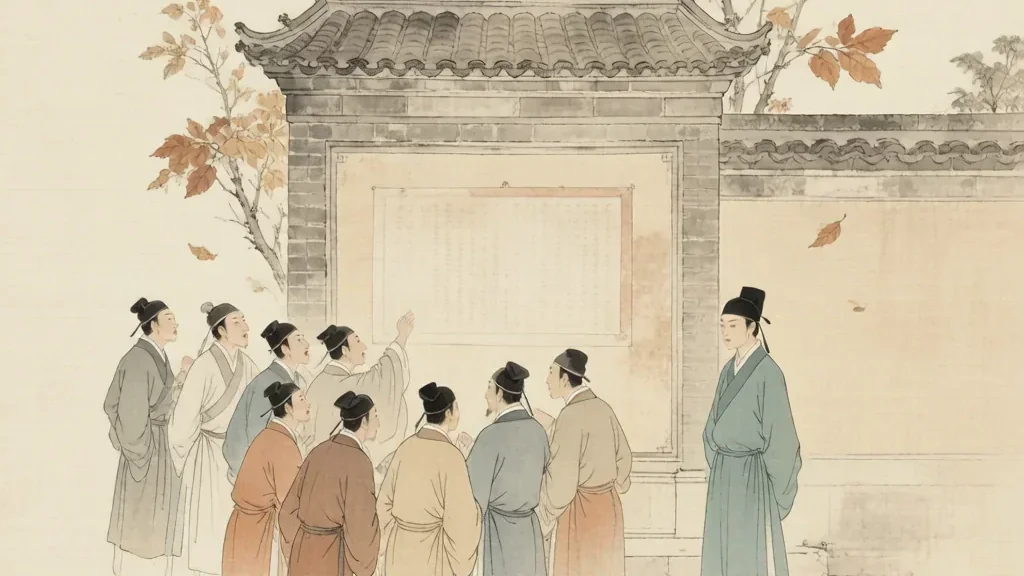
The idiom 名落孙山, pronounced , literally means one's name falls behind Sun Shan, and it has become the classic Chinese way to say that a candidate has failed an examination. The story concerns a witty scholar named Sun Shan who traveled with a neighbor's son to sit the imperial exams and, ranking last on the pass list, returned home to deliver the news with a clever couplet. When asked whether the neighbor's son had passed, Sun Shan answered that his own name was the last successful one and the friend's name fell behind him. The gentle joke fixed the phrase in the language as a polite, almost euphemistic term for failure. This article explores the imperial examination system that gave the idiom its setting, the character of Sun Shan, the structure of the joke, the social weight of exam failure, and the idiom's polished manners of breaking bad news.
The Imperial Examination System
The imperial examination, or 科举, was the great engine of Chinese social mobility for more than a millennium. Beginning in the Sui and maturing under the Tang and Song, it selected officials through competitive writing tests on the Confucian classics rather than through pure heredity. A village boy who mastered the curricula could in principle rise to the highest offices, and millions studied for a chance at the ladder.
Yet the exams were brutally selective. At each level, the vast majority failed, and the provincial and metropolitan rounds admitted only a tiny fraction of candidates. A single examination compound might hold thousands of men writing in isolated cells for days. The stakes were enormous: success brought rank, land, and honor to a whole family; failure meant another cycle of study and the slow erosion of youth.
It is against this high-pressure background that 名落孙山 makes sense. To fail was not a private disappointment but a public, family-bound event reported back to anxious relatives. The idiom therefore carries the weight of a society organized around a single, merciless gate of advancement.
Who Was Sun Shan
Sun Shan is presented in the anecdote as a scholar of quick wit and good humor, a man whose name happens to sit at the very bottom of the successful list. He is not the top graduate celebrated in stone, but the marginal passer whose placement becomes the pivot of a joke. His obscurity outside the tale suggests he may be a representative figure rather than a documented historical person.
The story appears in a Song-era collection of humorous anecdotes, where Sun Shan functions as the clever commoner who turns an awkward moment into wordplay. His role is to be both a passer and a comedian, the last name on the board and the first to make light of it. That duality is essential: only someone who had just barely succeeded could gracefully report another's failure.
Whether or not a real Sun Shan existed, the character embodies a valued trait: the ability to soften truth with humor. Chinese culture prizes the person who can deliver unwelcome news without cruelty, and Sun Shan's couplet is a small masterpiece of that art.
The Journey with the Neighbor's Son
The tale begins with Sun Shan accompanying a neighbor's son to the examination. Such companionship was common: candidates often traveled in groups for safety and company, and a local patron or elder might shepherd a younger man toward the testing center. The neighbor presumably hoped Sun Shan's experience would steady his son.
Both men sat the exam, and the results were posted on a public list ordered by rank. Sun Shan's name appeared at the very end of those who passed, while the neighbor's son did not appear at all. The two returned home together, the elder with a marginal victory and the younger with silent defeat, each carrying the outcome to waiting families.
The homecoming is the emotional core. The neighbor naturally asked Sun Shan about his son first, and the wording of the answer is what immortalized the scene. The question was ordinary; the reply was extraordinary in its compression of fact and tact.
The Famous Couplet
Sun Shan answered with two lines that have echoed for centuries. He said, in effect, that the distinguished name of Sun Shan was the last on the list, and that the honored son of the neighbor fell behind Sun Shan. In a single breath he stated his own marginal success and the other's failure, using his position as the boundary between pass and fail.
The elegance lies in indirection. Rather than saying the boy failed, Sun Shan located his own name at the end and placed the friend after it. The listener supplies the conclusion, which makes the blow lighter because it is inferred rather than stated. The couplet turns a roster into a riddle with a kind answer.
This form of speech reflects a broad Chinese preference for implied meaning over blunt statement, especially around shame and loss. To say someone's name fell behind Sun Shan is to fail him gently, preserving face for the family while conveying the truth without flinching.
The Burden of Exam Failure
In imperial society, failing the exams could mean a life outside the official class, with fewer prospects and sometimes quiet disgrace. Candidates often sat repeatedly across decades, and a man who never passed might be respected for learning yet barred from power. The neighbor's son in the tale faces exactly that uncertain future.
Failure also pressed on families who invested in a son's education, hoping he would lift them. A rejected candidate returned to relatives who had saved, borrowed, or sacrificed for his schooling, and the weight of that debt compounded the personal sting. The idiom thus speaks to a collective anxiety, not merely an individual one.
Yet the culture also produced ways to survive failure with dignity. Poetry, teaching, medicine, and commerce offered alternate paths, and many who missed the exams led useful lives. Sun Shan's joke belongs to this consoling repertoire, reminding the failed that they are not alone and that language can cushion the fall.
Politeness and the Art of Bad News
名落孙山 illustrates a wider Chinese etiquette of delicate communication. When news is bad, wrap it in form that lets the hearer keep composure. Sun Shan's couplet does not deny reality; it frames reality so the hearer is an active participant in understanding it, which respects his intelligence and his pride.
The idiom is therefore taught alongside other polite formulas for disappointment, such as euphemisms for death or poverty. Mastering such speech was part of cultivation, and a person who could deliver failure gracefully was counted refined. Bluntness, by contrast, was vulgar even when truthful.
Modern usage keeps this politeness. To say someone's name fell behind Sun Shan is still a softer way to report an exam or contest loss than to say plainly that he failed. The phrase carries a faint smile that distances the speaker from harsh judgment.
The Idiom in Literature and Speech
Writers have used the phrase for centuries to mark the moment of being passed over, whether in scholar novels, autobiographical essays, or comic sketches about cramming students. It evokes the examination hall, the posted list, and the long walk home, a scene recognizable to any literate audience.
The idiom also appears in advice literature that counsels perseverance after disappointment. To have one's name fall behind Sun Shan is not the end, the moralists argue, because Sun Shan himself was once last and still passed. The bottom of the list is still on the list, a nuance that offers the failed a sliver of hope.
In contemporary Chinese, the phrase extends beyond exams to any competition where one is not selected, from job applications to auditions. Its examination origin lingers, but the core sense of near-miss and gentle failure travels well into new contexts.
Why the Last Name Matters
The genius of the idiom is that it needs a named boundary. By anchoring failure to Sun Shan's last-place pass, the phrase gives absence a measurable position: one is not merely unnamed but specifically behind someone. That precision turns a vague loss into a comic geography of the roster.
Sun Shan's own marginal status is crucial to the sympathy. Had a top graduate delivered the news, it might feel like condescension. Because he barely made it, his report reads as camaraderie among the struggling rather than triumph from above. The last passer becomes the kindest messenger.
Finally, the idiom honors wit as a social grace. Sun Shan is remembered not for high rank but for a clever line, suggesting that in Chinese culture a well-turned phrase can outlast a certificate. His name, ironically, is immortal precisely because it was last.
❓ Frequently Asked Questions
What does 名落孙山 mean?
It means one's name falls behind Sun Shan, and it is the traditional way to say a candidate failed an examination.
Who was Sun Shan?
He was a scholar who ranked last among those who passed and used a clever couplet to report a friend's failure.
How did he report the failure?
He said his own name was the last to pass and the neighbor's son fell behind him, letting the hearer infer the loss.
What system produced this idiom?
The imperial examination system, whose brutal selectivity made failure a common and weighty experience.
Why is the idiom considered polite?
It conveys failure indirectly, preserving the hearer's face through wit rather than blunt statement.
Is it used only for exams?
No, it now applies to any selection one fails to make, such as job applications or competitive auditions.