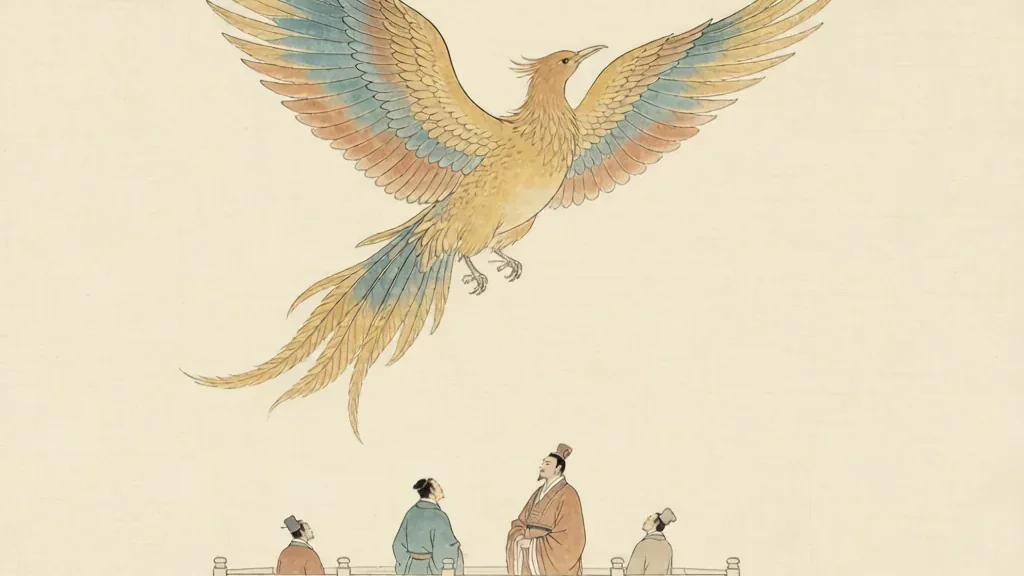
Most people want to be noticed. They want their talents recognized, their achievements celebrated, their worth acknowledged. But there is another kind of person — rarer and more dangerous — who understands that the most powerful move is sometimes not to move at all. The Chinese idiom 一鸣惊人 (yī míng jīng rén), "one cry that startles the world," is the story of this kind of person. It tells of a king who spent three years doing nothing, letting everyone around him think he was a fool, before revealing himself to be one of the greatest rulers in Chinese history.
The story comes from the Spring and Autumn period (770-476 BCE) and is recorded in the "Records of the Grand Historian" (史记) by Sima Qian. Its central figure is King Zhuang of Chu, who ascended to the throne as a young man and immediately baffled everyone by refusing to govern. The tale has become one of the most beloved Chinese idioms, a reminder that appearances can be deeply deceptive and that patience — even the patience to be underestimated — can be the most strategic of virtues.
A King Who Refused to Rule
When King Zhuang inherited the throne of Chu, one of the most powerful states of the Spring and Autumn period, his ministers expected great things. Chu was rich, populous, and militarily formidable, but it was also surrounded by rivals and riven by internal factions. The new king, it was assumed, would immediately set about consolidating his power, appointing loyal officials, and charting a course for the state.
Instead, King Zhuang did nothing. For three years, he ignored affairs of state entirely. He spent his days in the palace, indulging in wine, women, and hunting. He issued no decrees, made no appointments, and showed no interest whatsoever in the business of government. Ministers who came to him with urgent matters were waved away. Advisors who tried to counsel him were ignored. The state of Chu, which had been a rising power, began to drift dangerously, and its enemies began to circle.
The court was in despair. Some ministers believed the king was simply incompetent — a dissolute young man who had inherited a throne he was not fit to occupy. Others suspected something more sinister, perhaps that the king was ill or had been bewitched. A few, the wisest of them, held their tongues and waited. They had seen that the king's eyes, even in his moments of apparent dissipation, were too sharp, too watchful, for a man who had genuinely lost interest in the world.
The Riddle of the Bird
One of the ministers who chose to wait was a man named Wu Ju, known for his wisdom and his patience. But even Wu Ju's patience had limits, and the deteriorating state of the kingdom finally compelled him to act. He requested an audience with the king, knowing that a direct approach would be ignored. Instead, he came bearing a riddle.
"Your Majesty," Wu Ju said, bowing before the king, who was reclining with a wine cup in his hand, "I have heard a strange thing and wish to ask your opinion. In the southern hills, there is a great bird. For three years, it has neither flown nor sung. It sits on its branch, silent and still. What kind of bird is this?"
King Zhuang put down his wine cup and looked at Wu Ju with an expression that the minister would remember for the rest of his life. The mask of indolence fell away, and beneath it was the face of a ruler who had been watching, calculating, and waiting all along. "This bird," the king replied, "may not have flown for three years. But when it spreads its wings, it will soar to the heavens. It may not have sung for three years. But when it opens its beak, its cry will startle the entire world."
The Bird Takes Flight
What followed was one of the most dramatic transformations in Chinese political history. Within days of his conversation with Wu Ju, King Zhuang emerged from the palace and began to govern with a decisiveness and intelligence that stunned everyone who had written him off as a fool. He dismissed the corrupt officials who had revealed their true nature during his three years of silence, men who had assumed the king was too lazy or stupid to notice their abuses. He promoted honest and capable ministers — including Wu Ju — to positions of real authority. He reorganized the army, reformed the tax system, and launched a series of diplomatic initiatives that restored Chu's standing among the warring states.
The three years of apparent inactivity had not been wasted. King Zhuang had been watching. He had seen which ministers were loyal and which were corrupt, which advisors gave honest counsel and which simply told him what they thought he wanted to hear, which neighboring states were weak and which were strong. He had allowed everyone to reveal themselves, and in doing so he had gathered more intelligence than any amount of active investigation could have provided. The fool, it turned out, had been running the most sophisticated intelligence operation in the kingdom.
Under King Zhuang's leadership, Chu became the dominant power of the Spring and Autumn period. He defeated rival states in battle, expanded Chu's territory, and was eventually recognized as one of the Five Hegemons — the rulers who were acknowledged as the supreme leaders of the Chinese world. The king who had refused to govern for three years became the king who governed better than anyone else.
The Strategy of Silence
King Zhuang's story is not merely about hidden talent. It is about the strategic value of being underestimated. By allowing others to think him incompetent, King Zhuang achieved several things simultaneously. He identified his enemies — both within his court and among rival states — who revealed their intentions when they thought he was too weak to notice. He identified his allies, the ministers like Wu Ju who remained loyal even when loyalty seemed pointless. And he preserved his own options, avoiding the early mistakes that many new rulers make when they act before they understand the landscape.
There is a profound psychological insight in this strategy. People who believe they are dealing with a fool drop their guard. They speak more freely, scheme more openly, and reveal more of their true nature than they would ever do in the presence of someone they respect or fear. King Zhuang understood this, and he used his reputation as a wastrel as a shield behind which he could observe the world without being observed in return.
Why the Story Endures
In modern Chinese, 一鸣惊人 is used to describe anyone who achieves something remarkable after a long period of obscurity or apparent inactivity. A writer who publishes a masterpiece after years of silence, a scientist who makes a breakthrough after decades of patient research, an athlete who wins a championship after being overlooked by everyone — all of these are said to have "startled the world with a single cry." The idiom carries with it the implicit understanding that the period of silence was not wasted but was, in fact, essential to the eventual success.
The story is also deeply satisfying on a narrative level. It is a tale of the underdog who was never really an underdog, of the fool who was always the wisest person in the room. It appeals to anyone who has ever felt underestimated, anyone who has ever been told they would never amount to anything. King Zhuang's response to those who dismissed him was not to argue or to prove himself prematurely but to wait — and then, when the moment was right, to reveal himself so completely that no one would ever doubt him again.
Perhaps the most important lesson of the story is about the difference between inaction and passivity. King Zhuang was not passive. He was not lazy or indifferent. He was actively, strategically inactive — conserving his energy, gathering information, and waiting for the right moment to act. This is a kind of wisdom that is often overlooked in cultures that prize constant activity and visible achievement. But as King Zhuang demonstrated, sometimes the most powerful thing you can do is nothing at all — until the moment comes to do everything.
The Art of Indirect Remonstrance
Wu Ju's riddle is a classic example of 讽谏 (fěng jiàn), indirect remonstrance, the art of correcting a ruler without direct confrontation. Rather than scold a king who had wasted three years, Wu Ju offered a puzzle about a bird, letting the king supply his own self-criticism. This style was prized in Chinese political culture because it preserved the ruler's face while still delivering the message, and because it tested whether the ruler was wise enough to hear it. The Records of the Grand Historian is full of such scenes, but the silent-bird riddle is among the most elegant. It shows persuasion working through indirection: the minister does not accuse, he merely describes, and the ruler's own answer becomes the rebuke. The idiom thus preserves not only a king's patience but a counselor's craft.
Chu's Rise Under King Zhuang
Once King Zhuang acted, Chu became the dominant power of its age. He defeated rival states, expanded Chu's territory northward, and was recognized as one of the Five Hegemons, the leaders acknowledged as supreme among the warring states. His reign is remembered as a golden age for Chu, marked by able appointments and a strengthened army. The historical King Zhuang was thus not a lazy man who suddenly woke up but a ruler whose later energy matched the story's promise. Modern historians separate the real military and administrative achievements from the anecdote, yet the two reinforce each other: the tale explains the character, and the record confirms the result. For readers, the idiom gains force because a genuine golden age sits behind the comic three years of silence.
The Tale in Later Retellings
The story of the silent bird traveled far beyond Sima Qian. It appears in drama, historical novels, and school readers as a set piece about patience and hidden ability, and the paired phrases 一鸣惊人 and 一飞冲天 became stock compliments for late bloomers. Ming and Qing novelists borrowed the pattern for princes who seem foolish until they seize the throne, and modern biographies of scientists or athletes echo it when describing a breakthrough after long obscurity. What changed across retellings was the emphasis: earlier versions stressed political caution, later ones stressed personal perseverance. Through all of them the core image held, a bird quiet for years that suddenly fills the sky, which is why the idiom still feels contemporary whenever someone underestimated finally delivers.
❓ Frequently Asked Questions
📝 Chinese Vocabulary
一 — : "One" — emphasizing the singularity of the achievement, a single cry that changes everything.
鸣 — : "To cry" or "to sing" — the bird's call, representing the moment of revelation and achievement.
惊 — : "To startle" or "to amaze" — the shock of those who had underestimated the silent bird.
人 — : "People" or "the world" — the audience whose expectations are shattered by the sudden display of talent.
楚庄王 — : King Zhuang of Chu, one of the Five Hegemons, whose reign transformed Chu into the dominant power of its era.
伍举 — : Wu Ju, the minister whose riddle of the silent bird prompted King Zhuang's reply.
一飞冲天 — : One flight soars to the heavens; a companion idiom from the same story of sudden rise.
春秋 — : The Spring and Autumn period, the era of King Zhuang's reign.
🎉 Fun Facts
- A similar story also appears in connection with King Wei of Qi, recorded in the "Records of the Grand Historian," suggesting that the "bird that does not sing" was a popular political metaphor in ancient China, or that the two stories influenced each other over time.
- King Zhuang's reign (613-591 BCE) is considered the golden age of the state of Chu, and he is remembered as one of the most effective rulers of the entire Spring and Autumn period.
- The idiom 一鸣惊人 is often paired with 一飞冲天 (yī fēi chōng tiān) — "one flight that soars to the heavens" — which comes from the same story and carries a similar meaning of sudden, spectacular achievement after a period of obscurity.
- In modern business culture, the concept of "一鸣惊人" is sometimes cited as a strategic approach: waiting to launch a product or reveal a capability until it is fully developed and can make the maximum impact.
- The riddle Wu Ju posed is itself famous: learners memorize the line about the bird that does not fly for three years but then soars to the heavens, as a model of indirect persuasion.
- King Zhuang's three years of inaction became a template for the hidden talent character in later Chinese historical novels, where an idle-looking prince turns out to be the wisest ruler.