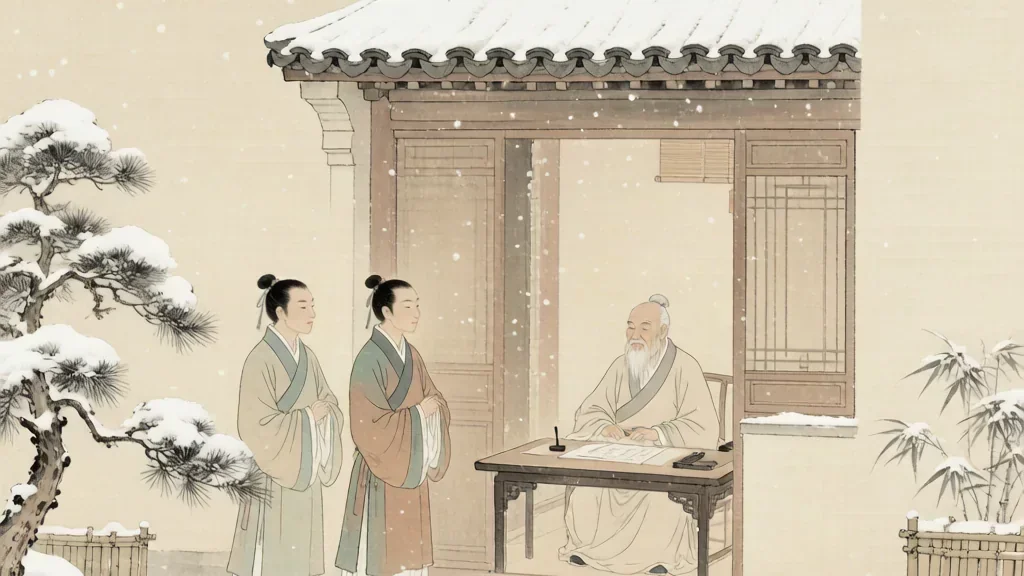
There is a famous Chinese image of patience that has nothing to do with suffering through study and everything to do with respect for the teacher. The idiom 程门立雪 (chéng mén lì xuě) — "standing in the snow at the Cheng gate" — tells of two young scholars who arrived to consult a master, found him resting, and chose to wait outside in falling snow rather than disturb him. By the time he woke, the snow had piled more than a foot deep around them. The phrase has become a byword for reverence toward learning and for the kind of deference a student owes a true teacher. It is a quieter cousin to the more painful study idioms, and its lesson is about attitude rather than endurance.
The Historical Setting: The Cheng Brothers and Neo-Confucianism
To appreciate the idiom we must first meet the "Cheng" in the title. The master was 程颐 (Chéng Yí, 1033–1107), one of the most important Neo-Confucian philosophers of the Song dynasty. Along with his brother 程颢 (Chéng Hào), Cheng Yi systematized Confucian thought by absorbing insights from Buddhism and Daoism, laying groundwork that the later thinker Zhu Xi would build into the dominant state philosophy of imperial China. To study with Cheng Yi was to study at the very center of living Confucian scholarship.
The two visitors were 杨时 (Yáng Shí) and 游酢 (Yóu Zuò), both already established scholars in their own right who nonetheless traveled to sit at Cheng Yi's feet. Yang Shi in particular would go on to transmit Cheng's teachings southward, where they deeply influenced Zhu Xi and the whole later tradition. So the story is not about novices but about accomplished men humble enough to wait in the cold for a greater master.
This context matters because the idiom is often misread as mere obedience. In truth it celebrates a recognition of intellectual hierarchy: knowing who has something to teach you, and being willing to subordinate your own comfort and schedule to receive it. That recognition was central to the Confucian teacher-student relationship.
The Story as Told
The anecdote appears in the 宋史 (Sòng Shǐ, the History of the Song) and in Neo-Confucian biographies. Yang Shi and You Zuo came to Cheng Yi's home to ask a question about a difficult passage. They arrived to find the old master seated with his eyes closed, taking an afternoon rest. Rather than wake him or push into his study, the two young men stepped outside and stood respectfully in the courtyard, waiting for him to rise.
Snow began to fall and kept falling. The two scholars, unwilling to intrude, remained where they were. When Cheng Yi finally opened his eyes and noticed his visitors were gone, he looked outside and was startled to see them still standing there, now enveloped by snow that had accumulated more than a foot deep. He invited them in, and the question was answered. The image of two learned men buried to the ankle in white, patient and uncomplaining, became the heart of the story.
What is striking is the asymmetry of power it depicts. The students had status and questions of their own; the teacher was an old man dozing. Yet the correct behavior, in this worldview, was for the junior party to yield completely. The snow is just the medium that makes their yielding visible and unforgettable.
The Literal Meaning of the Characters
Broken down, 程门 (chéng mén) means "the Cheng gate" or "Cheng's household door," 立 (lì) means "to stand," and 雪 (xuě) means "snow." So the phrase literally sketches a scene: standing at the master's gate in the snow. It is almost a frozen tableau, a single moment captured in four characters, and like the best idioms it lets the reader supply the cold, the silence, and the waiting.
Note that the idiom does not say "suffering in the snow" or "freezing for knowledge." It simply states the location and posture. The emotional weight comes from what the listener already understands: that snow is cold, that waiting is uncomfortable, and that choosing to do both unasked is a profound gesture of respect. The restraint of the language is part of its elegance.
In classroom settings, teachers often point out that the snow was not the point — the willingness to wait was. The weather merely proved the sincerity. A student who will not even wait five minutes for a teacher has, the idiom implies, missed the first lesson of learning, which is humility before those who know more.
The Cultural Lesson: Reverence as the First Step
Confucian education rested on a set of relationships, and the one between teacher and student was nearly as sacred as that between parent and child. A teacher who transmitted the classics was, in a real sense, giving the student access to civilization itself. To treat such a person casually was to insult the tradition. 程门立雪 dramatizes the proper posture: patient, self-effacing, and utterly sincere.
The idiom also teaches that true learning requires the suspension of ego. Yang Shi and You Zuo could have emphasized their own credentials; instead they melted into the snowfall. The lesson for every student is that you cannot receive wisdom while insisting on your own importance. The snow washes that importance away, literally and symbolically.
Yet there is a warmth beneath the cold. The master, waking to find his guests so devoted, surely felt honored, and the relationship that followed was deepened by the moment. Respect given freely creates bonds; respect demanded produces only fear. The idiom captures respect of the first, generous kind.
How the Idiom Lives in Modern Chinese
Today 程门立雪 is used to praise someone who shows deep respect for a teacher or mentor, or more broadly anyone who demonstrates admirable patience and deference in pursuit of knowledge. It appears in graduation speeches, in tributes to beloved professors, and in writing about the ideal student-teacher bond. Unlike the more painful study idioms, it carries no suggestion of self-harm — only quiet devotion.
Parents sometimes tell the story to children who complain about waiting for a lesson or who speak rudely to a teacher. The point is not that kids should stand in blizzards, but that they should recognize the value of those who instruct them. The idiom has become a gentle cultural shorthand for "honor your teachers."
It also survives in academic etiquette more broadly. A researcher who waits politely for a senior scholar's feedback, who refuses to interrupt, who shows up prepared and humble — such a person might be described, with approval, as one who "stands in the snow at the Cheng gate." The phrase links modern courtesy to an ancient ideal.
A Reflection on Waiting and Worth
There is a quiet radicalism in 程门立雪. In a culture increasingly impatient, where knowledge is often consumed in soundbites and teachers are rated like products, the image of two scholars buried in snow asks us to slow down and remember why we sought the teacher in the first place. The waiting was not wasted time; it was part of the education.
Perhaps the deepest lesson is that respect is not a formality but a frame of mind. The snow proved nothing the men did not already feel. They stood because they believed Cheng Yi worth waiting for, and in that belief they became the kind of students who could actually learn from him. The idiom does not command us to suffer for our teachers. It invites us to find teachers worth such devotion — and to become worthy of them in return.
Neo-Confucianism and the Teacher's Role
Cheng men li xue sits inside one of the great intellectual movements of imperial China, the rise of Neo-Confucianism during the Song dynasty. Thinkers such as the Cheng brothers tried to rebuild Confucian ethics by absorbing insights from Buddhism and Daoism while keeping the old concern for right conduct. In that world the teacher was not a mere instructor but a transmitter of civilization itself, a person who opened the classics to a willing student. To stand in the snow at such a teacher's gate was to acknowledge that debt before a word was spoken. The idiom therefore distills a whole educational philosophy into a single patient posture, where learning begins with reverence rather than with questions. The snow is simply the outward sign of an inward respect that the student already felt.
Patience Versus Pain in Study
Chinese has many idioms about devotion to learning, and Cheng men li xue is the gentle one. Others, such as tying the hair and jabbing the thigh, celebrate students who hurt themselves to stay awake and study. The snow story refuses that logic: the cold was not self-inflicted punishment but willing waiting, proof of respect rather than of endurance. This distinction matters, because the idiom teaches that the right attitude toward a teacher is warmth and humility, not suffering. Where the painful study tales can shade into glorifying self-harm, standing in the snow keeps the focus on the relationship between student and master. It is, in the end, a kinder model, and that kindness is why parents still tell it to children. The story asks not for suffering but for a willing humility before those who know more.
❓ Frequently Asked Questions
📝 Chinese Vocabulary
程门立雪 — : "Standing in the snow at the Cheng gate"; reverence and patience toward a teacher.
程颐 — : Song-dynasty Neo-Confucian master at whose gate the scholars waited.
杨时 — : One of the two scholars who waited in the snow; later a key transmitter of Cheng's teachings.
立 — : To stand; the posture of patient waiting in the idiom.
雪 — : Snow; the element that makes the scholars' devotion visible.
程颢 — : Cheng Hao, the elder Cheng brother and co-founder, with Cheng Yi, of the Neo-Confucian tradition.
游酢 — : You Zuo, the second scholar who stood in the snow with Yang Shi to wait upon Master Cheng Yi.
朱熹 — : Zhu Xi, the later philosopher who systematized Neo-Confucianism and was influenced by Yang Shi's transmission.
🎉 Fun Facts
- The "Cheng" was Cheng Yi, brother of Cheng Hao; together the Cheng brothers shaped the Neo-Confucianism Zhu Xi later systematized.
- The snow in the story reportedly reached over a foot (尺) deep by the time the master awoke.
- Yang Shi went on to influence the southern transmission of Neo-Confucianism, so the wait literally shaped Chinese philosophy.
- Unlike 悬梁刺股, this idiom celebrates respect rather than self-punishment, making it the gentle cousin of the study idioms.
- The phrase is still used in Chinese teacher-training materials as a model of the ideal student-teacher relationship.
- Some families tell the story in winter to encourage children to respect their teachers, turning the image of snow into a seasonal lesson about patience.