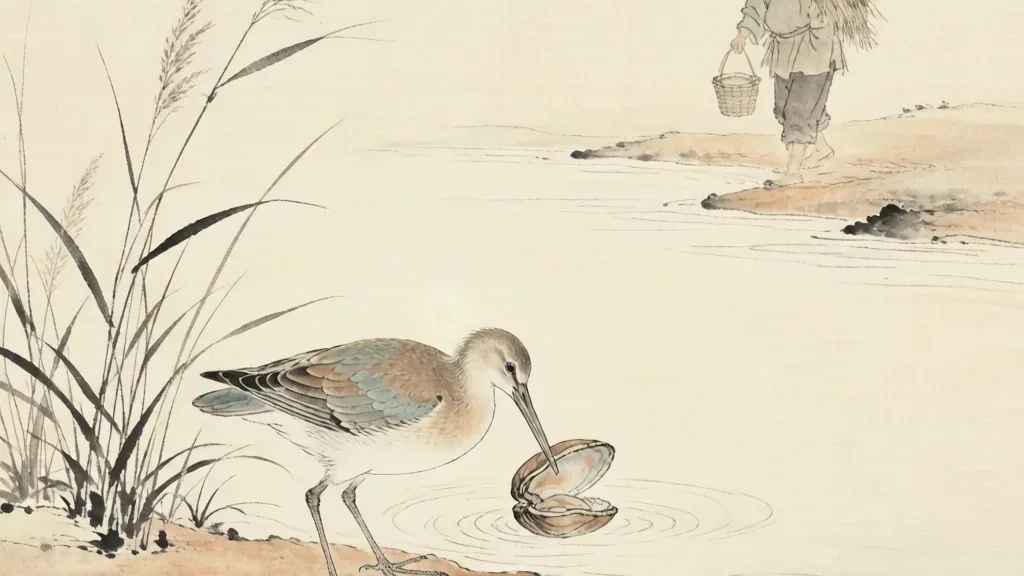
There is a kind of conflict that produces no winner. Two parties lock themselves into a struggle so total that even the victor, if there is one, will be too weakened to enjoy the victory. And while they exhaust themselves, a third party watches, waits, and gathers the spoils. The Chinese idiom 鹬蚌相争 (yù bàng xiāng zhēng), "the snipe and the clam fight each other," describes this situation with the clean, cruel geometry of a fable, and the story behind it has been guiding Chinese statecraft for over two thousand years.
The tale comes from the "Zhan Guo Ce" (战国策), the Han Dynasty compilation of Warring States political speeches that has already given us drawing legs on a snake, mending the fold after sheep are lost, and the fox borrowing the tiger's terror. Like those parables, this one was told for a sharply practical purpose — to talk a king out of a war that would have ruined him. The full version of the idiom is 鹬蚌相争,渔翁得利 (yù bàng xiāng zhēng, yú wēng dé lì) — "the snipe and the clam fight each other, and the fisherman gets the benefit." The moral is in the second half. The first half is only the trap.
The Strategist and the King
The story is set during the late Warring States period, when the state of Zhao (赵国) was preparing to attack the state of Yan (燕国). The king of Zhao had assembled his generals, drawn up his plans, and was on the verge of marching his armies north. A strategist named Su Dai (苏代) — the younger brother of the famous diplomat Su Qin — was sent by the state of Yan to dissuade him. Su Dai did not come with threats or bribes. He came with a story.
When he was granted an audience with the king, Su Dai did not begin with politics. He began, the "Zhan Guo Ce" tells us, by saying that he had just crossed the Yellow River and seen something on its banks. "Your Majesty," he said, "I saw a clam that had opened its shell to sun itself in the shallows. And I saw a snipe — a long-billed shorebird — swoop down to peck at the clam's flesh. The clam, in pain, snapped its shell shut on the snipe's beak."
The king, curious, asked what happened next. Su Dai continued, and his account of the conversation between the two trapped creatures is one of the most famous passages in classical Chinese prose.
The Standoff on the Riverbank
The snipe, its beak clamped tight in the clam's shell, spoke first. "If it does not rain today, and it does not rain tomorrow, you will die of thirst," it said. The meaning was plain: the clam needs water to survive, and if it cannot move, it will dry out in the sun.
The clam, holding the snipe's beak firmly, replied in kind. "If you cannot eat today, and you cannot eat tomorrow, you will die of hunger." The meaning was equally plain: the snipe needs to feed, and if its beak is trapped, it will starve.
And so the two stood, locked together, each threatening the other with slow death, each refusing to yield. Neither would let go. Neither would compromise. The sun climbed higher. The hours passed. The snipe grew weaker. The clam grew drier. And neither noticed — until it was too late — that an old fisherman had come walking along the riverbank, seen the two creatures caught in their standoff, and bent down to pick them both up. He dropped them into his basket and walked away, the day's catch secured with no effort at all.
The King and the Third Party
Su Dai let the story settle for a moment, then delivered his point. "Your Majesty," he said, "Zhao is the snipe, and Yan is the clam. If Zhao attacks Yan, the war will be long and bitter. Both states will exhaust themselves. Their armies will be depleted, their treasuries emptied, their people exhausted. And while they lie locked in their struggle, the powerful state of Qin — the fisherman — will march in and swallow them both."
The king of Zhao heard the parable and understood. He called off the invasion. The state of Yan was spared, at least for a time, and the story of the snipe and the clam passed into the language as one of the most powerful warnings in Chinese political thought. Su Dai's argument was not that war is wrong in principle. It was that this particular war — a war between two mid-sized states while a much larger predator waited nearby — would be suicide dressed as strategy. The snipe and the clam were not wrong to defend themselves. They were wrong to lock themselves into a fight that a third party could only win.
The Geometry of Mutual Destruction
The brilliance of the fable is in its clarity. There are no villains. The snipe is hungry. The clam is defending itself. Neither is malicious. But the dynamic between them — the refusal to release, the determination to win the standoff even at the cost of mutual destruction — creates a situation in which the only possible beneficiary is someone else. The fisherman does not have to be clever. He does not have to be strong. He only has to be patient, and the trapped creatures will hand themselves to him.
This is the geometry the idiom names, and it recurs everywhere in human life. Two companies lock themselves into a price war that drives both to the edge of bankruptcy, while a third competitor waits to acquire their remains. Two political parties destroy each other in a primary, and the opposing party walks into the general election unopposed. Two siblings fight over an inheritance in court until the legal fees consume the entire estate. Two nations bleed each other in a long war, and a third, untouched, emerges as the dominant power. In each case, the snipe and the clam are so focused on each other that they cannot see the fisherman. And by the time they see him, it is too late.
Why the Idiom Endures
鹬蚌相争 has lasted because the situation it describes is structural, not accidental. It arises whenever two parties are willing to pay any price to defeat each other, and whenever a third party is in a position to profit from their exhaustion. Chinese history is full of examples — warlords who destroyed each other while foreign powers moved in, dynasties that collapsed from internal rebellion while invaders watched from the border, factions that tore a movement apart while opponents consolidated power. The idiom is spoken as a warning, but also as a diagnosis: if you find yourself in a fight that consumes you and your opponent equally, look around. The fisherman is almost certainly already on his way.
The fable's quiet wisdom is that victory in a standoff is not always victory. Sometimes the winner of a fight is the one who refused to enter it. The fisherman did not fight the snipe. He did not fight the clam. He simply waited, and in the waiting, he became the only party whose position improved. The lesson is not that one should always avoid conflict — sometimes conflict is necessary. The lesson is that one should always look at the wider board before committing to a fight. If there is a fisherman in the picture, the snipe and the clam are already lost, no matter who appears to be winning.
In modern Chinese, the idiom is used in geopolitics, in business commentary, in analysis of any conflict where a third party benefits from the combatants' exhaustion. It carries a tone of grim realism — a recognition that the world is full of fishermen, and that the only way to avoid becoming their catch is to refuse the standoff before it begins. The old parable, told on the banks of the Yellow River in the third century BCE, still speaks with the same cold clarity it had on the day Su Dai told it: look at the snipe. Look at the clam. Look at the basket. And ask yourself, before you lock your beak in anyone's shell, who is walking along the shore.
Su Dai's Rhetorical Method
Su Dai belonged to a famous family of traveling persuaders who advised warring rulers, and his method was to win agreement through story rather than argument. By describing a clam, a snipe, and a fisherman, he let the king of Zhao see his own danger from a distance, where pride would not block the lesson. This was the signature trick of the Strategies of the Warring States: a well-told fable that mapped perfectly onto the listener's situation. Su Dai did not threaten or scold; he performed a little drama and let the ruler name himself as the snipe. The approach suited an age of competing states, where a single well-aimed tale could prevent a war. The idiom we use today is the leftover of that persuasion, a compact story still doing the work of warning.
The Snipe and Clam in Visual Culture
The standoff on the riverbank has proven irresistible to artists. Folk woodblock prints and children's illustrations show the plump clam clamped on the long snipe's beak, the two creatures glaring while a smiling fisherman bends down with his basket. On stage, local operas sometimes stage the fable as gentle comedy, with the birds and clam represented by stylized props and mime. The image's clarity, two enemies locked together and blind to the real threat, makes it easy to depict and easy to read at a glance. Unlike more abstract idioms, this one comes with a ready picture, which helps explain its endurance in classrooms and art alike. The fisherman's basket, in particular, has become a visual shorthand for the third party who profits from other people's conflict.
The Warring States Source
The Strategies of the Warring States gathers the speeches of advisers like Su Dai from a time when survival depended on persuasion. Compiled in the Han dynasty from older materials, it preserves not strict history but the craft of argument, and the snipe-and-clam tale is a showpiece of that craft. The collection values wit, timing, and the apt analogy over documentary accuracy, which is why the same story can read like both fable and policy brief. For modern readers the book is a window into how ancient diplomats thought about power, and why a short animal story could carry the weight of state strategy. The idiom's source thus matters: it was born not in a zoo but in the high-stakes bargaining of rival kingdoms.
❓ Frequently Asked Questions
📝 Chinese Vocabulary
鹬蚌相争 — : "The snipe and the clam fight each other" — when two parties in conflict destroy each other, allowing a third to profit.
渔翁得利 — : "The fisherman gets the benefit" — the second half of the idiom, naming the third party who profits from the conflict.
苏代 — : The Warring States strategist who told this fable to the king of Zhao to dissuade him from attacking Yan.
赵国 — : The State of Zhao, identified in the parable as the snipe — the aggressor in the planned war against Yan.
秦国 — : The State of Qin, the "fisherman" waiting to profit from Zhao and Yan's mutual exhaustion.
燕国 — : The State of Yan, the other party in the planned war the fable warns against.
战国策 — : Strategies of the Warring States; the collection that preserves Su Dai's fable.
蚌 — : A clam; the creature whose shell traps the snipe's beak in the standoff.
🎉 Fun Facts
- Su Dai, who told this fable, was the younger brother of Su Qin, one of the most famous diplomats of the Warring States period — the Su family produced several generations of skilled political strategists.
- The state of Qin, the "fisherman" of the parable, did in fact go on to conquer all the other Warring States and unify China under the Qin Dynasty in 221 BCE — vindicating Su Dai's warning with brutal historical precision.
- The dialogue between the snipe and the clam is one of the most quoted passages in classical Chinese, and the lines "今日不雨,明日不雨,必有死蚌" and "今日不出,明日不出,必有死鹬" are still taught by rote in Chinese schools.
- The idiom is frequently invoked in modern East Asian diplomacy, particularly in commentary on great-power conflicts in the Pacific, where smaller nations are often urged to avoid becoming the snipe or the clam in struggles between larger ones.
- Children's picture books in China retell the fable with cartoon snipe and clam, teaching that stubborn quarrels help no one but the onlooker who waits.
- In business-school case studies the idiom warns that a price war between two rivals can hand the whole market to a third competitor waiting on the sidelines.