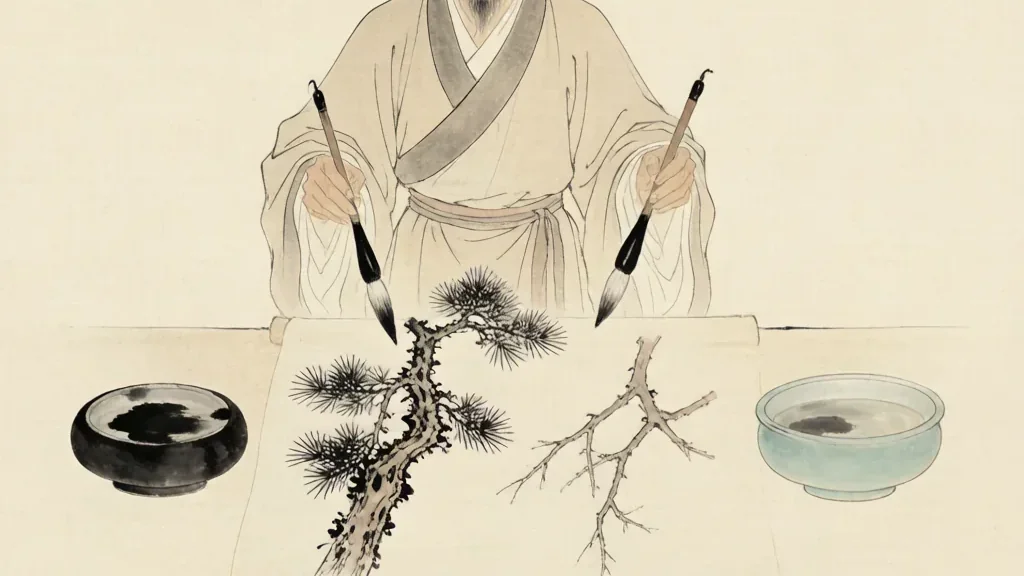
Some problems are too tangled for a single approach, and the Chinese idiom shuāng guǎn qí xià honours the person who meets them with two hands at once. Written 双管齐下 and pronounced , it means "two brushes applied simultaneously" — the image of a painter holding a brush in each hand and working both at once. Where the West might say "a two-pronged approach," Chinese reaches for the studio and the wrist. For readers new to the culture, the phrase reveals how deeply the vocabulary of art feeds Chinese thinking about strategy and life. In this article we meet the Tang painter who inspired it, unpack its meaning, and see why doing two things at once, deliberately, is often wiser than doing one thing twice.
The Painter With Two Brushes
The idiom traces to Zhang Zao (张璪, also written 张藻), a Tang dynasty painter renowned for his pine trees. According to the Record of Famous Tang Painters (唐朝名画录) by Zhu Jingxuan, Zhang Zao possessed a singular gift: he could hold a brush in each hand and paint with both at the same moment. One hand would render the living, sap-filled aspect of the tree; the other would render its withered, bare aspect — the "raw" and the "cooked," the flourish and the restraint, laid down in a single breath of creation.
The spectacle was not a circus trick but a philosophical point. A pine is both vital and austere, both growing and dying, and Zhang Zao's two brushes let him capture that paradox in one act. Witnesses remembered the performance as proof that true mastery is not mechanical repetition but the holding of opposites together. From his doubled wrist the idiom entered the language as a name for any balanced, two-sided method.
Literal Meaning and Characters
The phrase is built from plain words. (双) is two or double; (管) is a tube or, by extension, a brush (made of a bamboo tube); (齐) means together, level, or simultaneous; and (下) is to descend or apply (as a brush descends to paper). Read in order: two-brushes-together-apply. The grammar is a little more explicit than some idioms, almost a miniature sentence, which suits a phrase that describes an action in progress.
Notice that literally means the bamboo tube that forms a brush's handle. Chinese often names the tool by its material, so "two tubes" means "two brushes." The idiom thus keeps the artist's hand in view — we are not told about a plan in the abstract but shown the physical act of two brushes meeting the silk at once.
The Idea of the Two-Pronged Approach
Beyond painting, the idiom praises any method that attacks a problem from two sides. A doctor who treats both symptom and cause, a teacher who builds skill and confidence together, a leader who reforms the law while reforming the heart — all are said to work "with two brushes." The wisdom is that some goals cannot be reached by a single line; you must draw two at once and let them reinforce each other.
This is a distinctly Chinese way of valuing balance. Where a culture obsessed with single-minded focus might say "do one thing well," the idiom suggests that the hardest things need paired efforts held in tension. The two brushes are not a sign of divided attention but of a richer attention that sees more than one truth at a time. To use both hands is to refuse the false choice between two good things.
Modern Uses of the Phrase
Today is common in policy, business, and daily advice. A government that cuts pollution while growing the economy is urged to act with two brushes. A student who improves vocabulary and grammar together is praised for it. A parent who sets rules and shows love at the same time is, in this idiom's spirit, painting with both hands. The tone is approving and gently instructive.
The phrase also serves as a corrective. When people argue that we must choose between efficiency and kindness, or security and freedom, a Chinese speaker may invoke the two brushes to insist we need not. The idiom is a small argument for synthesis over division — a reminder that the most complete solutions are often those that refuse to drop either end of the contradiction.
Companions in the Lexicon
The idiom keeps company with several phrases about combined effort. 一箭双雕 (yī jiàn shuāng diāo, "one arrow, two hawks") achieves two results with one act; 双管齐下 achieves them with two acts held together. 文武双全 (wén wǔ shuāng quán, "complete in both civil and martial arts") praises a person balanced in letters and arms. Together they celebrate the ideal of the whole person and the whole method.
For learners, this cluster teaches an important cultural pattern: Chinese proverbs often resist either/or thinking. The two brushes are a visual motto for a habit of mind that looks for the second line, the other hand, the complementary truth. Absorbing the idiom means absorbing that habit — a useful thing in any cross-cultural conversation.
A Closing Reflection
There is something quietly radical in . It tells us that holding two truths at once is not confusion but mastery, that the artist's two hands are a model for the well-lived life. We are often taught to pick one path and march; the idiom invites us to pick up a second brush and discover that the picture only appears when both are moving. To work with two brushes is to trust complexity, and to believe that the fullest result is the one neither hand could paint alone.
The Yin and Yang of Two Brushes
Beneath the painter's studio lies a philosophical habit. The two brushes render the living and the withered, the soft and the stark, the flourish and the restraint, and the idiom quietly treats holding both as wiser than choosing one. This is the same impulse behind the yin-yang symbol, which teaches that reality is made of complementary opposites rather than isolated halves. Zhang Zao's doubled wrist becomes a small model of that thought: truth is not either-or but both-and. A person who can hold two truths, two methods, two sides of a question at once is, in this view, more awake than the person who picks a side and digs in. The idiom's durability owes much to this deeper current, which is why it is quoted by philosophers as readily as by painters.
Two Brushes in Translation and Bilingual Life
The idiom has found a second home in language itself. Chinese writers and translators use 双管齐下 to describe working in two languages at once, holding a source tongue and a target tongue like Zhang Zao's two brushes, letting each shape the other. A bilingual speaker toggles between worlds the way the painter toggled between living and withered strokes, and the phrase captures that balanced, double-handed attention perfectly. It also names the challenge of explaining one culture to another: you must speak to insiders and outsiders simultaneously, applying two methods in one breath. In an age of cross-cultural work, the old painting image turns out to describe the daily life of anyone who lives between languages, making a Tang anecdote quietly modern.
❓ Frequently Asked Questions
📝 Chinese Vocabulary
双管齐下 — : two brushes applied at once; a two-pronged approach.
管 — : tube, brush.
齐 — : together, simultaneous.
张璪 — : the Tang painter who inspired the phrase.
唐朝名画录 — : the Tang record of famous painters that tells the tale.
一箭双雕 — : One arrow, two hawks; winning two results from a single act, often compared with the two-brushes idiom.
文武双全 — : Complete in both civil and martial arts; a person balanced in letters and arms.
双 — : Two or double; the opening character that sets the idiom's theme of paired effort.
🎉 Fun Facts
- Zhang Zao was famous specifically for painting pine trees, a subject loaded with symbolic meaning in Chinese art.
- The "two brushes" reportedly rendered the living and the withered aspects of the same tree at once.
- The idiom is often taught alongside "one arrow, two hawks" as a pair of efficiency idioms with different emphases.
- Chinese proverbs frequently borrow from the painter's studio, showing how art shaped everyday reasoning.
- In modern Chinese writing guides, 双管齐下 is the standard phrase when an editor wants to say 'do both at once' without spelling out two separate steps.
- The two-brush image echoes the yin-yang ideal of holding complementary opposites together, which may be why the idiom feels philosophical and not merely practical.