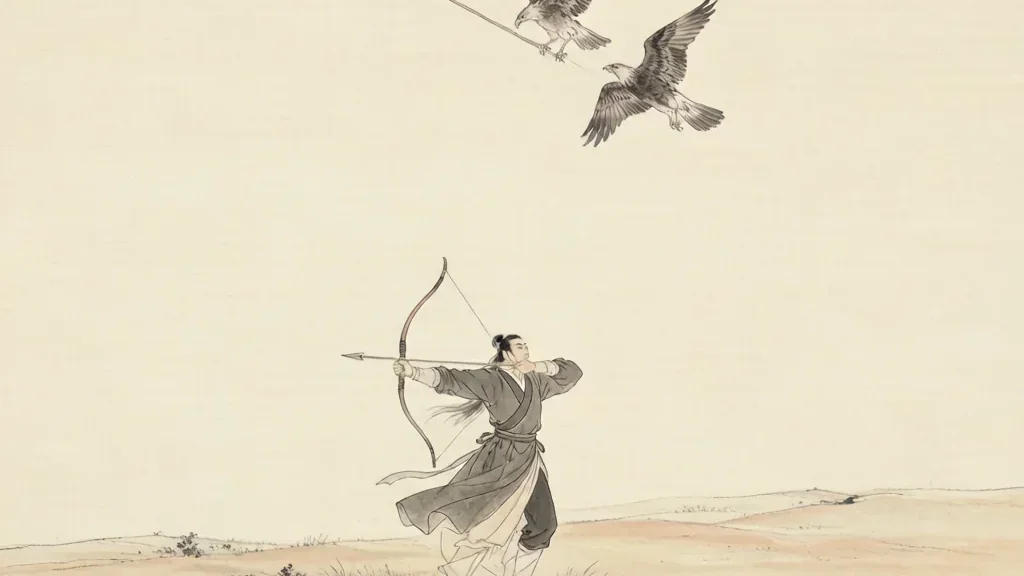
Efficiency has always been admired, but the Chinese idiom yī jiàn shuāng diāo turns it into a feat of legend. Written 一箭双雕 and pronounced , it means "one arrow, two hawks" — a single shot that brings down two birds at once. English speakers say "kill two birds with one stone," but the Chinese image is more martial and more dazzling: an archer's arrow passing through one great bird and into a second. For readers discovering Chinese culture, the phrase is a vivid introduction to a value placed on clever, economical action that gets the most from the least. In this article we follow the arrow back to a Turkic sky and a Northern Zhou marksman, then consider how the ideal of doubled result shapes Chinese thinking about strategy and work.
The Archer and the Two Eagles
The tale is set in the sixth century, during the Northern Zhou dynasty, when the empire's border met the vast grasslands of the Turkic khagans. The hero is Zhangsun Sheng (长孙晟), a commander celebrated less for command than for his uncanny skill with the bow. Sent as an envoy to the court of the Turkic ruler, he found himself among people who measured a man by his horsemanship and his aim.
The moment that made the idiom came when two large birds — , great vultures or eagles — were fighting in the air over a scrap of meat. The khagan, impressed by Zhangsun Sheng's reputation, handed him a bow and invited him to show his skill. Zhangsun Sheng loosed a single arrow that pierced both birds, and they tumbled from the sky together. The onlookers were astonished; the khagan honoured him. From that shaft the phrase was born: one arrow, two hawks, one act with a doubled prize.
Literal Meaning and Structure
The characters are transparent. (一) is one; (箭) is an arrow; (双) is a pair or double; and (雕) is a hawk, eagle, or vulture. Read in order: one-arrow-two-hawk. Unlike idioms drawn from philosophy, this one carries almost no hidden grammar — it is a snapshot of the deed itself. The listener supplies the admiration.
What the simplicity conceals is the difficulty. To hit two birds with one arrow is not merely lucky; it requires reading the line between them, the wind, the timing, and the angle in a single instant. The idiom thus quietly honours not just the result but the mastery that made it possible. A native speaker hearing it pictures not a fluke but a virtuoso's calm decision.
From Hunting to Statecraft
Although the story is about archery, the idiom quickly migrated to affairs of state. A diplomat who secures two alliances in one negotiation, a general who defeats two enemies with one maneuver, a minister who solves two crises with a single reform — all are praised as shooting "one arrow, two hawks." The phrase became a shorthand for strategic elegance: why spend two efforts when one, well aimed, will do?
This preference for economy runs deep in Chinese statecraft. The ideal official is not the one who works hardest but the one who works smartest, removing the root of a problem so the branches need not be pruned one by one. captures that ideal in a single flash of the bow — the satisfaction of the knife that cuts two knots at once.
How It Is Used Today
In modern Chinese, the idiom is everywhere. A commuter who combines exercise and transport by cycling to work is shooting one arrow, two hawks. A software feature that fixes a bug while adding a capability earns the phrase. A parent who turns a chore into a game gets two results from one action. The tone is approving, even playful; it celebrates the cleverness of living well with less waste.
The phrase also carries a caution. Not every doubled result is honest — a deal that helps two parties by harming a third is not what the idiom praises. The arrow is meant to strike true and fair, bringing genuine benefit, not merely appearing efficient. Used well, it rewards insight; used loosely, it can excuse cutting corners. The classic story keeps the standard high: the arrow must actually bring down both birds.
Companions in the Idiom Chest
has natural siblings. 一石二鸟 (yī shí èr niǎo, "one stone, two birds") is the near-twin borrowed from the same intuition. 事半功倍 (shì bàn gōng bèi, "half the work, double the result") praises the same economy without the archery. And 一举两得 (yī jǔ liǎng dé, "one move, two gains") states the principle in the plainest terms. Together they form a small hymn to efficient action.
For the learner, these related phrases are a gift, because once you know one you can guess the others and sound natural in praise of a clever plan. They also reveal a cultural bias worth noting: Chinese proverbial wisdom repeatedly honours the person who does more with less, the marksman whose single arrow solves what others would need two for.
A Closing Reflection
There is a quiet beauty in that the English "kill two birds" loses in its bluntness. The Chinese phrase keeps the sky, the bow, the two great birds wheeling and falling — a moment of grace as much as utility. It reminds us that efficiency need not be grinding; it can be elegant, even poetic, when aim and opportunity meet. To live by the idiom is to train the eye for the single action that will serve two needs, and to take quiet pride when the arrow flies true.
The Archer in Northern Zhou History
Zhangsun Sheng was more than a marksman. A general and diplomat of the Northern Zhou and later Sui periods, he was valued for his judgment as much as his bow, and he was sent on missions where a display of skill also served statecraft. His biography notes diplomatic work among the Turks that helped divide and manage steppe powers, so the famous shot was both a personal feat and a soft show of strength before a foreign court. The idiom thus preserves a real moment when martial talent and politics met. Later historians admired him as a model official whose abilities were practical rather than merely decorative. Reading the archer as a historical figure rather than a cartoon hero explains why the tale was deemed worthy of the official histories and not left to folklore alone.
Idioms of Doubled Success Worldwide
The impulse to celebrate one effort with two payoffs is nearly universal, and many languages have a phrase for it. English says kill two birds with one stone, Russian speaks of killing two hares, and German reaches for two flies at one swat. What differs is tone: the Chinese 一箭双雕 keeps the sky, the bow, and the two great birds, lending the moment a grace the English phrase loses in its bluntness. Across cultures the image agrees that efficiency is praiseworthy, but the Chinese version also quietly honors the mastery behind the shot, not just the luck. Comparing these phrases shows how a shared human value, getting more from less, gets dressed in the local imagination, with archery, stones, or hares standing in for the same elegant idea.
❓ Frequently Asked Questions
📝 Chinese Vocabulary
一箭双雕 — : one arrow, two hawks; one action achieving two aims.
箭 — : arrow.
雕 — : hawk, eagle, or vulture.
长孙晟 — : the archer of the original tale.
双 — : a pair, double.
突厥 — : The Turks; the Turkic khaganate whose court witnessed Zhangsun Sheng's feat.
一石二鸟 — : One stone, two birds; a near-twin idiom with the same logic of doubled result.
一举两得 — : One move, two gains; a related phrase praising efficient action.
🎉 Fun Facts
- The hero, Zhangsun Sheng, was also the father of a future Tang empress, linking the archer's legend to imperial history.
- The Turkic court measured a man by horsemanship and archery, which is why the feat won such respect.
- A near-identical phrase, 一石二鸟, shares the same logic with a stone instead of an arrow.
- The idiom appears in modern business writing as praise for a plan that solves two problems at once.
- The story of Zhangsun Sheng was recorded in both the Book of Zhou and the Zizhi Tongjian, so the archer's feat passed into official history as well as popular idiom.
- In Chinese sports commentary the phrase is a favorite for a single play that scores twice, such as a defender who blocks a shot and launches a counterattack in the same motion.