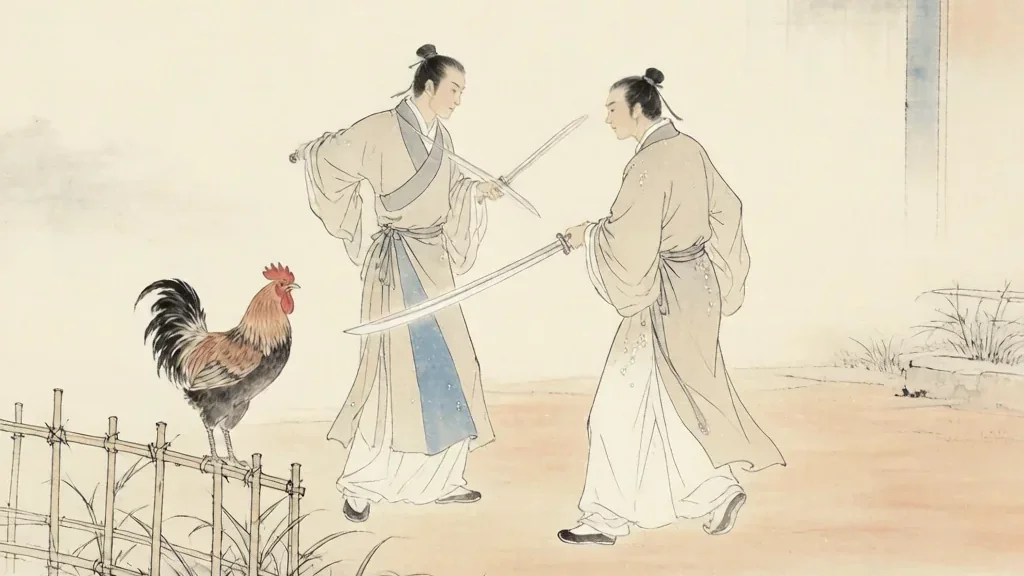
Some people hear a rooster crowing in the dark and roll over to sleep a little longer. The heroes of one famous Chinese idiom heard it and jumped out of bed to practice sword fighting. 闻鸡起舞 (wén jī qǐ wǔ) — "rising to dance [practice] upon hearing the cock crow" — celebrates the disciple of discipline who turns the natural alarm of dawn into a call to self-improvement. Behind the phrase lies a stirring story of friendship, patriotism, and the belief that personal preparation is a form of service to one's country. More than a study idiom, it is an idiom of action, of the body as well as the mind.
The Two Friends of the Western Jin
The story comes from the turbulent years of the Western and Eastern Jin dynasties, around the early fourth century CE, when the Chinese heartland was reeling from the collapse of the unified Han order and the pressure of nomadic incursions from the north. The two central figures were 祖逖 (Zǔ Tì) and 刘琨 (Liú Kūn), young men of ambition and patriotic feeling who shared a bed as they talked late into the night about the fate of their realm.
Both men were unusual: not merely scholars content with books, but men who felt a duty to be physically and militarily ready. They worried openly that the empire was in danger and that worthy men must prepare themselves to defend it. Their nightly conversations were less pillow talk than war council, charged with the anxiety of a falling age and the resolve to do something about it.
This背景 (background) is essential to the idiom's meaning. 闻鸡起舞 is not about studying for an exam or pleasing a teacher; it is about readying oneself for the defense of a civilization. The sword practice at dawn is a miniature of national service. The idiom thus carries a martial, civic weight that sets it apart from quieter learning tales.
The Cockcrow That Became a Call to Arms
As the anecdote is told in the 晋书 (Jìn Shū, the History of the Jin), Zu Ti and Liu Kun were sleeping when a rooster crowed in the middle of the night. In those times, such a sound might have been dismissed as an annoyance, or taken as a sign it was nearly morning. Liu Kun stirred and worried it was an ill omen. Zu Ti, however, kicked him awake and said, in effect, "That is not a bad sound — it is a call to rise and practice!"
From then on, whenever they heard the cock crow, the two friends got up, dressed, and practiced swordplay together in the cold pre-dawn dark. They trained their bodies as diligently as they trained their minds, convinced that the hour might come when both would be needed. The "dance" (舞, wǔ) in the idiom refers to their sword drill, graceful and disciplined like a dance, yet purposeful like combat.
The charm of the story is its intimacy. We picture two young men, half-asleep, kicking off blankets, stepping into frost to swing blades at first light. The rooster is an indifferent animal; the meaning is supplied entirely by the humans who choose to hear it as a summons. That choice is the whole point.
Zu Ti's Later Career and the Northern Expedition
The idiom would be mere sentiment if the men had done nothing afterward. But Zu Ti went on to lead a remarkable northern expedition to recover lost Chinese territory from the invading nomads. With only a small force and scant support from a court more interested in survival than reconquest, he rallied refugees and local defenders, crossed the Yangtze River, and reestablished a foothold in the north — famously vowing not to return south until the homeland was restored.
His campaign achieved real, if temporary, success and made him a folk hero of loyalty and perseverance. Liu Kun too served on the frontier, though his end was darker. The point for the idiom is that the dawn sword practice was not empty ritual; it foreshadowed a life of actual service. The discipline of the bedroom became the discipline of the battlefield.
Later generations told the story to inspire exactly this linkage: that small daily habits of self-preparation grow into the capacity for great deeds. Zu Ti's example answered the question every patriot asks — "what can one person do?" — with the reply: begin before dawn, begin with your own body, begin now.
The Literal and Figurative Meaning
Literally, 闻鸡 (wén jī) means "hear the rooster" and 起舞 (qǐ wǔ) means "rise to dance/practice." The phrase paints a single decisive action: the moment of hearing, then the choice to move. It has become a general exhortation to diligence and to seizing time before it slips away.
Figuratively, the idiom now applies to any earnest, self-starting effort. A student who studies at 5 a.m., an athlete who trains before work, an entrepreneur who builds before others wake — all might be praised with 闻鸡起舞. The rooster has become a symbol of opportunity itself, which each person must choose to answer.
Note the optimism baked into the story. Zu Ti reframed an omen of worry as a gift. The idiom thus also teaches reinterpretation: what looks like a nuisance (a loud bird at midnight) can be the cue for greatness, if you have the right attitude. The sound did not change; the listener did.
How the Idiom Is Used Today
In modern China, 闻鸡起舞 is a common fixture of motivational language, especially for students and young professionals. Exam-prep slogans and morning-routine influencers invoke it to champion early rising and proactive effort. It sits comfortably alongside other diligence idioms but carries a特别地 active, almost athletic flavor.
It also appears in patriotic and military contexts, where the original meaning — preparing the body for the defense of the state — still resonates. Speeches about national rejuvenation sometimes cite Zu Ti as a model citizen who turned personal discipline into public good. The idiom's dual nature, personal and civic, keeps it useful across settings.
Interestingly, the idiom has even lent its rhythm to children's books and cartoons about punctuality and exercise. The rooster-and-sword image is vivid enough for young audiences, and the underlying message — get up and practice — is one every culture teaches its children in some form.
A Reflection on the Courage to Begin
What makes 闻鸡起舞 endure is not the swordplay but the awakening. Every day offers a small cockcrow — an alarm, an email, a problem, a chance — and every day we decide whether to hear it as nuisance or as call. Zu Ti and Liu Kun chose the latter, and the choice, repeated at each dawn, built men capable of defending a fractured country.
The idiom gently accuses the rest of us. We have alarms smarter than any rooster and excuses more elaborate than any frost, yet we often choose the warmer blanket. 闻鸡起舞 does not demand heroism; it demands the first step, taken early and taken gladly. Master that, the old story suggests, and the larger courage may follow when the hour truly comes.
The Rooster as Timekeeper and Zodiac Sign
The cock that woke Zu Ti was more than a barn animal; it was a cultural timepiece. In the traditional cycle the rooster is the tenth of the twelve zodiac animals and is linked with the hour of the day when light fades, while its dawn crow announced the start of work. Villages kept time by the bird long before printed schedules, so the cockcrow carried a shared moral weight: it was nature's instruction to rise and labor. The idiom taps that deep association, transforming an ordinary farm sound into a call of duty. Even today, to mention the rooster in China is to summon punctuality and the disciplined day. Zu Ti simply heard what everyone heard and chose to treat it as a command, which is why the story feels less strange and more like a sharpened version of common rural wisdom.
Small Habits, Public Good
What lifts 闻鸡起舞 above a mere study tip is its civic aim. Zu Ti and Liu Kun did not practice swordplay to ace an exam or impress a master; they trained because their country was breaking apart and they felt liable for its defense. The dawn routine was the seed of public service, the daily body-work that later grew into a northern expedition. The idiom thus links private discipline to collective duty in a way few other sayings do. It tells the reader that small, repeated acts of self-preparation are not selfish polishing but rehearsal for responsibility to others. A student who rises early, an athlete who trains alone, a citizen who builds skill in obscurity, all echo the two friends: the practice done before dawn is the quiet foundation of whatever good they may later do in the light.
❓ Frequently Asked Questions
📝 Chinese Vocabulary
闻鸡起舞 — : "Rise to practice upon hearing the cock crow"; diligent self-preparation.
祖逖 — : Jin-dynasty patriot who rose at cockcrow and later led a northern expedition.
刘琨 — : Zu Ti's friend and fellow dawn-practitioner who also served on the frontier.
鸡 — : Rooster; the natural alarm that becomes a call to effort.
舞 — : To dance / practice; here, sword drill at dawn.
晋书 — : The History of the Jin, the official record that preserves the anecdote of Zu Ti and Liu Kun.
中流击楫 — : Striking the oar mid-river; Zu Ti's solemn vow, made while crossing the Yangtze, to recover the north or not return.
鸡鸣 — : The cockcrow, the natural dawn signal that the two friends turned into a call to practice.
🎉 Fun Facts
- The rooster's crow was initially feared by Liu Kun as a bad omen; Zu Ti reinterpreted it as a positive call to rise.
- Zu Ti famously vowed not to return south until the lost north was recovered, crossing the Yangtze as a symbolic act.
- The idiom's "dance" is actually sword practice, blending martial and artistic imagery.
- Unlike purely bookish study idioms, this one celebrates training the body as well as the mind.
- Before clocks, the rooster's crow was the most reliable alarm in rural China, which is why the idiom still feels like a natural, everyday wake-up call.
- The friends' nightly talks were so charged with worry for their falling country that the cockcrow became a release of that pent-up resolve.