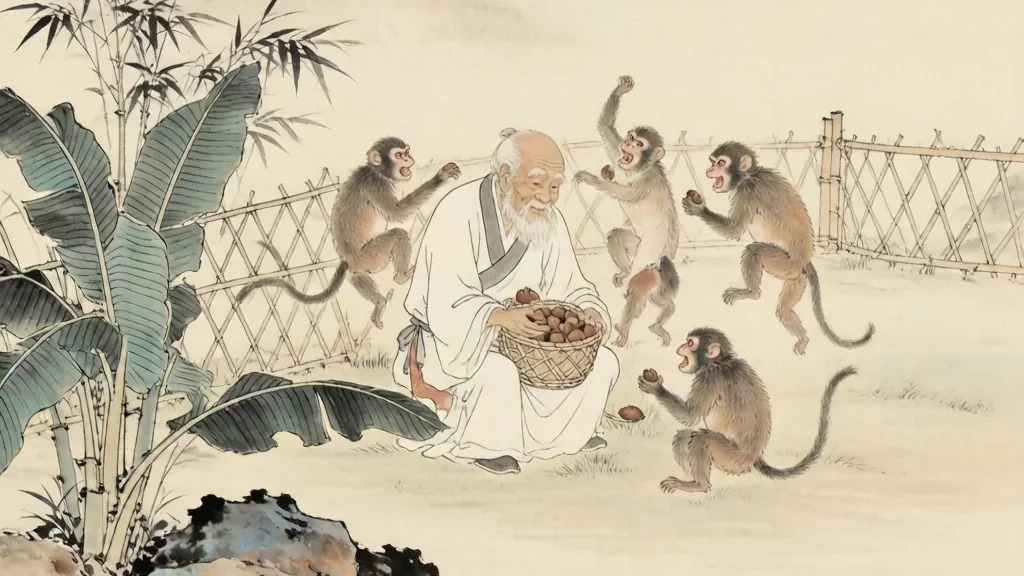
Of all the ways human beings can be fooled, the most embarrassing is to be fooled by a change of words rather than a change of facts. The thing itself remains exactly what it was. The substance is unchanged. Only the packaging has been altered — and yet, against all reason, the new packaging satisfies where the old one did not. The Chinese idiom 朝三暮四 (zhāo sān mù sì), "three in the morning, four at night," describes this kind of fooling, and the fable behind it is one of the oldest and most pointed in the entire Daoist tradition. It is a story about monkeys, but it is also a story about us.
The tale comes from the "Zhuangzi" (庄子), the foundational Daoist text attributed to the philosopher Zhuang Zhou, who lived in the fourth century BCE. Zhuangzi was a master of the comic parable — short, sharp stories in which animals behave like humans and humans behave like animals, each revealing something about the nature of perception and the absurdity of our certainties. The story of the monkey keeper appears in the chapter "Qi Wu Lun" (齐物论), the "Discussion on Making All Things Equal," one of the most celebrated passages in all of Chinese philosophy.
The Keeper and His Hungry Monkeys
In a certain mountain forest, the story goes, there lived a man who kept monkeys. He was, by the standards of his time, a good keeper — attentive to his animals, knowledgeable about their habits, and patient with their moods. But monkeys, as anyone who has dealt with them knows, are difficult creatures. They are clever, demanding, and chronically dissatisfied. They want what they want, when they want it, and they are perfectly capable of throwing fits when their wants are not met.
The keeper had a problem. His monkeys ate a great deal, and acorns — their preferred food — were growing scarce. He needed to reduce their rations, but he knew his monkeys well enough to know that the moment they perceived a reduction, there would be trouble. So he devised a plan. He would offer them a deal that sounded, on the surface, like a choice, while in fact being exactly the ration he wanted to give them.
He called the monkeys together and made his announcement. "From now on," he said, "I will give you three acorns in the morning and four in the evening. Is that acceptable?" The monkeys heard this, and they were furious. Three in the morning? Only three? What about breakfast? What about the hunger they would feel all day, waiting for the evening portion? They chattered and screeched and stamped their little feet in outrage. The deal was unacceptable. The keeper was a tyrant. Three in the morning was an insult.
The Trick That Was Not a Trick
The keeper watched this performance with the calm of someone who has done this kind of thing before. He waited for the noise to subside. Then he spoke again. "Very well," he said. "Since you do not like that arrangement, I will give you four in the morning and three in the evening. Is that acceptable?"
The monkeys heard this, and they were delighted. Four in the morning! A generous breakfast! A full portion to start the day! They chattered and capered and bobbed their heads in approval. The new arrangement was wonderful. The keeper was wise. Four in the morning was clearly better than three.
And here is the joke, which is also the philosophical point. The total number of acorns was the same. Three plus four is seven. Four plus three is also seven. The monkeys would receive, in either arrangement, exactly the same amount of food on any given day. Nothing had changed except the order — the temporal placement of the acorns within the day. And yet the monkeys reacted to the second arrangement as if it were a victory, and to the first as if it were a defeat. They had been fooled, not by a change in substance, but by a change in presentation. The keeper had not given them anything more. He had merely made them believe that he had.
The Daoist Point Beneath the Joke
Zhuangzi's purpose in telling this story was not merely to mock monkeys. He was making a serious philosophical argument about the nature of human judgment. The monkeys in the story are not stupid because they cannot count. They can count well enough to know that three is less than four. They are stupid because they treat the order of the acorns as if it were the same as the quantity — because they allow the immediate perception (the morning portion) to dominate their judgment of the whole. They see the first number, react to it, and never bother to add up the total.
Zhuangzi's claim, in the "Discussion on Making All Things Equal," is that human beings do this constantly. We fix on one frame for an event — one way of describing it, one moment of experiencing it, one set of words for it — and we react to the frame as if it were the event. The same situation, described differently, can produce opposite reactions. The same life, framed one way, is a tragedy; framed another way, is a comedy. The same quantity of acorns, distributed differently, is an insult or a gift. And we, like the monkeys, are far more responsive to the framing than to the underlying reality.
This is, in modern terms, a recognition of what psychologists now call "framing effects" — the well-documented fact that human beings make different decisions depending on how a situation is described, even when the underlying facts are identical. Zhuangzi arrived at this insight twenty-three hundred years before the modern behavioral economists did, and he did it with a story about a man and his monkeys rather than a controlled experiment. The story's longevity is, in part, a tribute to how precisely it captures a permanent feature of human psychology.
The Idiom's Shifting Meaning
There is an interesting wrinkle in the history of the idiom. In Zhuangzi's original telling, 朝三暮四 was a parable about perception and the manipulation of perception — about how easily we are fooled by a change in presentation. Over the centuries, however, the phrase drifted. By the Ming and Qing dynasties, it had come to mean something quite different: inconstancy, fickleness, the habit of changing one's mind or one's plans from morning to night. A person who said one thing in the morning and another in the evening was said to be "three in the morning, four at night."
Both meanings are alive in modern Chinese. The older, philosophical meaning — the one Zhuangzi intended — is still invoked in discussions of rhetoric, advertising, and political language, where it serves as a warning about how easily presentation can disguise substance. The newer, colloquial meaning — inconstancy and fickleness — is more common in everyday speech, where it describes the unreliable friend, the wavering suitor, the manager who changes direction every week.
Why the Idiom Endures
Both meanings, despite their divergence, point to the same underlying human weakness. We are creatures of perception more than of substance. We respond to the frame, not the picture. We judge by the morning portion, not the daily total. And we are easily pacified — or enraged — by a mere reordering of the words used to describe our circumstances. The keeper in the story is not cruel. He does not starve his monkeys. He simply understands them well enough to know that the order of the acorns matters more to them than the number, and he uses that understanding to manage them without conflict.
The deeper wisdom of the parable is its implicit warning: be careful which framing you accept. The monkeys, satisfied with "four in the morning," believed they had won something. They had won nothing. The keeper had given them exactly what he had planned to give them from the start. Their satisfaction was real, but it was based on nothing — on a rearrangement of words that left the underlying reality untouched. In the same way, much of what satisfies us in life — the raise that is offset by inflation, the new title that comes with no new power, the "reform" that leaves the structure intact — is a rearrangement of acorns, designed to make us feel we have gained when we have merely been re-described.
The idiom's quiet counsel is to add up the total. Look past the morning portion. Look past the evening portion. Ask what the day actually contains, regardless of the order in which it arrives. The monkeys could not do this, and so they were managed. We are not monkeys, the story suggests. We have the capacity to see the whole. Whether we use that capacity — whether we look past the framing to the substance — is, in the end, the question that determines whether we are the keeper or the kept.
Zhuangzi's Animal Parables
Zhuangzi rarely argues straight; he prefers to put the lesson in the mouth of a fish, a butterfly, or a monkey keeper. The keeper and his acorns belong to a whole menagerie of comic animal tales through which the philosopher changes how readers see the world. In these stories the animals are not cute decorations but instruments of philosophy, used to expose the stiffness of human certainty. The monkey keeper works especially well because the monkeys are just clever enough to be fooled and just foolish enough to be us. By choosing animals, Zhuangzi lowers the reader's guard and makes a hard point about perception feel like a joke. The idiom is thus one exhibit in a larger method: teach through laughter, and let the reader realize, with a start, that the monkey is human.
What Psychology Now Confirms
Centuries after Zhuangzi, behavioral science rediscovered his insight under the name framing effects: people choose differently depending on how options are described, even when the facts are identical. The monkeys who celebrated four-in-the-morning and raged at three-in-the-morning are a perfect ancient illustration of the same bias. Experiments with humans show the same pattern in pricing, medicine, and risk, where a gain framed one way beats the same gain framed another. What the philosopher saw by watching a keeper and his troop, modern researchers confirmed with controlled trials. The idiom therefore reads today as a piece of folk psychology that anticipated a finding of contemporary economics, a reminder that some truths about the mind were noticed long before they were measured.
Monkeys as Trickster Figures
Monkeys hold a special place in Chinese folklore as clever, restless, and easily duped all at once, and the acorn keeper's troop fits a long line of simian tricksters. The most famous is the Monkey King, who is both supremely wily and periodically outwitted, a cousin in spirit to Zhuangzi's easily pleased monkeys. Because monkeys mimic human behavior so closely, they make ideal mirrors for human folly, which is why storytellers return to them. The idiom's comedy depends on that resemblance: we laugh at the monkeys and then recognize the keeper's logic in our own marketing, politics, and self-deception. In Chinese imagination the monkey is never only an animal; it is a small, furry comment on the people watching it, and 朝三暮四 is one of the sharpest such comments ever made.
❓ Frequently Asked Questions
📝 Chinese Vocabulary
朝三暮四 — : "Three in the morning, four at night" — originally a parable about the manipulation of perception; in modern usage, inconstancy or fickleness.
庄子 — : The Daoist philosopher (c. 369–286 BCE) whose work preserves this parable in the chapter "Discussion on Making All Things Equal."
狙公 — : "The monkey keeper" — the protagonist of the parable, whose clever management of his monkeys gives the idiom its name.
橡子 — : "Acorns" — the food whose distribution (three and four, or four and three) forms the central image of the story.
齐物论 — : "Discussion on Making All Things Equal" — the celebrated chapter of the "Zhuangzi" in which this parable appears.
朝 — : Morning; the first part of the day in the feeding schedule.
暮 — : Evening or dusk; the later part of the feeding schedule.
猴 — : Monkey; the easily pleased animals whose reaction drives the parable.
🎉 Fun Facts
- The "Discussion on Making All Things Equal" in which this parable appears is considered one of the most philosophically rich passages in all of Chinese literature — its arguments about the relativity of perspective influenced centuries of Daoist and Buddhist thought.
- The idiom's meaning shifted dramatically over the centuries: in Zhuangzi's original text it was a parable about perception, but by the Ming Dynasty it had come to mean inconstancy — a meaning now dominant in everyday speech.
- The story is sometimes cited in modern Chinese discussions of marketing and advertising, where "monkey keeper logic" (狙公之术) refers to the practice of repackaging the same product to make it seem new.
- The parable has a near-identical cousin in Indian Buddhist literature, where the Buddha tells a story of a monkey keeper who uses the same trick — suggesting a shared narrative tradition across ancient Asian philosophy.
- In contemporary Chinese, the phrase is sometimes used by parents to describe a child whose moods or plans change from morning to night, a direct use of the inconstancy meaning.
- Linguists note the idiom preserves an ancient way of telling time by meal periods, morning and evening rations, a small clue to how daily life was measured in Zhuangzi's era.