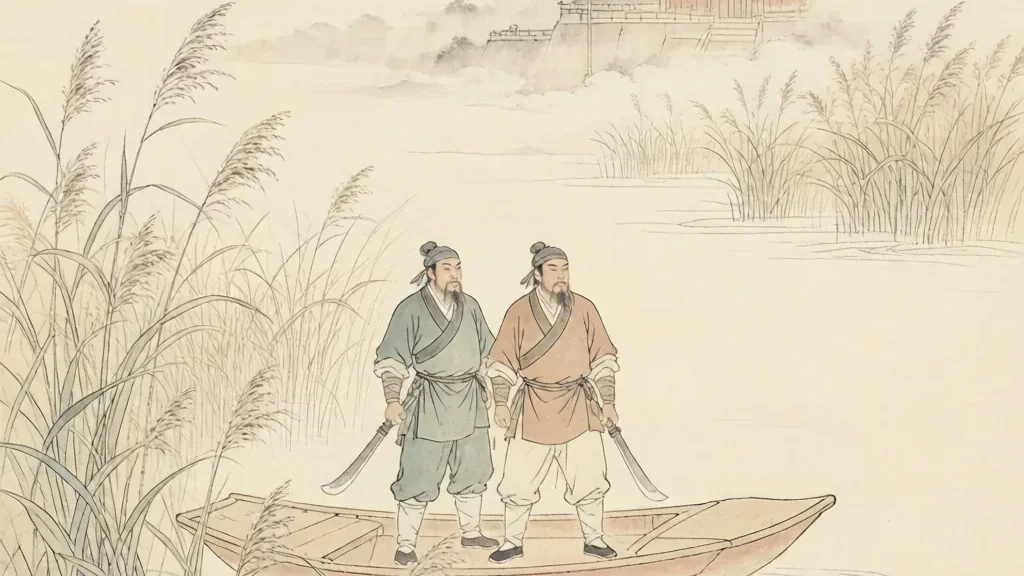
In the pantheon of Chinese classical novels, Water Margin (水浒传) occupies a unique and transgressive position. It is the great outlaw epic — a sprawling, violent, morally ambiguous chronicle of 108 men and women driven to banditry by a corrupt system, who gather at the mountain stronghold of Liangshan Marsh and wage a righteous war against injustice. Where other classics celebrate loyalty to the state, Water Margin asks the dangerous question: what do you do when the state itself is the enemy of justice?
Attributed to Shi Nai'an (施耐庵) in the fourteenth century (with possible contributions from Luo Guanzhong, author of Three Kingdoms), the novel is based on historical events: during the Northern Song Dynasty, a band of outlaws led by Song Jiang did indeed operate from Liangshan Marsh. But the historical band of thirty-six has been expanded in fiction to 108 — a number rich in Buddhist and Daoist symbolism — and the historical outlaws have been transformed into folk heroes of legendary proportions.
The Structure: 108 Stories of Injustice
Water Margin is structured as a series of origin stories, each following a different character's fall from respectable society into outlawry. This episodic structure, reminiscent of a television series centuries before the medium existed, creates a mosaic portrait of a society in which justice is systematically denied to the powerless.
The pattern is remarkably consistent: an honorable person — a military instructor, a magistrate's clerk, a wealthy landowner — is wronged by a corrupt official, a scheming relative, or a predatory local power. The legal system, rather than providing redress, compounds the injustice. The hero is framed, beaten, exiled, or condemned. Only by taking matters into their own hands — usually through spectacular violence — can they achieve a rough justice. And having shed blood, they can never return to lawful society.
This pattern encodes a radical political message: the novel's heroes are not born criminals but made criminals by a system that protects the powerful and preys on the weak. Their outlawry is not a rejection of justice but a desperate pursuit of it in a world where official justice has failed.
Song Jiang: The Timely Rain
Song Jiang (宋江), the band's eventual leader, is an unlikely outlaw chief. A minor county clerk known for his generosity — his nickname, "Timely Rain" (及时雨), refers to his habit of helping anyone in need — Song Jiang is constitutionally law-abiding. He believes in the system. Even after he is forced to kill his unfaithful mistress, even after he is branded and exiled, he resists the call to banditry.
What finally drives Song Jiang to Liangshan is not personal grievance but the accumulation of evidence that the system he believes in is irredeemably broken. His journey from loyal subject to outlaw leader is the novel's moral arc, and his tragedy — for Song Jiang is ultimately a tragic figure — is that he never stops believing in the very state that has persecuted him. His eventual acceptance of an imperial amnesty and his service to the Song Dynasty, which leads to the destruction of the band he built, has divided readers for centuries. Was he a loyal patriot or a traitor to his brothers? The novel refuses a simple answer.
Wu Song: The Tiger-Slaying Hero
Among the 108 heroes, none captures the popular imagination more vividly than Wu Song (武松). His story, occupying ten of the novel's most celebrated chapters, is a masterpiece of escalating violence and righteous vengeance. It begins with one of the most iconic scenes in Chinese literature: Wu Song, drunk on wine, encounters a man-eating tiger on Jingyang Ridge and kills it with his bare hands. The feat makes him a local hero and earns him a position as a constable.
But Wu Song's story darkens rapidly. His brother, the dwarf Wu Dalang, is murdered by his adulterous wife Pan Jinlian and her lover Ximen Qing. When the local magistrate — bribed by Ximen Qing — refuses to prosecute, Wu Song takes justice into his own hands. He kills Pan Jinlian and Ximen Qing in a ritual of vengeance that is both horrifying and, within the novel's moral framework, entirely justified. He then turns himself in, accepting exile rather than fleeing — a gesture that distinguishes him from mere criminals.
Wu Song's subsequent adventures — his escape from a corrupt prison, his bloody revenge on the officials who tried to murder him, his eventual journey to Liangshan — establish him as the novel's supreme embodiment of righteous violence. He is terrifying and admirable in equal measure, a man whose moral clarity is as absolute as his capacity for destruction.
Lin Chong: The Leopard Head
If Wu Song represents the warrior's path to outlawry, Lin Chong (林冲) represents the victim's. A respected arms instructor for the imperial guard — his nickname "Panther Head" (豹子头) describes his fierce appearance — Lin Chong is the most reluctant of outlaws. His downfall begins when the son of a powerful official, Gao Yanei, becomes infatuated with Lin Chong's wife. When Lin Chong's loyalty prevents him from violently defending his honor, the Gao faction frames him for a crime, brands him, and exiles him.
Even in exile, Lin Chong tries to accept his fate. It is only when he learns that his wife has committed suicide rather than submit to Gao Yanei, and that assassins have been sent to kill him, that he finally breaks. His revenge — killing his would-be assassins in a snowstorm at a mountain temple — is one of the novel's most emotionally devastating sequences. Lin Chong emerges from that snowstorm a changed man, his loyalty to the state replaced by a cold, implacable fury.
Lin Chong's story is the novel's most powerful critique of the system he once served. He is not rebellious by nature; he is loyal, patient, and law-abiding to a fault. The system's destruction of such a man is its own indictment.
The Band of 108: A Society in Miniature
The 108 heroes of Liangshan represent a cross-section of Song Dynasty society. Among their number are former generals and magistrates, monks and priests, fishermen and farmers, scholars and physicians, innkeepers and thieves. The novel's egalitarian vision — in which a former imperial general and a former grave-robber sit as equals in the Brotherhood Hall — is radical for its time and remains compelling today.
Each of the 108 is associated with one of 36 Heavenly Spirits (天罡) or 72 Earthly Fiends (地煞) — stars whose earthly incarnations they are said to be. This astrological framing elevates their banditry to cosmic significance: they are not merely criminals but agents of a celestial order that transcends the corrupt earthly one.
The band's code — "Carry out the Way on behalf of Heaven" (替天行道), inscribed on their banner — articulates their self-understanding. They do not reject the moral order of the universe; they claim to embody it more truly than the officials who persecute them. This is dangerous territory for a novel published under imperial rule, and Water Margin was banned at various points in Chinese history for its potential to inspire rebellion.
Justice vs. Corruption: The Novel's Central Conflict
The moral universe of Water Margin is starkly dualistic, yet more complex than it first appears. The villains are unambiguously villainous — corrupt officials who sell justice, lustful bullies who prey on the weak, treacherous relatives who betray their own. The heroes, in contrast, are morally complex. They kill freely, sometimes brutally. They drink, gamble, and brawl. Wu Song, for all his heroism, massacres an entire household — servants included — in his revenge against a corrupt official.
The novel does not flinch from this violence, nor does it sentimentalize its heroes. Instead, it presents a world in which violence has become the only available language of justice. When the legal system is a tool of oppression, the fist and the blade become the instruments of morality. This is a deeply unsettling proposition, and the novel's refusal to resolve its moral tensions is part of its enduring power.
The Tragic Ending: Amnesty and Dissolution
The novel's final chapters are among the most controversial in Chinese literature. Song Jiang, ever the loyalist, accepts an imperial amnesty and leads the Liangshan band into imperial service, suppressing other rebellions. One by one, the heroes die — some in battle, some by poison, some by suicide. Of the original 108, only a handful survive to old age.
This ending has been read in multiple ways. As political allegory, it warns that rebellion, however justified, leads to destruction. As character study, it reveals Song Jiang's tragic flaw — his inability to imagine a political alternative to the system that created him. As popular entertainment, it provides the emotional catharsis of watching larger-than-life figures meet larger-than-life ends. The novel's final image — the ghosts of the 108 heroes, now deified, haunting the marshes they once called home — suggests that their spirits, at least, cannot be contained by imperial authority.
Water Margin remains one of the most widely read and frequently adapted works of Chinese literature. It has inspired films, television series, video games, and even a Japanese manga. Its influence on the martial arts genre — both in literature and film — is incalculable. And its central question — what does a good person do in a bad system? — remains as urgent in the twenty-first century as it was in the fourteenth.
Sources and the Making of the Novel
Water Margin grew from a real episode into a centuries-long legend before becoming a book. The historical Song Jiang led a small band in the early twelfth century, and within decades storytellers were enlarging his feat into tales of 108 heroes. By the Yuan dynasty these stories filled stage plays and oral cycles, and in the fourteenth century Shi Nai'an is said to have shaped them into a connected novel, possibly with help from Luo Guanzhong. The text circulated in different lengths: an early hundred-chapter version, an expanded hundred-and-twenty-chapter edition, and a shortened seventy-chapter recension that ends at the brothers' gathering. This layered birth explains the novel's episodic feel, each hero's story a complete unit within the larger arc of the Liangshan band.
❓ Frequently Asked Questions
📝 Chinese Vocabulary
- 水浒传 (Shuǐ Hǔ Zhuàn) — "Water Margin"; one of the Four Great Classical Novels of Chinese literature
- 梁山泊 (Liáng Shān Pō) — Liangshan Marsh; the mountain stronghold where the 108 outlaws gather
- 替天行道 (Tì Tiān Xíng Dào) — "Carry out the Way on behalf of Heaven"; the outlaws' motto and banner inscription
- 一百单八将 (Yī Bǎi Líng Bā Jiàng) — The 108 Heroes; the full complement of the Liangshan band
- 及时雨 (Jí Shí Yǔ) — "Timely Rain"; Song Jiang's nickname, referring to his generosity in helping those in need
🎉 Fun Facts
- Water Margin was banned during the Ming and Qing dynasties for its perceived encouragement of rebellion.
- The novel's influence on Japanese culture is immense. The 1973 Japanese television series The Water Margin was a massive hit, and the manga Fist of the North Star draws heavily on its themes of righteous violence in a corrupt world.
- The character Wu Song's tiger-slaying feat has become so iconic that "Wu Song beats the tiger" (武松打虎) is a standard reference in Chinese conversation, used to describe any impressive feat of strength or courage.
- The 108 outlaws are divided into 36 Heavenly Spirits and 72 Earthly Fiends, a celestial roster that frames their banditry as ordained by heaven rather than mere crime.
- Behind the fiction lay a real early-12th-century outlaw, Song Jiang, who led a band of about thirty-six men in the Huainan region before being pardoned by the court.
- The novel is counted among the Four Great Classical Novels of Chinese fiction, alongside Romance of the Three Kingdoms, Journey to the West, and Dream of the Red Chamber.