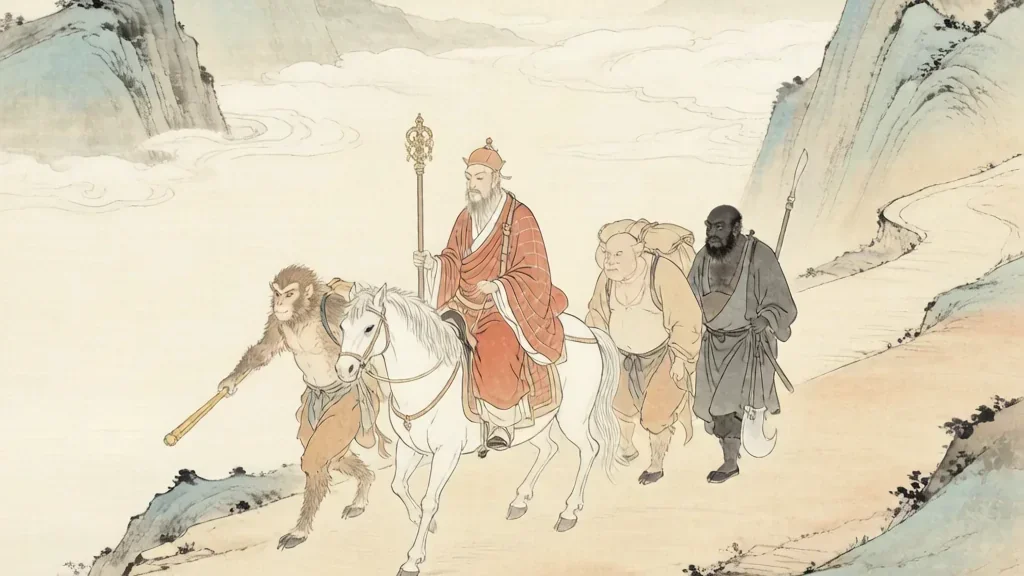
Imagine a novel that combines the epic scope of Homer's Odyssey, the spiritual allegory of Bunyan's Pilgrim's Progress, the slapstick comedy of a cartoon, and the cosmic scale of superhero mythology — all filtered through the unique sensibilities of sixteenth-century China. That is Journey to the West (西游记), one of the Four Great Classical Novels of Chinese literature, and arguably the most beloved work of fiction ever written in the Chinese language.
Published in the 1590s and attributed to Wu Cheng'en (吴承恩), Journey to the West fictionalizes the historical pilgrimage of the Buddhist monk Xuanzang, who traveled from China to India in the seventh century to obtain sacred scriptures. But the novel transforms this historical journey into a riotous fantasia of shape-shifting demons, celestial bureaucracies, magical weapons, and one of the most charismatic heroes in world literature: Sun Wukong, the Monkey King.
Sun Wukong: The Irresistible Monkey King
No character in Chinese fiction enjoys greater popular recognition than Sun Wukong. Born from a stone egg fertilized by the wind on the Mountain of Flowers and Fruit, the Monkey King is a figure of pure, anarchic energy. Before the main journey even begins, he has already: learned the secrets of immortality from a Daoist master, acquired the magical staff Ruyi Jingu Bang (which can shrink to the size of a needle or expand to hold up the heavens), erased his name from the registers of death in the underworld, and declared himself "Great Sage Equal to Heaven."
The Jade Emperor, ruler of the celestial realm, tries to contain this chaos by giving Sun Wukong a heavenly position — only for the Monkey King to discover he has been appointed "Keeper of the Heavenly Stables," the lowest of all celestial posts. His rebellion escalates into full-scale war against heaven itself. The celestial armies, with all their divine generals and magical weapons, cannot defeat him. Finally, the Buddha intervenes, making a wager: if Sun Wukong can leap out of the Buddha's palm, he may rule heaven. The Monkey King somersaults to the very edge of the universe, finds what he believes are five pillars marking the boundary, and — in a moment of characteristic irreverence — urinates on one. Returning triumphantly, he discovers that the "pillars" were the Buddha's fingers. The Buddha overturns his palm, trapping Sun Wukong under a mountain for five hundred years.
This origin story, occupying the first seven chapters, is a masterpiece of comic-epic storytelling. Sun Wukong embodies the subversive appeal of the trickster archetype — he mocks authority, refuses to know his place, and possesses such irrepressible life force that even the gods seem pale by comparison. Yet his imprisonment under the mountain is also the beginning of his redemption, for it is there that the bodhisattva Guanyin finds him and offers a path to freedom: protect the monk Tripitaka on his westward journey.
The Pilgrim and His Companions
The journey's nominal hero is Tang Sanzang, also known as Tripitaka, a devout Buddhist monk tasked with retrieving scriptures from India. As a character, Tripitaka presents a challenge for modern readers: he is physically helpless, perpetually anxious, and often seems more concerned with preserving his own purity than with the welfare of his disciples. He frequently falls for the disguises of demons who want to eat his flesh (which, inconveniently, grants immortality), and he repeatedly punishes Sun Wukong for using violence against these demons — only to beg for rescue when the demons inevitably capture him.
Yet Tripitaka is not merely comic relief. His compassion, however naive, represents the Buddhist ideal that the journey is meant to embody. The tension between Sun Wukong's pragmatic violence and Tripitaka's principled pacifism is one of the novel's central themes. The tightening golden circlet that Guanyin places on Sun Wukong's head — which Tripitaka can activate with a magic spell whenever the Monkey King disobeys — literalizes the conflict between enlightenment through force and enlightenment through suffering.
The other two disciples round out the pilgrim band with their own distinctive flaws and charms. Zhu Bajie (猪八戒), or "Pigsy," was once a heavenly marshal banished to earth for drunkenly flirting with the moon goddess. Reborn as a pig-monster, he retains his appetite for food, comfort, and women. Zhu Bajie is the comic foil — lazy, lecherous, and always ready to abandon the quest when things get difficult. Yet his very human weaknesses make him endearing, and his brute strength proves useful in battle.
Sha Wujing (沙悟净), or "Sandy," is the quietest member of the group — a former celestial general exiled for breaking a crystal goblet at a heavenly banquet. Transformed into a river ogre, he wears a necklace of skulls from the travelers he has devoured. Sha Wujing is the steady, reliable presence that holds the fractious group together, a model of quiet devotion.
The Structure: 81 Ordeals on the Road to Enlightenment
The novel's hundred chapters are organized around eighty-one tribulations — a sacred number in Buddhism — that the pilgrims must overcome. These episodes follow a loose pattern: the travelers enter a new territory, encounter a demon (often a celestial being's escaped animal or servant in disguise), face capture or deception, and ultimately prevail through Sun Wukong's ingenuity, the intervention of a bodhisattva, or both.
The demons themselves are a wonderfully varied gallery. There is the White Bone Demon, who assumes the forms of a beautiful girl, an old woman, and an old man in succession — forcing Sun Wukong to "kill" what appears to be innocent humans, with Tripitaka punishing him each time. There is the Bull Demon King and Princess Iron Fan, whose magical palm-leaf fan is needed to extinguish the flames of a mountain blocking the pilgrims' path. There are spider spirits, scorpion demons, and a pair of boy immortals who are really the Gold and Silver Horn Kings, servants of Laozi who have stolen their master's magical treasures.
What emerges from this episodic structure is a worldview in which nothing is quite what it seems. Demons are often fallen immortals; seeming dangers may be tests; and the most formidable enemy may be the pilgrims' own impatience, desire, and fear. The journey is at once a physical crossing of mountains and rivers and an allegory for the Buddhist path to enlightenment — a dual nature that has inspired centuries of interpretation.
Allegory and Deeper Meanings
Scholars have debated the allegorical dimensions of Journey to the West for centuries. Traditional commentaries interpret the five pilgrims (including the white horse that carries Tripitaka) as representing the five elements of Chinese cosmology — metal, wood, water, fire, and earth — whose harmonious interaction is necessary for the journey's success. Sun Wukong represents the "mind-monkey" (心猿) of Buddhist psychology, the restless consciousness that must be disciplined through spiritual practice.
The novel also functions as a satire of Ming Dynasty bureaucracy. Heaven is organized as a vast imperial administration, complete with ministries, memorials, and petty rivalries between officials. When Sun Wukong encounters bureaucratic obstruction in heaven, the comedy has a sharp edge: readers would have recognized their own frustrations with government inefficiency.
At its deepest level, the novel is about the relationship between order and chaos, discipline and spontaneity. Sun Wukong begins as pure chaos — destructive, creative, uncontrollable. Through the discipline of the journey, he is transformed without being diminished. The Monkey King who attains Buddhahood at the novel's end is still recognizably himself: irreverent, clever, and full of life. The novel suggests that enlightenment does not mean the extinction of personality but its fulfillment.
Global Influence and Enduring Appeal
Journey to the West has traveled almost as widely as its characters. The Japanese television series Monkey (1978) introduced the story to Western audiences, while the manga and anime Dragon Ball loosely adapts Sun Wukong's adventures into a science-fiction martial arts epic. The novel has inspired operas, films, video games, and countless retellings across Asia and beyond.
Its enduring appeal lies in the perfect balance of its elements: the thrilling action of Sun Wukong's battles, the humor of Zhu Bajie's appetites, the poignancy of Tripitaka's vulnerable faith, and the profound allegorical depths that reward rereading. Journey to the West is that rarest of achievements — a book that can be enjoyed as pure entertainment by a child and studied as a philosophical text by a scholar. It remains, after four centuries, an invitation to set out on the road.
The Comedy of the Journey
For all its theology, Journey to the West is very funny, and the comedy is part of its meaning. Zhu Bajie supplies the low humor, his hunger, laziness, and pursuit of pretty women ground the quest in appetite and make the holy band wonderfully human. Sun Wukong's trickery is the other pole: he dupes demons, mocks heavenly bureaucrats, and turns solemn moments inside out, so that authority is forever being punctured. The laughs also do moral work, deflating pride and showing that enlightenment is not solemn. Even Tripitaka's fretful piety becomes comic when set against the Monkey King's impatience. This mix of slapstick and sermon is why the book travels so well to children and to cultures far from Buddhism; the jokes carry the philosophy, and readers laugh before they notice they are being taught.
How the Novel Travelled the World
Published in the 1590s and attributed to Wu Cheng'en, Journey to the West spread through cheap print and then through translation. The first English versions appeared in the nineteenth century, often as abridged tales of the Monkey King rather than the full hundred chapters, and the character took on a life of his own abroad. In the late twentieth century the Japanese television series Monkey and the Dragon Ball manga carried Sun Wukong to new audiences who knew little of the source. Today the novel is taught in world-literature courses and rewritten as games, film, and web fiction across Asia. Its adaptability is a measure of its strength: the bones of the pilgrimage fit almost any medium, and each generation finds the episode, the rebellion, the tests, the homecoming, that speaks to it.
The Quiet Companions
Behind the loud duo of Monkey and Pig stands Sha Wujing, the former celestial general turned river-ogre, whose role is steadiness rather than spectacle. He carries the baggage, keeps the group from fracturing, and rarely complains, the ballast that lets the flashier disciples shine. Equally easy to overlook is the white dragon horse, a prince in equine form who bears Tripitaka across rivers and battles and who, like the others, is a fallen immortal doing penance. These supporting figures matter because the pilgrimage is a company, not a solo: each disciple embodies a failing or a virtue the journey must balance. The novel's wisdom is that salvation is traveled together, and the quiet companions are the proof that every temperament has a place on the road to the scriptures.
❓ Frequently Asked Questions
📝 Chinese Vocabulary
- 西游记 (Xī Yóu Jì) — "Journey to the West"; one of the Four Great Classical Novels
- 孙悟空 (Sūn Wù Kōng) — Sun Wukong, the Monkey King; the novel's unforgettable hero
- 唐僧 (Táng Sēng) — Tang Monk, or Tripitaka; the Buddhist pilgrim based on the historical Xuanzang
- 猪八戒 (Zhū Bā Jiè) — Zhu Bajie, or Pigsy; the comic, gluttonous former heavenly marshal
- 金箍棒 (Jīn Gū Bàng) — The Ruyi Jingu Bang; Sun Wukong's magical staff, which can change size at will
🎉 Fun Facts
- The historical monk Xuanzang really did travel from China to India and back between 629 and 645 CE, covering over 10,000 miles. His detailed travelogue, Great Tang Records on the Western Regions, is still used by archaeologists studying ancient Central Asia.
- Sun Wukong's cloud-somersault covers 108,000 li (about 54,000 kilometers) in a single leap. This number is significant in Buddhism, representing the 108,000 afflictions that must be overcome on the path to enlightenment.
- The novel contains some of the most famous scenes in Chinese literature, including Sun Wukong's rebellion against heaven — a sequence so iconic that the Chinese phrase "Havoc in Heaven" (大闹天宫) has become shorthand for any spectacular disruption of order.
- The novel's first seven chapters, before the journey begins, are often read on their own as the self-contained story of the Monkey King's rebellion.
- Journey to the West blends at least three layers, a historical pilgrimage, Daoist alchemy, and Buddhist allegory, which is why it supports so many readings.
- The Monkey King's ability to clone himself with handfuls of hair is one of many tricks that made him a favorite of puppet and shadow theatres.