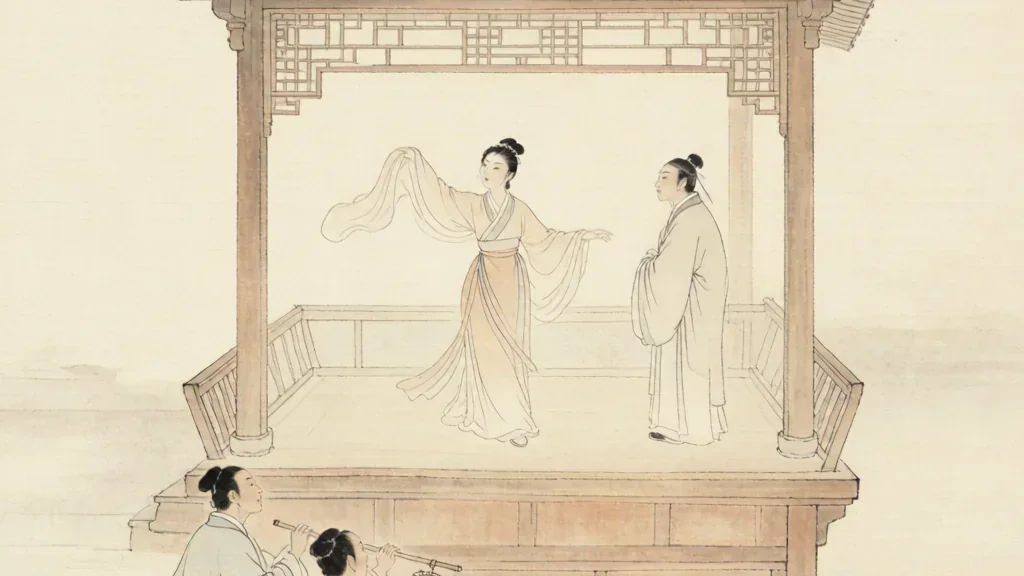
Before the Yuan Dynasty (1271-1368), Chinese literature belonged overwhelmingly to the elite. Poetry, history, and philosophy were written in classical Chinese — a compressed, allusive language that required years of study to master. The common people, who spoke vernacular dialects, were largely excluded from literary culture. Yuan drama changed everything. For the first time, ordinary Chinese people saw their language, their concerns, and their sense of justice enacted on stage in stories they could understand and feel.
The rise of Yuan drama, known as zaju (杂剧, "variety plays"), represents one of the great democratizing moments in world literature. Within a single century, a fully developed theatrical tradition emerged — complete with musical scores, acting conventions, and a repertoire of plays that remain in performance today. Modern Beijing Opera, though evolved from later forms, traces its lineage directly to the innovations of Yuan playwrights.
Why the Yuan Dynasty? The Historical Context
The Mongol conquest of China under Kublai Khan created conditions uniquely favorable to popular theater. The traditional path to prestige — the imperial examination system that had channeled talent into government service — was largely suspended under Mongol rule. Educated Chinese men who would have been scholar-officials under the Song found themselves shut out of power. Many turned to writing for the stage, bringing literary sophistication to a popular medium.
Meanwhile, the Mongol rulers, themselves from a nomadic culture with strong oral and performance traditions, patronized theater enthusiastically. The Yuan capital of Dadu (modern Beijing) became a thriving theatrical center, with permanent playhouses and professional acting troupes. Unlike the elite poetry of earlier dynasties, which circulated among a small literate class, Yuan drama was a genuinely popular art form, performed before mixed audiences of Mongols and Chinese, nobles and commoners.
The plays themselves reflect this diverse audience. They draw on history, legend, and contemporary life, mixing high sentiment with low comedy, philosophical reflection with slapstick. A single play might shift from arias of heart-breaking beauty to a clown's bawdy jokes, then to a courtroom scene of righteous indignation — all within the span of an evening's entertainment.
The Structure of Zaju Drama
A standard Yuan zaju play consists of four acts, sometimes preceded by a "wedge" (楔子) prologue. This four-act structure — far more compact than the sprawling multi-act dramas of Shakespeare or the endless cycles of traditional Chinese opera — gives Yuan plays a tight, almost cinematic focus. Each act centers on a single character who sings all the arias, while other characters speak in prose dialogue or comic verse.
The music of zaju was organized into gongdiao (宫调), or modal keys, each associated with particular emotions. All arias within a single act used the same modal key and rhyme scheme, creating musical and emotional unity. The original scores have been lost, but surviving libretti indicate a sophisticated integration of poetry, music, and dramatic action.
At the end of each play, a "title" and "topic" couplet summarized the story — a convention that later influenced the chapter titles of vernacular novels. This combination of musical, poetic, and narrative elements made zaju the most complex literary form China had yet produced, a Gesamtkunstwerk centuries before Wagner coined the term.
Guan Hanqing: China's First Great Playwright
Guan Hanqing (关汉卿, c. 1241-1320) stands at the head of the Yuan dramatic tradition as its acknowledged master. A prolific writer who produced over sixty plays, Guan was equally comfortable in the high tragic mode and the earthy comedy of the marketplace. His work displays a fierce sympathy for the powerless — especially women — and a righteous anger at corruption that has kept his plays startlingly relevant across seven centuries.
Guan's masterpiece, The Injustice to Dou E (窦娥冤), is often called China's first great tragedy. The plot is devastating in its simplicity: a young widow named Dou E is falsely accused of murder by a rejected suitor. A corrupt magistrate tortures her until she confesses to protect her mother-in-law from the same fate. Before her execution, Dou E pronounces three prophecies — that her blood will spurt upward onto a white banner, that snow will fall in midsummer, and that drought will afflict the region for three years. All three come true, and only when her ghost appears to her now-grown father, who has become an imperial inspector, is justice finally done.
The play works on multiple levels simultaneously. As courtroom drama, it exposes the brutal inadequacy of a legal system where torture produces confessions. As ghost story, it draws on ancient Chinese beliefs about the cosmic consequences of injustice — heaven itself responds to human cruelty. As character study, it presents Dou E as an ordinary woman whose stubborn integrity transforms her into something approaching a folk saint.
Other Major Playwrights and Works
Alongside Guan Hanqing, several other playwrights built the Yuan dramatic canon. Wang Shifu (王实甫) wrote The Story of the Western Wing (西厢记), a romantic comedy that was unprecedented in its length — twenty acts instead of the usual four — and in its sympathetic portrayal of young lovers defying social convention. The play follows the scholar Zhang Sheng and the beauty Cui Yingying as they pursue their love despite parental opposition, aided by Yingying's quick-witted maid Hongniang. Its celebration of romantic love over arranged marriage made it both enormously popular and mildly scandalous.
Ma Zhiyuan (马致远) brought philosophical depth to the stage with plays like Autumn in the Han Palace (汉宫秋), which retells the story of the Han Dynasty beauty Wang Zhaojun, sent to marry a barbarian chieftain as a political hostage. Ma's play transforms a historical incident into a meditation on patriotism, sacrifice, and the cruelty of power.
Bai Pu (白朴) and Zheng Guangzu (郑光祖) round out the traditional list of the "Four Great Yuan Playwrights" (元曲四大家), each contributing distinctive works that expanded the emotional and thematic range of the form.
The Vernacular Revolution
The most consequential innovation of Yuan drama was its use of vernacular Chinese. Previous literature had been written in wenyan (文言), a classical language as different from spoken Chinese as Latin is from Italian. Yuan playwrights wrote dialogue in the living language of their time, creating characters who spoke like real people — merchants, servants, soldiers, and courtesans, not just scholars and officials.
This vernacular turn had far-reaching effects. It established a precedent for literature in the common tongue that would lead, in the following Ming and Qing dynasties, to the great vernacular novels — Journey to the West, Romance of the Three Kingdoms, Water Margin, and Dream of the Red Chamber. In a very real sense, the entire tradition of Chinese fiction descends from the Yuan stage.
The Legacy: From Zaju to Modern Chinese Theater
Yuan zaju declined after the fall of the Mongol dynasty, replaced by the more elaborate chuanqi drama of the Ming. But its influence persisted. The conventions it established — the integration of song, speech, and action; the mixing of tragic and comic modes; the use of vernacular dialogue; the sympathy for ordinary people — became permanent features of Chinese theater.
Today, The Injustice to Dou E is still performed, studied, and adapted. It has been made into films, operas, and even a contemporary dance production. The story of a woman destroyed by a corrupt system resonates in any language and any era — a testament to Guan Hanqing's achievement in creating characters and situations that transcend their historical moment.
For modern readers approaching Yuan drama for the first time, the experience can be disorienting. The conventions are unfamiliar, the mixture of poetry and slapstick can seem jarring, and the moral universe — in which ghosts demand justice and heaven sends snow in summer — belongs to a different worldview than our own. But the emotional core of these plays is immediate and universal. When Dou E, facing death, cries out that heaven and earth have abandoned the innocent, we recognize the voice of every person who has ever been failed by the institutions meant to protect them. That is the power of Yuan drama: it speaks across centuries in a language anyone can understand.
The Music Behind the Words
A zaju was as much a musical event as a spoken one. Each act was set in a single modal key, the gongdiao, and the lead character sang all its arias to northern tunes while others spoke or jested. The modal key was meant to color the emotion, some keys for grief, some for brightness, so that the score shaped feeling as much as the lines did. The original melodies are lost, which is why modern revivals must reconstruct or invent them, but the libretti show tight rhyme and pattern work that only makes sense as song. Reading Yuan drama silently thus misses half the art: the words were written to ride a tune, and the famous arias of Dou E or the Western Chamber were the parts audiences actually sang along with and remembered.
Theatre for a Crowded City
Yuan drama was a big-city, mixed-crowd entertainment in a way earlier literature never was. In Dadu and other Yuan centers, playhouses sold seats to Mongols and Chinese, officials and vendors, and the stories answered to all of them at once, high sentiment beside bawdy jokes, courtroom justice beside clowning. This breadth is why the plays feel modern: they assume an audience that laughs and weeps in the same evening and does not separate refined from popular. The form also gave women performers a public stage rare for the era, and some became stars. To sit in a Yuan playhouse was to see the whole city reflected, its grievances, its humor, its hunger for a happy or a just ending, performed in the vernacular it actually spoke.
❓ Frequently Asked Questions
📝 Chinese Vocabulary
- 元曲 (yuán qǔ) — Yuan drama or Yuan opera; the theatrical form of the Yuan Dynasty
- 杂剧 (zá jù) — "Variety plays"; the specific dramatic form, typically four acts with songs and dialogue
- 窦娥冤 (Dòu É Yuān) — "The Injustice to Dou E"; Guan Hanqing's masterpiece and China's first great tragedy
- 宫调 (gōng diào) — Modal key; the musical mode that governed the arias in each act
- 元曲四大家 (Yuán Qǔ Sì Dà Jiā) — The Four Great Yuan Playwrights: Guan Hanqing, Ma Zhiyuan, Bai Pu, and Zheng Guangzu
🎉 Fun Facts
- Guan Hanqing was not only a playwright but also an actor and possibly a physician. He described himself as "a copper pea that cannot be steamed, boiled, hammered, or fried" — meaning he was unbreakable.
- The Yuan Dynasty saw the first known use of playbills and printed scripts for commercial sale. Theater was a genuine industry, with playwrights earning their living from box office receipts.
- Women performed on the Yuan stage alongside men — a practice that later dynasties suppressed. Some actresses became famous celebrities, and several playwrights married performers.
- The Four Great Yuan Playwrights list was fixed by later critics and varies slightly across sources, showing how canons get codified.
- Yuan drama's four-act limit meant a whole story had to be told in tight scenes, unlike the sprawling multi-act forms that came later.
- Many zaju plots drew on the same stock of historical and legendary figures that popular storytellers already used, blurring stage and street.