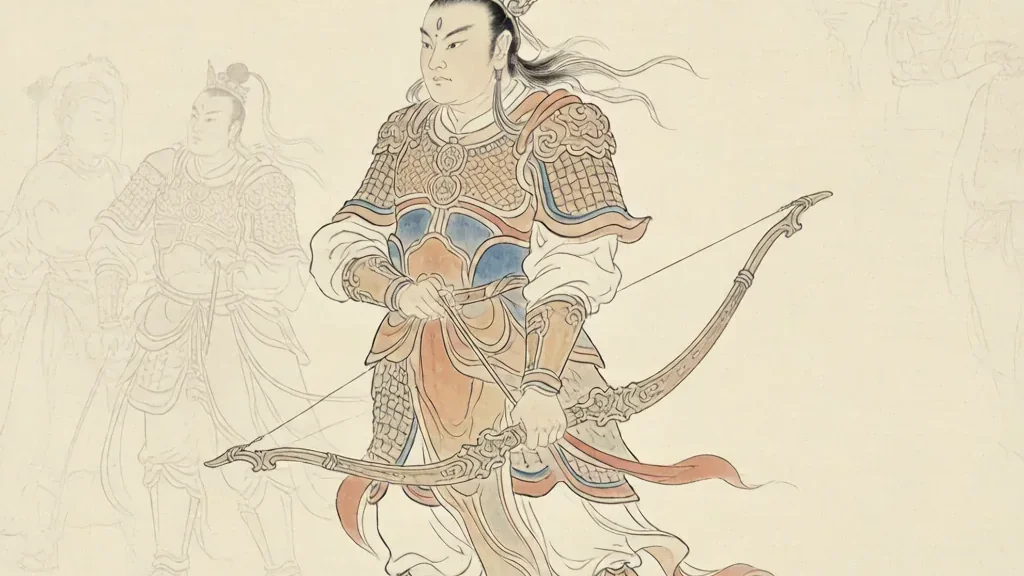
In the vast pantheon of Chinese mythology, few deities are as distinctive — or as formidable — as Erlang Shen. He is the warrior god with three eyes, the third set vertically in the center of his forehead, glowing with divine light that sees through all illusions and deceptions. He carries a three-pointed, double-edged lance, rides a divine hound that can fell demons with a single bark, and answers only to the highest authorities in heaven. He is, in many ways, heaven's champion — the one called upon when all other options have failed.
The story of Erlang Shen (二郎神, "Second Lord God") is one of the most complex in Chinese mythology, blending elements from Daoist, Buddhist, and folk traditions into a figure of remarkable depth. He is at once a loyal servant of heaven and a proud, independent warrior who does not hesitate to challenge even the Jade Emperor when his sense of justice demands it. He is a hero of order, but also a figure of immense personal power, and his legends explore the tension between these two roles.
A Divine Birth
The origins of Erlang Shen are multiple and sometimes contradictory, reflecting the way his character developed over centuries of storytelling. In the most widely accepted version, he is the nephew of the Jade Emperor himself, born to the emperor's sister, Yaoji, who had fallen in love with a mortal scholar named Yang Tianyou. Their union was forbidden — celestial beings were not supposed to marry mortals — and when the Jade Emperor learned of it, he was furious. He imprisoned Yaoji beneath Mount Tao, and she would never see her husband again.
But she had already given birth to a son, Yang Jian, who would grow up to become Erlang Shen. Raised by his father in the mortal world, Yang Jian showed extraordinary abilities from an early age. He was stronger, faster, and more perceptive than any ordinary child. Most remarkably, he was born with a third eye in his forehead, a sign of his divine heritage and his ability to see the truth that others could not.
When Yang Jian learned the truth about his mother — that she was imprisoned by her own brother, the Jade Emperor, for the crime of loving a mortal — he was consumed with rage. He trained in the martial arts and in Daoist magic, mastering the seventy-two transformations, the arts of warfare, and the secrets of immortality. And then, armed with his divine powers and his unbreakable will, he set out to free his mother from her mountain prison.
The Splitting of the Mountain
The story of Yang Jian's rescue of his mother is one of the most beloved episodes in his legend. He traveled to Mount Tao, where Yaoji was imprisoned, and confronted the mountain itself. No ordinary force could break the Jade Emperor's enchantment, but Yang Jian was no ordinary being. He wielded his three-pointed lance — the same weapon he would carry throughout his immortal career — and struck the mountain with all his divine strength.
The mountain split open. Yaoji was freed. But the story does not end there, for the Jade Emperor was not finished. Enraged by his nephew's defiance, he sent the ten suns — the same celestial birds that would later plague Houyi — to scorch Yaoji to death. Yang Jian, unable to protect his mother from the combined heat of ten suns, could only watch as she died in his arms. (In some versions, he pursues the suns and shoots them down himself, a variant that may explain the similar story told about Houyi.)
This tragedy defined Erlang Shen's relationship with heaven. He was, by blood, a member of the celestial ruling family. But he was also a being who had been wronged by that family, whose mother had been murdered by his uncle's decree. He would serve heaven when heaven's cause was just, but he would never be its obedient puppet. His loyalty was to truth and justice, not to the hierarchy that had cost him everything.
The Divine Hound and the Third Eye
Two features set Erlang Shen apart from all other deities in the Chinese pantheon: his third eye and his divine hound, Xiao Tian Quan (啸天犬), the "Howling Sky Dog."
The third eye, located vertically in the center of his forehead, is his most distinctive feature. It is not merely an extra eye; it is a divine organ of perception, capable of seeing through all forms of illusion, disguise, and deception. When demons transform themselves into humans, when spirits conceal their true nature, when tricksters weave spells of confusion, Erlang Shen's third eye sees the truth beneath. In a mythology filled with shape-shifters and tricksters, this ability makes him uniquely qualified to hunt down those who would evade heavenly justice.
Xiao Tian Quan is his constant companion and ally. The divine hound is no ordinary dog — it is a supernatural beast, capable of fighting demons on its own, of tracking any being through any realm, and of growing to enormous size in battle. In many of Erlang Shen's legends, the hound plays a crucial role, attacking enemies from behind while Erlang engages them from the front, or pursuing fleeing demons that its master cannot reach. The bond between warrior and hound is one of the most enduring images in Chinese mythological art, and Xiao Tian Quan is so closely associated with Erlang Shen that the two are rarely depicted apart.
Together, the third eye and the divine hound make Erlang Shen the ultimate hunter of demons and supernatural criminals. He is the one heaven sends when the problem cannot be solved by armies, when the enemy cannot be found by ordinary means, when the truth is hidden beneath layers of deception. He is, in essence, heaven's detective and executioner, a figure of both terror and justice.
The Battle with Sun Wukong
Erlang Shen's most famous appearance in literature comes in "Journey to the West," the great Ming dynasty novel that chronicles the adventures of the Monkey King, Sun Wukong. When Wukong — having declared himself "Great Sage Equal to Heaven" and wreaked havoc in the celestial palace — proves too powerful for the ordinary heavenly armies, the Jade Emperor is forced to call upon Erlang Shen.
The battle that follows is one of the most spectacular in all of Chinese literature. Erlang Shen and Sun Wukong are, in many ways, mirror images of each other. Both are warriors of extraordinary skill, both masters of the seventy-two transformations, both proud and independent, both possessed of a fierce sense of their own worth. Their duel is not merely a physical contest but a game of one-upmanship, each transforming in response to the other's transformations, each matching the other's magic with equal magic.
When Erlang Shen grows to enormous size, Wukong grows equally large. When Wukong transforms into a fish to escape, Erlang transforms into a fish-eating bird. When Erlang becomes a crane, Wukong becomes a falcon. The chase spans mountains and rivers, heavens and earths, each combatant refusing to yield. It is a battle between two beings who are, in essence, unbeatable — and the outcome can only be decided by outside intervention.
Eventually, with the help of Laozi's magic diamond snare and Guanyin's strategic counsel, Erlang Shen and the heavenly forces manage to capture Wukong. But the victory is not Erlang Shen's alone, and both he and Wukong know it. In their duel, they have recognized each other as equals, and a grudging respect is born. This mutual respect would, in later stories, evolve into something approaching friendship — or at least, the understanding that exists between worthy adversaries.
The God of Guankou
Beyond his role in "Journey to the West," Erlang Shen has a rich mythological life of his own. He is associated with the city of Guankou, in Sichuan province, where his primary temple is located. In this aspect, he is worshipped as a protector deity, a god who defends the people against floods, demons, and natural disasters. The people of Sichuan have venerated him for centuries, and his festivals are major events, featuring elaborate processions, theatrical performances, and ritual combats.
He is also associated with Li Bing, the historical engineer who built the famous Dujiangyan irrigation system in Sichuan around 256 BCE. In some traditions, Erlang Shen is identified with Li Bing's son, who assisted in the construction of the irrigation works and was later deified. This connection to a real historical figure — one who tamed the floodwaters of the Min River and made the Sichuan basin one of the most fertile regions in China — adds a layer of meaning to Erlang Shen's character. He is not merely a warrior; he is a civilizer, a being who brings order to chaos, whether that chaos takes the form of demons or of destructive waters.
The Independent Warrior
What makes Erlang Shen such a compelling figure, across all his different stories, is his essential independence. He serves heaven, but he is not heaven's creature. He fights for order, but he does not hesitate to challenge the authorities who maintain that order when they are unjust. He is, in many ways, the Chinese mythological ideal of the righteous warrior — powerful enough to enforce justice, but principled enough to defy power when power is wrong.
This independence is reflected in his iconography. Unlike most celestial deities, who are depicted in formal robes and crowns, Erlang Shen is usually shown as a warrior in armor, his third eye blazing, his hound at his side, his expression fierce and proud. He does not sit on a throne; he stands ready for battle. He does not carry a scepter; he carries a weapon. He is, in every image, a god of action, not of authority.
In modern culture, Erlang Shen has experienced a resurgence, appearing in films, television series, video games, and comic books. He was memorably portrayed as an antagonist in the 2019 animated film "Ne Zha" and its 2023 sequel "New Gods: Yang Jian," which reimagines his story for a new generation. These adaptations emphasize his complexity — his loyalty to heaven warring with his resentment of its injustice, his duty as a warrior conflicting with his conscience as a son. He is, in these modern retellings, a tragic figure as much as a heroic one, a being defined by the contradictions of his existence.
And perhaps that is why he endures. Erlang Shen is not a simple hero. He is a being caught between worlds — mortal and divine, justice and authority, family and duty. His third eye sees the truth, but the truth is not always comfortable. His hound tracks the guilty, but the guilty are not always clear. In his story, we find a reflection of our own struggles with the tensions that define human life: the tension between what we are told is right and what we know is right, between the powers that rule our world and the principles that rule our hearts. Erlang Shen, the three-eyed warrior, stands at that crossroads still, his weapon ready, his eye blazing, waiting for the next battle he cannot refuse.
Erlang Shen and the Sichuan Floods
Erlang Shen's deepest roots lie in Sichuan, where he merged with the memory of Li Erlang, son of the engineer Li Bing who built the Dujiangyan irrigation system around 256 BCE. That marvel tamed the violent Min River without a dam, using channels and levees to split the flow and feed the Chengdu plain, turning flood country into fertile farmland. Locals honored the engineer's helper as a god of water control, and the warrior with the third eye absorbed that reputation. At Guankou, near the great works, his temple still draws pilgrims who thank him for protection from flood and disaster. The link matters because it shows Erlang as a civilizer as much as a fighter: his true enemy is chaos, whether in the form of demons or of unchecked water, and his cult began where Chinese engineering first bent a river to human will.
Erlang in Opera and Festival
Onstage Erlang Shen is a favorite of regional opera, where his third eye and hound make for striking costume and acrobatics. Plays retell the splitting of the mountain to free his mother and the shape-shifting duel with the Monkey King, letting actors show off transformation skills. At Guankou his festival once turned the town into a theater, with his image paraded so the god could inspect his people and bless the harvest. Temple fairs sold small third-eyed figurines to children as charms against evil, and martial troupes demonstrated the lance drills associated with him. These performances kept his independence and pride vivid for ordinary audiences, presenting a god who serves heaven but answers to justice alone. In modern film and animation he has found new stages, yet the festival drum and the opera mask remain his oldest and most beloved forms.
❓ Frequently Asked Questions
📝 Chinese Vocabulary
二郎神 — : "Second Lord God" — the title of Erlang Shen, the three-eyed warrior deity of heaven.
天眼 — : "Heavenly eye" — the third eye in Erlang Shen's forehead, capable of seeing through all illusions.
啸天犬 — : "Howling Sky Dog" — Erlang Shen's divine hound, his constant companion in battle.
杨戬 — : Erlang Shen's personal name; the hero who freed his mother from Mount Tao.
灌口 — : Guankou, the Sichuan town that is the chief cult center of Erlang Shen.
三尖两刃刀 — : The three-pointed, double-edged lance, Erlang Shen's signature weapon.
七十二变 — : The seventy-two transformations, the shape-shifting art Erlang Shen mastered.
二郎庙 — : Erlang temple, where the warrior god is worshipped as a local protector.
🎉 Fun Facts
- Erlang Shen's third eye is one of the most recognizable features in all of Chinese mythology — only the Buddha and a few other high deities are depicted with similar divine vision.
- The character of Erlang Shen may be partly based on Li Erlang, the son of the historical engineer Li Bing, who helped build the famous Dujiangyan irrigation system in Sichuan around 256 BCE.
- His battle with Sun Wukong in "Journey to the West" is considered one of the greatest duel scenes in world literature — a contest between two equally matched shape-shifters.
- The 2023 animated film "New Gods: Yang Jian" reimagines Erlang Shen as a bounty hunter in a futuristic, mythological world, continuing the character's evolution for new audiences.
- Erlang Shen is sometimes grouped with Li Jing and Nezha as one of the great warrior gods of the heavenly court.
- His annual festival at Guankou once featured a grand procession in which his image was carried through town to inspect his domain.
🐉 Find Your Zodiac Animal
Erlang Shen's divine hound represents loyalty and protection — traits also celebrated in the Chinese zodiac. Discover your zodiac animal and its meanings.
Calculate My Zodiac →