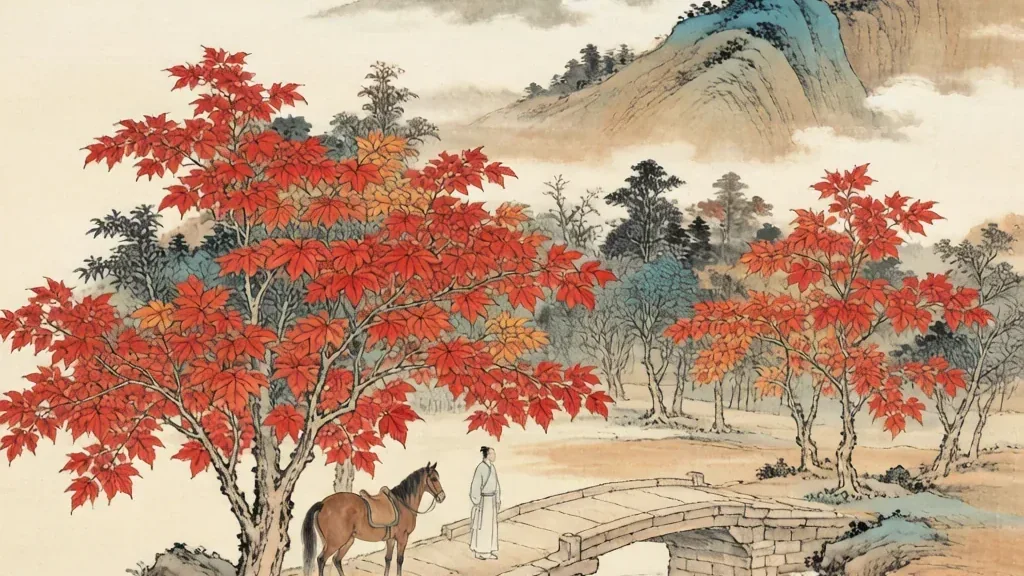
In the twilight decades of the Tang dynasty, when the empire was fractured by rebellion and factional intrigue, poetry found its last great voice in Du Mu (杜牧, Dù Mù, 803–852 CE). Neither as towering as Du Fu nor as ecstatic as Li Bai, Du Mu was instead a poet of poignant elegance — a romantic who wrote about ruined palaces, Yangzhou courtesans, and the autumn mountains with equal lyrical grace. He and his contemporary Li Shangyin are remembered as the "Little Li-Du" (小李杜, xiǎo Lǐ-Dù), the final brilliant pair of Tang masters before the dynasty collapsed and the poetic center of gravity shifted to the Song. His quatrains are among the most memorized poems in China today.
The Frustrated Official
Du Mu was born into a prestigious family in Chang'an (长安, modern Xi'an) in 803 CE. His grandfather Du You (杜佑) had been a high-ranking chancellor under Emperor Dezong, but by Du Mu's generation, the family's political standing had diminished. He passed the jinshi examination in 828 CE at age twenty-five — a respectable but not exceptional result — and entered government service as a proofreader in the imperial library. His career, however, never fulfilled its early promise. The Niu-Li factional strife (牛李党争) that poisoned late-Tang politics trapped him in a series of provincial postings: he served as a secretary in Yangzhou, as magistrate of Huangzhou (黄州) and Chizhou (池州), and as a commissioner in the southern backwaters of Xuanzhou (宣州).
These provincial exiles were the making of him as a poet. Yangzhou (扬州), then as now one of China's most romantic cities, was the site of his most famous love poems. The city's pleasure quarter on the Qinhuai River, with its lantern-lit boats and singing girls, became the setting for a whole cycle of poems about transience and desire. His nickname among his contemporaries was "the romantic" (风流, fēng liú), a label he both cultivated and regretted. In one famous self-mocking poem written late in life, he reflected: "For ten years on the Yangzhou road I was lost, / Winning in the brothels the name of a heartless man" (十年一觉扬州梦,赢得青楼薄幸名). The couplet captures his central paradox: he knew that the pursuit of pleasure was a distraction from political failure, but the resulting poems are so beautiful that posterity has forgiven him completely.
Master of the Quatrain
Du Mu's enduring fame rests largely on his jueju (绝句, quatrains), the four-line form that demands maximum compression and precision. No Tang poet after Li Bai handled the jueju with more grace. His most famous poem, "Mooring on the Qinhuai River" (泊秦淮, bó qín huái), written during a sleepless night on a boat near the Qinhuai River, captures his characteristic blend of sensuousness and historical grief: "Smoke veils the cold water, moonlight veils the sand. / I moor at night near the Qinhuai where the taverns stand. / The singing girl does not know the sorrow of a fallen land — / Still she sings 'Hind Flowers' across the river, hand in hand." The "Hind Flowers" (后庭花, hòu tíng huā) was a song composed by the last emperor of the Southern Chen dynasty, whose debauchery led to his downfall. Du Mu's poem is simultaneously a beautiful night scene, a lament for the Tang dynasty's own decline, and a subtle criticism of pleasure-seekers who ignore political danger.
His quatrain "Clear and Bright" (清明, qīng míng) is among the most recited poems in China, taught to every schoolchild during the Qingming Festival. It describes a traveler caught in drizzling rain who asks a shepherd boy where to find a tavern. The boy points to a distant village apricot-blossom-screened inn. The poem is deceptively simple — its power lies in what it leaves out, the way a single finger-pointing gesture evokes an entire landscape. Another quatrain, "On a Walk in the Mountains" (山行, shān xíng), paints a brief but indelible image: "Far up the cold mountain path the rocks slant steep; / Deep in the white clouds there are homes where people keep. / I stop my carriage to sit and watch the maple grove — / The frosted leaves are redder than the flowers of February." The reversal in the last line — frost leaves more vivid than spring flowers — is characteristically Du Mu: beauty is most intense at the edge of decay.
The Epang Palace and Historical Prose
Du Mu was not only a poet but also a prose master in the ancient-style (古文, gǔ wén) revival. His most famous prose work is "Epang Palace" (阿房宫赋, ē páng gōng fù), a long poetic essay describing the legendary palace built by the First Emperor of Qin. The Epang Palace was said to be so vast that it covered the entire hillside, its towers "touching the sun above and blocking the wind below." Du Mu describes its construction in breathtaking detail — the timber stripped from whole forests, the forced labor of millions — and then pivots to its destruction: the palace was burned to the ground within a year of the Qin collapse. The essay's moral is unambiguous: an empire built on cruelty will not stand, no matter how magnificent its monuments. This was a thinly veiled warning to the late-Tang emperors, who were repeating the Qin dynasty's mistakes.
"Epang Palace" became one of the most influential prose works in Chinese literature. It was memorized by generations of scholar-officials and frequently cited as a model of political allegory. Its vivid imagery — "the smoke of the kitchen hearths of the palace ladies / was a fog that darkened the sky" — shows Du Mu's poetic sensibility operating even in prose. The essay also established the fu (赋, rhapsody) form as a vehicle for political criticism, influencing later writers from Su Shi to the Qing reformers.
A Romantic in a Falling Age
Du Mu's poetry captures the mood of a dynasty in its final decline — the sense that all glory is already past and only the shell of former greatness remains. His poems about historical sites are elegies for the whole Tang world. Visiting the Red Cliff (赤壁, chì bì) where the famous battle of the Three Kingdoms was fought, he imagines how different history would have been "if the east wind had not favored Zhou Yu" — a gentle reminder that chance governs human affairs more than talent or ambition. Mourning at the ancient palace of the Jin dynasty, he writes, "Below the castle, the river still flows east. / The grasses by the palace wall grow thickeach year." The river and the grass are indifferent to the fall of dynasties; only the poet remembers.
Du Mu's legacy was secured during the Song dynasty, when his poems were collected and widely anthologized. The great Song poet Su Shi admired his ability to "paint scenes and feelings in the same brushstroke." The Ming anthologist Shen Deqian (沈德潜) ranked his jueju second only to Li Bai's. In modern China, Du Mu's poems remain staples of primary education, and "Clear and Bright" is sung as a folk song during the Qingming Festival. He is the poet of golden afternoons and autumn mountains — the one who teaches Chinese schoolchildren that beauty and sorrow are the same thing seen from different angles, and that the best response to a crumbling world is to write a poem so perfect that the crumbling stops, for a moment, to listen.