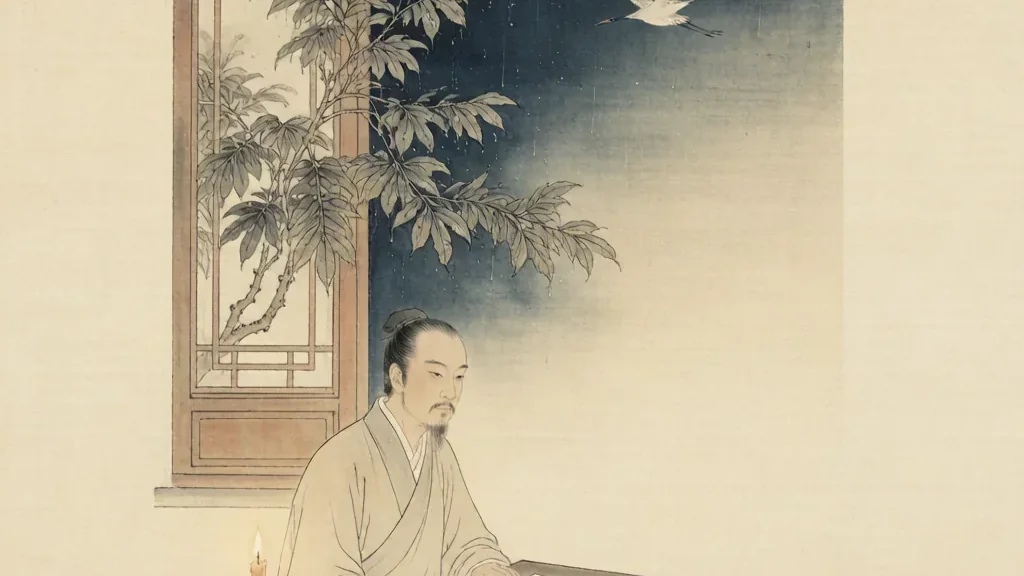
Among the great poets of the Tang dynasty, Li Shangyin (李商隐, Lǐ Shāngyǐn, 813–858 CE) stands as the most elusive. Where Li Bai is direct in his ecstasy and Du Fu direct in his grief, Li Shangyin is deliberately oblique — a poet of veiled references, untitled love poems, and lines that shimmer with multiple, contradictory meanings. He wrote during the twilight of the Tang, when the dynasty was decaying from within, and his poems capture the mood of an age that had lost its confidence. His "Ornamented Zither" (锦瑟, jǐn sè) is considered the most beautiful and the most uninterpretable poem in the Chinese language, and his "Untitled Poems" (无题诗, wú tí shī) have inspired a millennium of passionate commentary.
A Career Broken by Factional Strife
Li Shangyin was born in 813 CE in Qinyang (沁阳, modern Henan), into a minor official family that had known better days. His father died when he was nine, forcing him to grow up quickly and take responsibility for his mother and siblings. He was a brilliant student and passed the jinshi examination in 837 CE at age twenty-four, but his career was immediately entangled in the vicious Niu-Li factional strife (牛李党争, Niú Lǐ dǎng zhēng) that paralyzed late-Tang politics.
The catastrophe was this: Li Shangyin's early patron, Linghu Chu (令狐楚), was a leader of the Niu faction (牛党). But after passing the exams, Li Shangyin married the daughter of Wang Maoyuan (王茂元), a high official affiliated with the Li faction (李党). In the brutal logic of Tang factionalism, this was an unforgivable betrayal. The Niu faction saw him as an ingrate who had married into the enemy camp; the Li faction never trusted him because of his Niu connections. For the rest of his life, Li Shangyin was passed over for promotion, sent to provincial backwaters, and denied the central court appointment his talents deserved. He served in minor posts in places like Guangxi, Sichuan, and Jiangsu, always hoping for recall to Chang'an — and always disappointed. He died in 858 CE at age forty-five, still in provincial exile, one of the most brilliant poets of his generation unrecognized by his own government.
The Poetics of Ambiguity
Li Shangyin's poetry is defined by what it withholds. His most famous works are the "Untitled Poems" (无题诗, wú tí shī) — love poems that he refused to give titles, thereby refusing to fix their meaning. Are they about a forbidden love affair? A political allegory addressed to a lost patron? A religious meditation on separation? The poems resist all single answers. This opening couplet from his most famous untitled poem sets the tone: "It is hard to say goodbye — hard to meet again. / The east wind has no power; the hundred flowers wither" (相见时难别亦难,东风无力百花残). The poem's central image — "The spring silkworm's thread ends only when death comes" (春蚕到死丝方尽) — is a pun: the word for "silk thread" (丝, sī) sounds identical to the word for "longing" (思, sī). The silkworm spins silk until it dies; the lover longs until death. The pun, untranslatable in English, creates a density of meaning that feels almost symphonic.
Li Shangyin was a master of the seven-character regulated verse (七言律诗, qī yán lǜ shī), the most demanding form in Tang poetry. Within its strict tonal and parallel constraints, he created lines that are grammatically ambiguous — a single couplet can be read as three or four different sentences, each yielding a different emotional register. This was not carelessness but technique: he was the first Chinese poet to understand ambiguity as a deliberate artistic resource, a way of making language bear the weight of contradictory experience.
The Ornamented Zither: China's Most Enigmatic Poem
Li Shangyin's "Ornamented Zither" (锦瑟, jǐn sè) is — if consensus is possible — the single most commented-upon poem in Chinese literature. It begins: "The ornamented zither, for no reason, has fifty strings. / Each string, each bridge, recalls a youthful year" (锦瑟无端五十弦,一弦一柱思华年). The zither with fifty strings is a reference to the legendary instrument of the Yellow Emperor's musician, but it is also a coded reference to Li Shangyin himself — at age fifty (he died at forty-five, close enough for poetic license), looking back on a wasted life. The next two couplets pile allusions to the ancient philosopher Zhuangzi dreaming of a butterfly, the tears of the Shaman goddess on the emerald-green water, the moon over the coral sea, and the sun warming the mica stone. Each image is drawn from a different legend, and their juxtaposition produces an effect of overwhelming beauty and overwhelming loss.
The final couplet is devastating: "This feeling might have been remembered with regret, / But even then it was already bewildering" (此情可待成追忆,只是当时已惘然). The poem refuses to say what "this feeling" was — lost love, wasted talent, the irrecoverable past in general. By leaving the referent blank, Li Shangyin makes the poem universally available: every reader fills the gap with their own regret. Wang Shizhen (王士禛), the Qing dynasty critic, wrote that reading the "Ornamented Zither" was like "trying to understand the stars by counting their reflections in a thousand separate pools of water."
Innovations in Poetic Form
Beyond his untitled poems, Li Shangyin made significant contributions to the yongwu (咏物, "singing of things") tradition — poems about objects that function as allegories for the self. His poem on the "Cicada" (蝉, chán) describes the insect's desperate singing as a metaphor for the hungry poet unable to win recognition: "You sing to the highest sky from the tallest branch, / But your voice reaches no ear that can reward you." His erotic poems about palace ladies and Taoist priestesses pushed against the boundaries of conventional Tang decorum, hinting at affairs in such coded language that scholars still debate basic biographical facts.
He also experimented with ancient-prose (古文, gǔ wén) poetry, a form that was being revived by his contemporaries Han Yu and Liu Zongyuan. His longer narrative poems, though less famous than his lyrics, show a sophisticated engagement with history, mythology, and the condition of women in late-Tang society. In "Sui Palace" (隋宫, suí gōng), he writes about the doomed extravagance of Emperor Yang of the Sui dynasty, using the emperor's pleasure canal as a figure for imperial overreach — a barely concealed critique of his own late-Tang rulers.
Li Shangyin's Legacy: The Poet's Poet
Li Shangyin was neglected immediately after his death — his dense style went against the late-Tang taste for simplicity, and his political disgrace meant few dared to praise him. But his reputation underwent a remarkable revival during the Song dynasty, when poets like Wang Anshi (王安石) and Huang Tingjian (黄庭坚) championed his work as a model of craft and depth. Wang Anshi said that Li Shangyin was the equal of Du Fu, a radical judgment at the time. During the Ming and Qing dynasties, the "Untitled Poems" became the subject of a vast exegetical literature, with scholars producing competing interpretations of almost every line.
In the 20th century, Li Shangyin's ambiguity found new audiences in the West and in modern China. The American poet Ezra Pound translated some of his poems (through the notes of Ernest Fenollosa), and critics compared his deliberate obscurity to T.S. Eliot and Paul Valéry. In China, the great modern writer Lu Xun (鲁迅) wrote that Li Shangyin was "the only Tang poet whose work feels modern" — a judgment that still echoes in contemporary Chinese literary criticism. Today, the "Ornamented Zither" remains a rite of passage for every serious student of Chinese poetry, and Li Shangyin is recognized as the most psychologically complex poet of the Tang dynasty — the one who understood that some feelings are too tangled to be named.