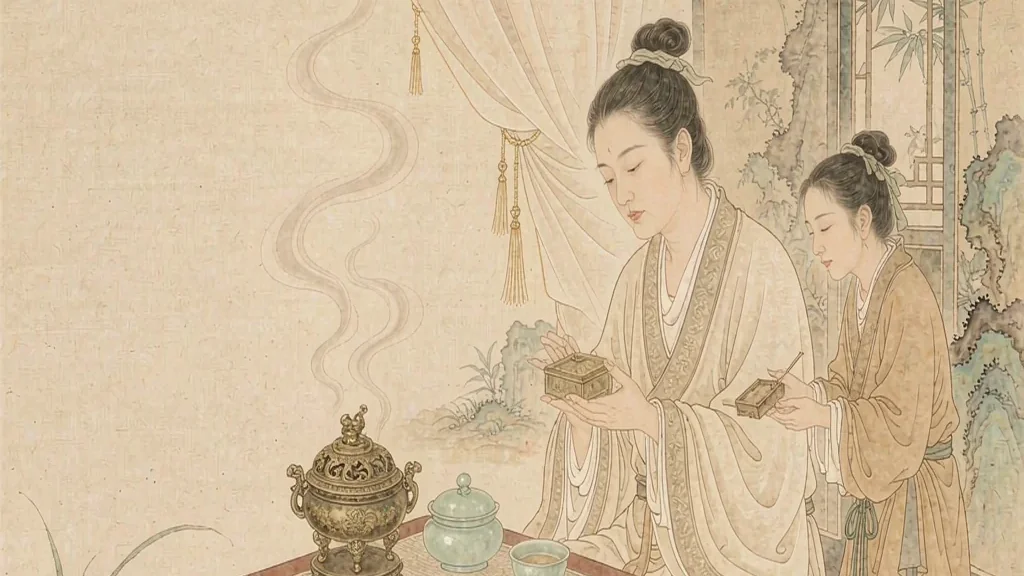
Scent and sound are the two invisible arts of Chinese poetry, and the tradition treats them as kin. The word 香 (xiāng) means fragrance, and it names both the incense burned in palace and monastery and the natural perfume of orchid, lotus, and plum that poets loved to cite; the word 韵 (yùn) means rhyme, resonance, and the lingering flavor of a line. Together they describe a poetry meant to be inhaled and heard at once, a verse in which the censer's smoke and the poem's music rise together. This article explores the place of incense and fragrance in Chinese verse and the parallel idea of rhyme as the scent of language, showing how the Chinese poet used smell and sound to make a poem linger in the body as well as the mind.
The Censer in the Palace and the Cloister
Burning incense was a fixture of the two institutions that most supported poetry, the court and the monastery. In the palace the golden censer stood in the ladies' quarters and the hall of audience, its smoke a sign of rank and of the slow ritual of the day. In the temple the incense accompanied chant and meditation, marking the hours and perfuming the air in which the monk or the visiting poet composed. Many poems open with the censer's thread of smoke as the visible proof that the scene is one of refined leisure or holy calm.
The poet who writes of incense is therefore also writing of the room that holds it: the screened chamber, the cold stone stairs, the night watch. The smoke becomes a gentle character in the poem, drifting across the lamp, blurring the line between the worldly and the spiritual. Because both palace and monastery burned the same substance, the image could slide easily from desire to devotion, and the finest poems exploit that slide.
Incense as a Measure of Time
A stick or coil of incense burns at a known rate, and so it served the Chinese household as a clock. Poets seized on this: the shortening incense marks the passing of a sleepless night, the wait for a lover, or the vigil beside a sick friend. To say that three sticks of incense have burned is to say that a long stretch of feeling has elapsed without the poet's moving from his seat. The image gives time a smell and a visible length, turning duration into something almost tangible.
The burning censer also measures the distance between people. A woman in the inner chamber notes the incense failing and knows her husband is later still in returning; a monk watches the coil end and knows the night of meditation is done. The fragrance thus carries the weight of patience and of anxiety, two states that Chinese poetry is never tired of distinguishing by the same quiet smoke.
The Natural Fragrance of Flowers
Beyond the censer, the great natural source of fragrance is the flower, and the perfume of orchid, lotus, plum, and cassia recurs as a token of virtue that travels without being seen. The orchid's scent in the empty valley figures the gentleman's reputation carried on the wind; the lotus's cool fragrance figures the awakened mind; the plum's cold sweetness figures integrity in hardship. The poet who writes of a flower's scent is usually making an ethical point by way of the nose.
This natural incense contrasts with the artificial one of the palace. The censer is human craft and signals luxury or ritual; the wild flower's perfume is uncaused and signals innocence. A poem may set the two against each other, the heavy scent of the court against the faint breath of the mountain orchid, and in that contrast the whole debate between wealth and withdrawal is staged as a matter of smell.
Heart Incense and the Offering of Verse
A striking development is the idea of the 心香, the incense of the heart, a metaphor in which sincere feeling itself is the offering, needing no material smoke. Buddhist and later literati poets used the phrase to say that a true thought sent to a friend or a Buddha counts as worship. The poem becomes the censer, and the writer's loyalty the fragrance. This inward turn lets the scent imagery survive even when no literal incense is present.
The heart incense also solves a social problem. The exiled official, far from court and temple, cannot light the proper offerings, but he can claim that his steady mind is its own perfume. The metaphor dignifies absence and turns the impossibility of ritual into a higher form of it. In this way fragrance migrates from the object to the intention, a move typical of the mature poetic tradition.
The Fragrance of the Beloved
In love poetry the scent clings to the person. A woman's sleeve retains the perfume of the orchid or the incense of her room; the poet who has left her can still smell it on a keepsake. The lingering fragrance is the physical proof of presence when the body is gone, and it carries the ache of parting more keenly than a visual memory, because smell is the sense hardest to summon and easiest to lose. The sleeve, the pillow, the fallen handkerchief all keep the scent a little longer than the person stays.
This motif belongs to the broader poetry of the inner chamber, where the furnished room is described by its smells as much as its colors. The cold incense of dawn, when the night's burning has spent, becomes an image of abandonment, the empty censer answering the empty bed. The scent thus records both the fullness of the night and the desolation of the morning after.
Rhyme as the Scent of Language
The second half of our subject is rhyme, and the Chinese tradition has always likened a good rhyme to a good smell. The character 韵 means not only the matching of final sounds but the lingering quality, the aftertaste, of a line. To praise a poem's yùn is to say it keeps breathing after the words stop, much as incense keeps scenting the room after the flame is out. The metaphor is not casual; it reflects a real belief that sound and smell are both modes of diffusion, both ways a thing leaves itself behind.
In regulated verse the rhyme words are fixed at the line ends, and the choice of which rhyme to use shapes the feeling of the whole piece. A bright, open rhyme sounds confident; a closed, dark one sounds grieved. The poet selecting rhymes is therefore like the perfumer blending notes, building an atmosphere from the sounds alone. The ancient rhyme tables and dictionaries that scholars compiled are, in this light, manuals of an invisible art comparable to the mixing of incense.
The Music of the Sung Poem
Classical Chinese poetry was often chanted or sung, and the rhyme carried the tune. The 词 (cí) and 曲 (qǔ) lyrics were written to existing melodies, their rhymes fitted to the rise and fall of the song. The incense-filled room and the musical performance belonged to the same evening: one inhaled the smoke while one heard the line. A poem composed for a courtesan to sing was thus a multisensory object, designed for the nose and the ear together, and its success depended as much on its yùn as on its sense.
The close bond between poem and song meant that rhyme was never merely decorative. It was the hinge between language and music, the point at which words became breath. When the tradition later prized a poem's lingering flavor, it was praising exactly this moment where sound leaves the page and enters the air, like smoke leaving the censer.
Incense, Rhyme, and the Chan Taste
The Chan and Daoist writers refined the pairing toward emptiness. They prized a faint incense rather than a heavy one, and a rhyme that suggests more than it states. The ideal poem, on this view, is like a room with a single thread of smoke and a single clear note: almost nothing, yet enough. The restraint is itself the meaning. A poet who overloaded his verse with scent and sound was judged as lacking in discipline, much as a host who burned too much incense was judged vulgar.
This aesthetic of the sparse connects the two halves of our subject at the deepest level. Both incense and rhyme are valued for what they withhold; both are most powerful when least asserted. The mature tradition asks the poet to leave a trace, not a presence, and the censer and the rhyme are the two instruments by which the trace is made. The poem that ends on a fading sound and a dying smell has done its work.
Incense and Rhyme in the Later Ages
In the Ming and Qing the scholar's studio kept the censer as a companion to writing, and the literary Criticism of rhyme grew into a fine art of judging a poem's flavor. Manuals taught how to match incense to occasion and how to hear a line's resonance, treating both as learned pleasures. The linkage of smell and sound passed into the decorative arts, the garden, and the teahouse, so that the educated person moved through a world scored for nose and ear alike.
The survival of the imagery into modern verse shows how natural it became. To write of a fading scent or a lingering rhyme is still, for a Chinese poet, to reach for the oldest tools of suggestion. The censer may be absent from the modern room, but the habit of letting a poem smell and sound its way into memory remains, and that is the real inheritance of the incense and the rhyme.
The Union of Scent and Sound
What finally joins incense and rhyme is the shared grammar of disappearance. Both rise, both please, both fade, and both are treasured precisely because they do not stay. The Chinese poem is built to exploit this: it offers an image that smells and a line that sounds, then withdraws them, training the reader to value the trace over the thing. In a literature obsessed with transience, the censer and the rhyme are the two teachers of how to love what vanishes, and the frag_ file you are reading is itself a small censer of words, meant to leave a scent behind.
❓ Frequently Asked Questions
How was incense used in Chinese poetic life?
The censer stood in palace and monastery as a sign of rank or devotion, and its smoke opened many poems as proof of refined or holy calm.
What is the heart incense?
The heart incense is a metaphor in which sincere feeling itself is the offering, needing no material smoke, letting the exiled still worship in spirit.
Why is rhyme compared to scent?
The word yùn means both rhyme and lingering flavor, and both sound and smell are ways a thing leaves itself behind after it ends.
How did incense measure time?
Because a stick or coil burns at a known rate, poets used the shortening incense to mark a sleepless night or a long vigil.
How did fragrance mark the beloved's absence?
A kept sleeve or pillow retained the lover's perfume, the scent proving presence when the body had gone and sharpening the ache of parting.
What was the Chan taste in incense and rhyme?
Chan writers prized a faint incense and a suggesting rhyme, valuing the trace over the presence as the true sign of discipline.