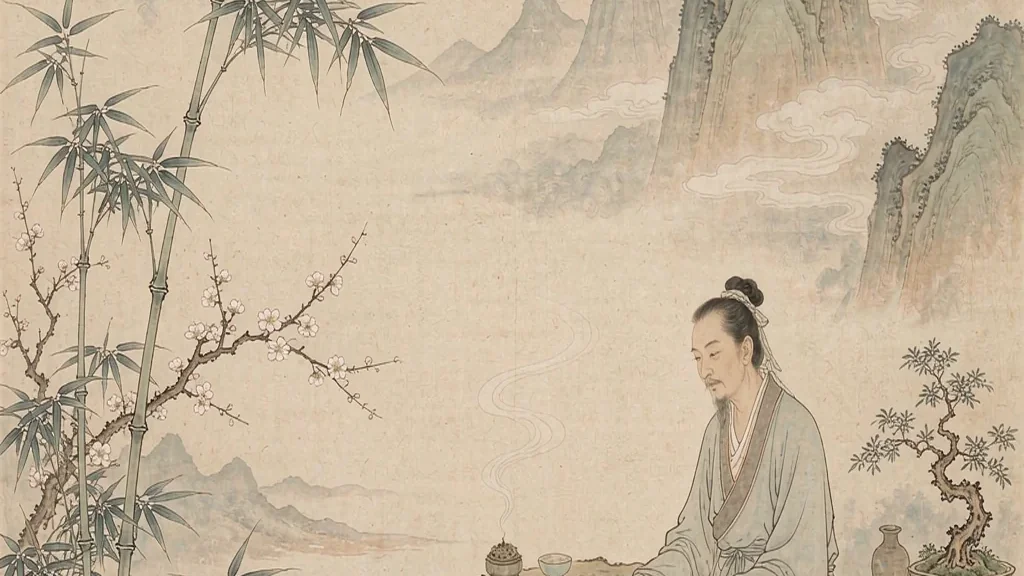
When Chan Buddhism declared that ultimate truth cannot be captured in words, it created a paradox for poets: how can you write poems about something that cannot be said? The answer, as Chan poets from Wang Wei to Hanshan to Su Shi demonstrated, is to write poems that show, not tell — poems that create the conditions for insight rather than explaining what the insight should be. Chan poetry (禅诗, chan shi) is one of the most fascinating strands of the Chinese tradition: a body of verse that systematically undermines confidence in language while producing some of the most beautiful poems in the language.
The Chan View of Language
Chan Buddhism developed from the Indian Mahayana tradition in China, and it inherited a deep suspicion of language. The mind discriminates, categorizes, and conceptualizes — and in doing so, it creates the illusion of a separate self and a separate world. Liberation means seeing through this illusion, and language, which is the very instrument of discrimination, is more often an obstacle than an aid. The Chan master does not explain; he points, shouts, or simply remains silent.
Yet Chan produced a vast literature. The paradox was resolved by a distinction between two kinds of language: the language that describes and explains (which is useless for enlightenment) and the language that evokes and points (which can be useful). Chan poetry belonged to the second category. A Chan poem does not tell you what reality is like; it invites you to see for yourself. The poem is a finger pointing at the moon — you must not mistake the finger for the moon.
Wang Wei: Poetry as Silent Illumination
Wang Wei (王维, 699–759 CE) was a devout Chan Buddhist layman, and his poetry is the supreme expression of Chan principles in verse. His poems do not preach or explain; they simply present the world with such clarity that the reader might, for a moment, see it as it really is. In 'Deer Enclosure': 'Empty mountain not seeing anyone, / only hearing echoes of people's voices. / Reflected light enters the deep forest, / again shining on the green moss.' The poem is not about Chan; it is Chan — a direct presentation of reality as perceived by a mind that has stopped grasping.
Wang Wei's technique is one of radical simplification. He strips away all conceptual commentary, all explicit emotion, all evaluation. He gives us only the empty mountain, the echoing voices, the light on the moss. The meaning — if that is even the right word — emerges from the relationship between these elements, not from anything the poet says about them. The reader who tries to 'understand' the poem conceptually will miss the point. The reader who simply experiences it — who sees the moss, hears the echo — has already understood.
Hanshan: The Hermit of Cold Mountain
Hanshan (寒山, 'Cold Mountain') is the most famous Chan poet-recluse of the Tang. His poems are written in a deliberately rough, colloquial style that contrasts with Wang Wei's elegant spareness. Hanshan's voice is that of a wild man who has seen through the pretenses of society and who speaks with shocking directness: 'Men these days / look for truth in books and words. / But the truth is not in books — / it is in the cold mountain stream.' The poems are often funny, sometimes crude, and always uncompromising.
Hanshan's poems are full of Chan paradoxes. He tells the reader that the Way cannot be found by seeking, that the truth is in plain sight but invisible, that the enlightened person is just an ordinary person who has stopped worrying. His most famous poem begins: 'People ask the way to Cold Mountain. / But Cold Mountain is not a road you can follow.' The poem is itself a teaching: the search for truth is the very thing that prevents you from finding it.
Su Shi and the Chan of Everyday Life
The Song dynasty master Su Shi (苏轼) was not a Chan monk but was deeply influenced by Chan thought. His Chan poems differ from Wang Wei's and Hanshan's in their subject matter: where Wang Wei wrote about empty mountains and Hanshan about mountain caves, Su Shi found Chan insight in the ordinary activities of daily life. His poem 'Written on the Wall of the West Forest Temple' uses the experience of viewing a mountain from different angles to illustrate the Chan teaching that there is no single, objective perspective.
Su Shi's 'Night Sailing on the Yangzi' describes a boat trip during which the poet realizes that the distinction between motion and stillness is an illusion created by the mind. 'The boat is not moving — the shore is moving. / We are both still, and both in motion.' These lines could be taken from a Chan meditation text. Su Shi's genius was to find Chan insight in the most ordinary experiences — a boat ride, a cup of wine, a conversation with a friend — and to express it in language of luminous clarity.
The Legacy of Chan Poetry
Chan poetry has had an enormous influence beyond the Buddhist tradition. Its techniques — the use of concrete imagery to evoke transcendent states, the preference for suggestion over statement, the willingness to use paradox — entered the mainstream of Chinese poetry and shaped the aesthetic values of the entire tradition. Even poets who were not Buddhists wrote poems that used Chan techniques, because Chan had become a universal language for talking about what cannot be said.
In the West, Chan poetry has been a major influence on the Beat Generation and on contemporary American poetry. Gary Snyder's translations of Hanshan, Jack Kerouac's 'The Dharma Bums,' and the poetry of Allen Ginsberg all show the influence of Chan poetics. The appeal of Chan poetry in the West is not hard to understand: in an age of noise and information overload, the Chan poem's quiet insistence on direct experience feels like a liberation. The empty mountain still echoes, and the moss is still green.
The Training Case and the Poem
The public case is the training tool most associated with Chan, and it shares the logic of Chan poetry. A case presents a knot that cannot be untied by reason — a master's shout, a meaningless question, a contradiction. The Chan poem works the same way: it offers an image or a silence that short-circuits explanation. Both aim not to inform but to awaken, trusting that the failure of language is itself the lesson.
Chan and the Southern School of Painting
Chan aesthetics moved naturally into ink painting. Southern School painters, many of them Chan adepts, used sparse, wet brushwork to suggest rather than depict, letting empty space carry meaning. The same taste for restraint, suddenness, and the unspoken that defines Wang Wei's poetry defines these paintings. A single reed or a distant peak could stand for the whole landscape of mind.
Sudden Versus Gradual Enlightenment
One of the great debates in Chan was whether awakening is sudden or gradual. The southern strain, following the Sixth Patriarch, insisted that enlightenment could arrive in an instant, like a mirror suddenly cleared. The northern strain favored step-by-step cultivation. This dispute echoes in poetry: some poets describe a long discipline of attention, while others claim the truth was always already there, waiting to be noticed.
❓ Frequently Asked Questions
📝 Chinese Vocabulary
禅诗 — : Chan poetry; Buddhist verse pointing toward enlightenment
寒山 — : Hanshan (Cold Mountain); the wild hermit-poet of the Tang
空 — : Kong; emptiness — the central concept of Chan philosophy
顿悟 — : Dunwu; sudden enlightenment — the goal of Chan practice
公案 — : A paradoxical story or question used as a training device in Chan practice
菩提 — : Bodhi; awakening or enlightenment
无言 — : Wordlessness; the state beyond speech prized in Chan
机锋 — : The sharp, sudden exchange of question and reply between a Chan master and student
🎉 Fun Facts
- Wang Wei was given the title 'Layman of the Most Perfect Truth' (最上乘居士) by his Chan teacher.
- Hanshan is said to have disappeared at the end of his life — he walked into a cave in Cold Mountain, and the cave closed behind him.
- Su Shi wrote his most famous Chan-inspired poem, 'Written on the Wall of the West Forest Temple,' while living in exile at Huangzhou.
- The Japanese term for a paradoxical training riddle is simply the Japanese pronunciation of the Chinese term for a public case or record used in meditation.
- Chan monasteries often held sessions in which monks tested each other with rapid paradoxical replies, a kind of verbal fencing meant to expose attachment to logic.
- The Platform Sutra, attributed to the Sixth Patriarch, is the only Chinese Buddhist text honored with the title of sutra, reflecting the uniquely Chinese character of the Chan school.