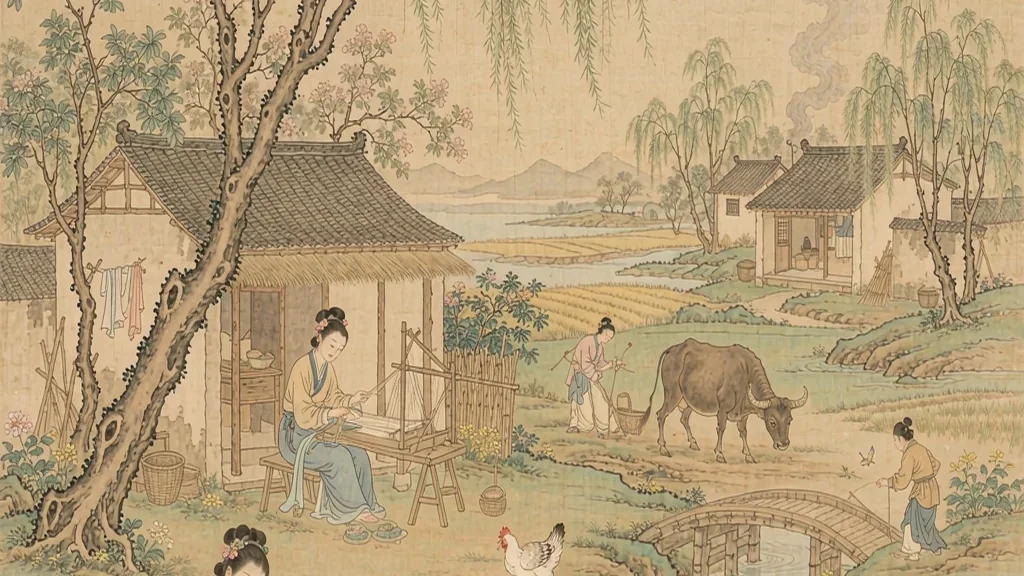
If landscape poetry (shanshui shi) takes you to the peaks of sacred mountains and the banks of rushing torrents, its gentler sister — pastoral poetry (田园诗, tianyuan shi) — invites you to a quieter place: a vegetable garden after rain, a farmhouse where wine is being heated, a path through mulberry trees leading to a village of a few dozen households. Chinese pastoral poetry celebrates the ordinary, the humble, and the close-at-hand. Its greatest practitioner, Tao Yuanming, discovered in the cycles of planting and harvest, in the company of old farmers and neighborhood children, a depth of meaning that grander subjects could not provide. The pastoral tradition reminds us that the most profound poetry often comes from the simplest circumstances.
Tao Yuanming: The Founder of Pastoral Poetry
The pastoral tradition in Chinese poetry begins with one man: Tao Yuanming (陶渊明, 365–427 CE, also known as Tao Qian). After holding a minor official post for less than three months, Tao resigned, declaring that he would not 'bend his back for five pecks of rice a year.' He returned to his ancestral farm, where he lived as a gentleman farmer for the remaining twenty-two years of his life. His poems about farming, drinking wine, reading books, and raising his children created a new subject for Chinese poetry: the beauty and difficulty of ordinary life.
Tao's most famous prose work, 'The Peach Blossom Spring' (桃花源记), tells of a fisherman who stumbles upon a hidden utopian village where people live in perfect peace, unaware of the wars and dynasties outside. The story is an allegory of the pastoral ideal: a life of simplicity, community, and harmony with nature, untouched by ambition and politics. But Tao's poems themselves are more honest than the allegory. He writes about failed harvests, house fires, sick children, and the loneliness of old age. His pastoralism is not naive — it is a choice made in full awareness of its costs.
The Art of Simplicity
The most striking feature of Tao Yuanming's poetry is its plainness. His vocabulary is everyday, his syntax is straightforward, and his subjects are deliberately undramatic: 'Planting beans below the southern mountain: / the grass grows lush, the bean shoots are sparse. / I rise at dawn to clear away the weeds / and return, carrying my hoe, under the moon.' The Chinese critic Su Shi said that Tao's poetry seemed 'bland' (淡, dan) but that this blandness was the highest artistic achievement — like plain rice, it nourishes without exciting, and its flavor deepens with familiarity.
This aesthetic of blandness, or pingdan (平淡), became a central value in later Chinese poetry and painting. It is an art that hides its art, that appears effortless while being the product of immense discipline. Tao Yuanming's poems appear simple, but their simplicity is the result of extraordinary compression and control. Every character is exactly right; nothing could be added or removed. His poetry taught Chinese writers that the deepest truths are not shouted but whispered.
Wang Wei and Meng Haoran: The Tang Pastoral
The Tang dynasty's two great nature poets, Wang Wei and Meng Haoran, were both deeply influenced by Tao Yuanming. Meng Haoran's 'Passing the Old Friend's Farmstead' is perhaps the perfect Tang pastoral poem: 'My old friend prepared chicken and millet / and invited me to his farmhouse. / Green trees surround the village; / beyond the blue mountains slopes the city wall. / We open the window facing the field and garden / and talk, over wine, of the mulberry and hemp. / We agree to meet again / when the Double Ninth Festival comes.'
Wang Wei's pastoral poems often depict his estate on the Wang River, where he lived as a semi-recluse after the An Lushan Rebellion. His 'Pastoral Song' series describes the daily rounds of farm life with a calm attentiveness that Tao Yuanming would have recognized: 'The shepherd boy whistles and the cattle return; / the hunter on horseback brings home his game. / We look at each other without speaking: / what need for worldly talk?' Wang Wei's Buddhist tranquility gives his pastoral poems a meditative quality that Tao's more robust temperament did not have.
Fan Chengda: The Song Dynasty Farmer
The Song dynasty poet Fan Chengda (范成大, 1126–1193 CE) took the pastoral tradition in a new direction with his famous series 'Four Seasons of Fields and Gardens' (四时田园杂兴). Unlike Tao Yuanming, who wrote about farming from the perspective of a retired gentleman, Fan wrote from the perspective of a real farmer — or as close to one as a scholar-official could get. His poems describe the specific labors of each season: planting rice in spring, weeding in summer, harvesting in autumn, repairing tools in winter.
Fan's poems are notable for their detailed observation of farming techniques. He explains how to transplant rice seedlings, how to manage irrigation, how to determine when the crops are ready for harvest. But he also captures the emotional life of the farming community: the anxiety before a storm, the joy of a good harvest, the grief of a family whose son has been conscripted. Fan Chengda's pastoral poetry is both a document of Song agricultural life and a meditation on the dignity of labor.
The Pastoral Ideal in Chinese Culture
The pastoral ideal — the dream of a simple life close to nature — has been one of the most persistent themes in Chinese culture. It shaped not only poetry but also painting, garden design, and the philosophy of eremitism. Every educated Chinese person knew Tao Yuanming's story of the Peach Blossom Spring, and many dreamed of finding their own hidden valley. The pastoral ideal provided an alternative to the competitive world of officialdom — a spiritual refuge to which the frustrated scholar could always retreat, if only in imagination.
In the modern era, the pastoral tradition has taken on new meanings. Industrialization and urbanization have made the country life that Tao Yuanming celebrated seem more distant and more precious. Contemporary Chinese poets continue to write in the pastoral mode, though often with a note of elegy — the fields their grandparents farmed have become factories and shopping malls. The pastoral ideal has become, in part, a form of cultural memory, a way of holding onto a world that is disappearing. But Tao Yuanming's poems endure, and every spring, somewhere in China, someone plants beans under the southern mountain.
The Farmer's Eye: Labor in Pastoral Verse
Pastoral poetry is not only about leisure; at its best it honors work. Tao Yuanming writes of rising at dawn to clear weeds and carrying his hoe home by moonlight, treating labor as part of a good day rather than a burden to escape. Fan Chengda goes further, detailing the tasks of each season, how rice seedlings are moved, how water is managed, how the crop is judged ready. These poems give dignity to the farmer's body and schedule, showing that the rural year is a discipline as exacting as any office. They also record the village's emotional weather, the dread of a coming storm, the relief of a full granary, the grief when a son is conscripted. By taking the field seriously, pastoral verse refuses the fantasy that the country is merely a view. The labor it describes is what makes the peace real, and the best pastoral poets know that rest tastes best after the hoe.
Gardens as a Portable Pastoral
Not every lover of the fields could leave the city, so the garden became a way to carry the pastoral inward. Scholar-officials laid out private gardens that compressed mountain, water, and rock into a few square yards, and they wrote poems about these small scenes with the same care given to wild ranges. A single stone could stand for a peak, a narrow pond for a lake, a winding corridor for a mountain path. The garden let a busy official keep a piece of nature inside the wall and retreat to it after court, a portable refuge that asked no travel. Poems on the garden treat the miniature with full seriousness, proving that scale was never the point of pastoral feeling. This taste joined landscape verse to the art of the scholar's garden, where design and poem were one act of attention. The portable pastoral shows that the country could be summoned anywhere by a mindful eye.
Pastoral, Eremitism, and the Scholar's Choice
In China the pastoral was never only a style; it was a decision. To write of fields and gardens was often to announce a refusal of official ambition, a choice to retire rather than bow. Tao Yuanming's walk away from his post became the archetype, the model of integrity over comfort that later scholars invoked when disappointed at court. Eremitism and pastoral thus share a root, the belief that a simple life close to nature is truer than a career of intrigue. The choice was practical as well as moral, since retirement farms and gardens offered real places to go. The tradition thereby gave the frustrated official a spiritual exit, available even in imagination when circumstances blocked the door. Pastoral verse is the literature of that exit, the repeated assurance that one can, if need be, lay down the rank and pick up the hoe, and be the better for it.
❓ Frequently Asked Questions
📝 Chinese Vocabulary
田园诗 — : Pastoral poetry; field-and-garden verse
陶渊明 — : Tao Yuanming; founder of Chinese pastoral poetry
桃花源 — : Peach Blossom Spring; Tao's utopian allegory of the simple life
平淡 — : Pingdan; the aesthetic of 'blandness' or deliberate plainness
归园田居 — : Returning to Live in the Country; Tao Yuanming's famous pastoral sequence on leaving office for the farm.
范成大 — : Fan Chengda; the Song poet who wrote pastoral verse from the farmer's point of view.
四时田园杂兴 — : Four Seasons of Fields and Gardens; Fan Chengda's sixty-poem series on the farming year.
五斗米 — : Five pecks of rice; the salary Tao Yuanming refused to bow for, now a byword for integrity.
🎉 Fun Facts
- Tao Yuanming's farm was destroyed by fire in 408 CE, leaving him and his family homeless. His poems after the fire are among his most moving.
- The phrase 'five pecks of rice' (五斗米) — the salary Tao refused to bow for — became a byword in Chinese for integrity over comfort.
- Fan Chengda's 'Four Seasons of Fields and Gardens' consists of sixty poems, fifteen for each season.
- Tao Yuanming's Returning to Live in the Country opens with a famous line about freeing himself from the dusty cage of official life.
- The Peach Blossom Spring ideal proved so powerful that it became a standard shorthand for utopia in later Chinese art and fiction.
- Keeping a retirement farm was a real option for scholar-officials, who could withdraw to it after a career, making the pastoral a practical as well as poetic choice.