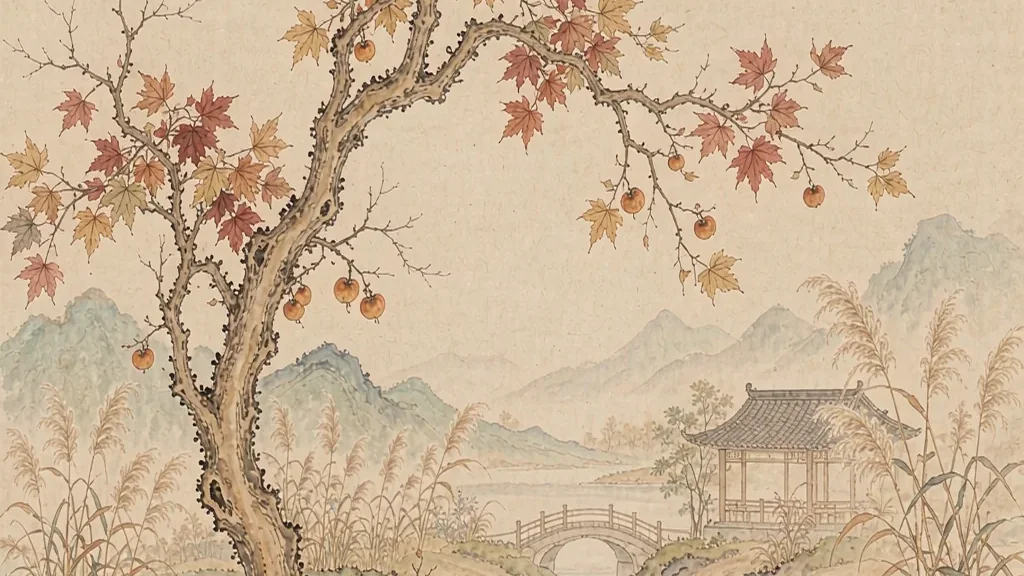
In China, autumn is the season of poetry. The spring may be the season of love and the summer the season of action, but autumn — with its clear skies, its falling leaves, its harvest moons, and its first chill in the air — is the season of reflection. Chinese poets have written more poems about autumn than about any other season, and the autumn poem (秋诗, qiu shi) is one of the most important genres in the tradition. Autumn in Chinese poetry is not merely a season; it is a state of mind, a philosophical condition, a vantage point from which the whole of life can be seen.
Autumn as the Season of Melancholy
The dominant tone of Chinese autumn poetry is melancholy. The shortening days, the dying vegetation, the migration of birds, and the sound of the wind in the bare trees all speak of loss and ending. The Chinese word for autumn, qiu (秋), is etymologically related to the word for sorrow, chou (愁). The poet sees in autumn the approach of winter — the end of the year, the end of youth, the end of life. Du Fu's 'Autumn Meditation' series begins: 'The jade dew withers and wounds the maple forest. / Over Witch Mountain and Witch Gorge, the air is desolate.'
But autumn melancholy in Chinese poetry is not mere sadness. It is a clarified sadness — a sadness that has been distilled by the cool air of autumn into something almost beautiful. The Tang poet Liu Yuxi (刘禹锡, 772–842 CE) wrote a poem that directly challenges the convention of autumn sorrow: 'Since ancient times, autumn has been sad and lonely. / But I say autumn is better than spring. / A crane flies into the clear sky above the clouds / and brings my poetic feeling to the blue heavens.'
Du Fu's 'Autumn Meditations': The Greatest Autumn Poems
Du Fu's 'Autumn Meditations' (秋兴八首), a series of eight linked lüshi poems, is the greatest achievement in Chinese autumn poetry. Written in 766 CE, when Du Fu was living in Kuizhou on the Yangzi River, the poems meditate on the poet's exile, the passing of time, the decline of the Tang empire, and the beauty of the autumn landscape. Each poem is a masterpiece of regulated verse, and together they form an extended meditation on loss.
The poems are held together by recurring images: the jade dew, the withered maple forest, the solitary boat, the white hair of the poet. The third poem describes Du Fu's daily life in exile: 'Thousands of households on the mountain — the morning sun is peaceful. / Every day, I sit in the study and watch the blue hills. / The fishermen in the river float on the invisible tide; / the swallows in autumn fly lightly in the cold wind.' The peacefulness of the scene is deceptive; beneath it, the poet is wrestling with the knowledge that he will never return home.
Autumn in Ci Poetry
The ci form of the Song dynasty was particularly suited to autumn themes. The irregular line lengths allowed poets to capture the rhythms of autumn — the changes in the wind, the falling of leaves, the ebb and flow of feeling. The Song dynasty's greatest autumn poem is a ci by Fan Zhongyan (范仲淹, 989–1052 CE) to the tune 'Su Curtain Covering' (苏幕遮): 'The blue sky is streaked with yellow leaves on the ground. / Autumn colors spread across the waves; the waves are cold and green. / The reflection of the mountains in the river touches the sky. / The grass is without feeling, fading beyond the setting sun.'
The final couplet of Fan Zhongyan's poem — 'Alone, the traveler is lost in dreams; / the night deepens, and the person he dreams of is far away' — expresses the loneliness of the autumn exile with a simplicity that is heartbreaking. Li Qingzhao's autumn ci are also famous for their capture of the season's melancholy.
Autumn and the Philosophy of Impermanence
Autumn in Chinese poetry is inseparable from the Buddhist concept of wuchang (无常, impermanence). The falling leaf, the fading flower, the shortening day — all are reminders that everything passes, that attachment to anything is a source of suffering, and that wisdom lies in acceptance. The poet does not merely observe this; he feels it in his bones, and the poem is the record of that feeling.
The Song poet Su Shi understood this deeply. In his 'Autumn Night Song,' he writes: 'The autumn wind enters the courtyard, / blowing the leaves from the trees. / The wanderer looks at the moon in the sky; / his white hair catches the chill of the frost. / Life is like a dream — / how many autumns can a person see?' The question is rhetorical, and the answer — not many — is the poem's truth. Su Shi's greatness as a poet is his ability to face this truth without flinching and without despair.
Autumn Harvest and the Pleasures of the Season
Not all autumn poems are about melancholy. Some celebrate the pleasures of the season: the clear skies, the cool weather, the harvest, the chrysanthemums in bloom. Tao Yuanming's autumn poems, written on his farm, describe the satisfaction of bringing in the harvest: 'I planted beans below the southern mountain; / the grass flourished and the bean sprouts were sparse. / I rose at dawn to clear the weeds; / I came back under the moon carrying my hoe.' The autumn harvest is a time of fulfillment, not decline.
The chrysanthemum (菊花, juhua) is the flower of autumn, and its blooming during the season of decline made it a symbol of the recluse who flourishes when others fade. Tao Yuanming's love for chrysanthemums — 'Picking chrysanthemums by the eastern fence, / I see the southern mountain in the distance' — established the flower as autumn's emblem. The autumn poem is not only about dying; it is also about the beauty that only appears when everything else is ending.
Autumn in the Solar Terms
In the traditional Chinese calendar, autumn is not a vague mood but a measured sequence of solar terms. It begins at Start of Autumn and moves through White Dew, Autumn Equinox, Cold Dew, and Frost's Descent before winter begins. Poets keyed their verses to these markers: the first chill, the condensation on grass, the hardening frost. This precision gave autumn poetry a rhythmic structure, so that a poem might turn on the moment the dew whitens or the day the chrysanthemum survives its first frost.
The Maple and the Chrysanthemum
Two plants carry the weight of autumn symbolism. The maple, whose leaves turn crimson as the cold deepens, appears in Du Fu's Autumn Meditations as a sign of wounded beauty. The chrysanthemum, blooming when nearly everything else has faded, became the emblem of the recluse who thrives in decline, thanks to Tao Yuanming's famous lines. Together they frame autumn's double lesson: that beauty is most intense as it passes, and that some lives flower precisely in the cold.
Women Poets and the Autumn Mood
Autumn was not only a male register. Women poets, especially in the Song dynasty, used the season to voice confinement and longing. Li Qingzhao's autumn lyrics transform falling leaves and the west wind into images of a widow's empty chamber. The season let women writers articulate grief that social convention often silenced, and their autumn poems remain among the most psychologically acute in the tradition.
❓ Frequently Asked Questions
📝 Chinese Vocabulary
秋诗 — : Autumn poetry; the season of reflection in verse
秋兴八首 — : 'Eight Autumn Meditations'; Du Fu's masterpiece series
菊花 — : Chrysanthemum; the flower of autumn and the recluse
无常 — : Wuchang; impermanence — the philosophical heart of autumn poetry
悲秋 — : Mourning autumn; the long literary tradition of poems lamenting the season's decline
重阳 — : The Double Ninth Festival, a ninth-month autumn holiday for mountain climbing
枫叶 — : Maple leaf; the red foliage that became a signature image of autumn verse
萧瑟 — : Xiaose; the desolate rustling of wind through bare trees in late autumn
🎉 Fun Facts
- Du Fu's 'Autumn Meditations' were written when he was 54 years old and suffering from tuberculosis, partial paralysis, and total poverty.
- The Mid-Autumn Festival (中秋节), celebrated on the 15th day of the 8th lunar month, is the occasion for the most famous autumn poems about the moon.
- The Chinese character for 'autumn' (秋) contains the character for 'fire' (火) — a reminder that autumn was when the fields were burned after harvest.
- The Double Ninth Festival on the ninth day of the ninth lunar month is the autumn occasion for climbing mountains, and the poem 'Thinking of My Brothers on the Double Ninth' made it a classic theme of family longing.
- In the traditional agricultural calendar, autumn spans the solar terms from Start of Autumn through White Dew, Autumn Equinox, Cold Dew, and Frost's Descent before winter begins.
- The motif of mourning autumn became so established that imperial poetry anthologies devoted entire subsections to poems written in its sorrowful key.