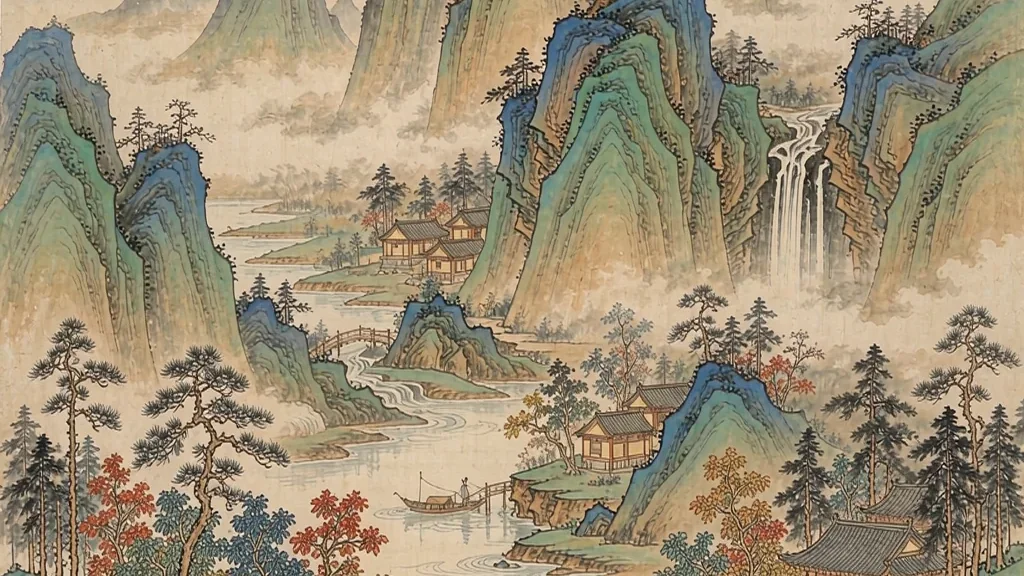
In the Chinese tradition, landscape is never merely a setting; it is a protagonist, a teacher, a companion, and a mirror of the soul. The great landscape poets of China — from Xie Lingyun in the fourth century to Wang Wei in the eighth — did not simply describe mountains and rivers; they entered into relationship with them, believing that the natural world held spiritual truths that could be accessed through attentive perception. Chinese landscape poetry (山水诗, shanshui shi) is one of the most enduring and beloved strands of the tradition, a poetry that invites us to slow down, look closely, and let the world speak in its own language.
The Origins: Xie Lingyun and the Discovery of Landscape
The first great landscape poet of China was Xie Lingyun (谢灵运, 385–433 CE), a scion of the aristocratic Xie family who retired to the mountains of Guiji after falling out of political favor. Xie was not content merely to enjoy the scenery; he set out to explore it, climbing peaks that no one had climbed before and writing poems that recorded his journeys in meticulous detail. His contemporary critics complained that his poems were 'too descriptive' — that they catalogued the features of a landscape without adequately expressing emotion. But that was precisely Xie's innovation: he believed that careful attention to the external world was itself a form of spiritual practice.
Xie Lingyun's poems are packed with visual detail — the color of a stream, the shape of a cliff, the angle of sunlight through a grove of bamboo. He writes like a painter naming pigments, and indeed he was both a poet and a landscape architect (he designed gardens that were famous in their time). His poetry reflects the influence of Daoist and Buddhist ideas about the natural world as a manifestation of transcendent principles. By losing himself in the mountains, Xie Lingyun believed he could find himself — or rather, lose his small self in a larger one.
Wang Wei: The Poet-Painter of Silent Mountains
Wang Wei (王维, 699–759 CE) is the supreme genius of Chinese landscape poetry. A painter of the first rank and a devout Chan Buddhist, Wang Wei practiced 'poetry in painting and painting in poetry.' His landscapes are characterized by their spareness: he does not catalogue everything, as Xie Lingyun did, but selects a single image — a patch of moss, a distant bird, the sound of a bell — and lets it carry the entire weight of meaning. His 'Bird-Singing Stream' is a perfect example: 'Man at leisure, cassia-flowers fall; / the night still, spring mountains empty. / The moon rises, startling the mountain birds — / they sing for a while in the spring stream.'
Wang Wei's Buddhist practice shaped his poetry profoundly. Chan Buddhism taught that enlightenment comes through direct, non-conceptual perception — through seeing things as they are, without the interference of the discriminating mind. Wang Wei's landscapes are attempts to render this pure perception. His poems do not analyze or interpret the natural world; they simply present it with such clarity that the reader might, for a moment, see it as the poet did — as a manifestation of the Buddha-nature that pervades all things. The empty mountain, the falling flower, the singing bird: these are not symbols but realities, and their reality is the teaching.
Meng Haoran: The Gentle Rustic
Meng Haoran (孟浩然, 689–740 CE), Wang Wei's older contemporary and close friend, represents a different mode of landscape poetry — more relaxed, more intimate, less burdened by Buddhist metaphysics. Meng was a lifelong recluse who never held significant office, and his poems have the unhurried quality of a man who has all day to watch the clouds pass. His 'Spring Morning' is one of the most familiar poems in Chinese: 'In spring, I sleep without waking to dawn; / everywhere I hear the birds singing. / Last night, the wind and rain came — / who knows how many petals fell?'
Meng Haoran's landscapes are not the awesome, vertical landscapes of Wang Wei's Buddhist mountains but the gentle landscapes of a domesticated countryside: farms and rivers, villages and trees, the simple beauties of a world in which human beings belong. His poems remind us that 'landscape' does not have to mean wilderness; it can also mean the view from a farmhouse door, the path between two rice paddies, the river that flows past the village. Meng Haoran is the poet of ordinary beauty, and his poems have been loved for centuries precisely because the landscapes they describe are accessible to everyone.
The Landscape of Exile: Liu Zongyuan and Han Yu
For poets who were exiled to the remote southern regions of China, landscape took on a darker, more complex meaning. Liu Zongyuan (柳宗元, 773–819 CE) was banished to the malarial swamps of Yongzhou, where he wrote some of the most haunting landscape poems in the language. His famous 'River Snow' — 'A thousand mountains: no bird flying. / Ten thousand paths: no human trace. / A single boat, bamboo hat and cape — / an old man fishing the cold river snow.' — captures the desolation of exile in an image of absolute solitude. The old man in the boat is alone, but he is also at peace, doing what he has always done under skies that care nothing for imperial favor.
Han Yu (韩愈, 768–824 CE), another fearless exile, took a different approach. His landscape poems about the southern wilderness emphasize its strangeness and danger — the miasmic vapors, the poisonous insects, the inscrutable local customs. Han Yu was writing to a central Chinese audience, and his landscapes are deliberately exoticized. His exile poems express a double vision: he sees the southern landscape as both beautiful and terrifying, both a spiritual refuge and a place of death. This tension — between the landscape as sanctuary and the landscape as prison — runs through much of the exile poetry tradition.
The Legacy of Chinese Landscape Poetry
Chinese landscape poetry has had an enormous influence on world literature. In East Asia, the landscape poems of Wang Wei and Xie Lingyun shaped the visual arts of painting and garden design — the famous Chinese landscape scrolls are visual equivalents of shanshui poetry, inviting the viewer to journey through a mental landscape just as the poems invite the reader. The Japanese traditions of haiku and renga owe a profound debt to Chinese landscape poetry, particularly to Tang concision and Song subtlety.
In the West, Chinese landscape poetry was a revelation to modern poets. Ezra Pound's translations of Li Bai (mistakenly attributed to 'Rihaku'), Arthur Waley's versions of Wang Wei and Bai Juyi, and Kenneth Rexroth's love for Du Fu introduced English-language readers to a tradition in which nature was not a background for human drama but the drama itself. The Chinese landscape poets taught the West that poetry could be a way of paying attention — that the act of looking at a mountain, a stream, or a flower could be an act of spiritual and artistic devotion. In a world increasingly detached from nature, that teaching has never been more urgently needed.
Meditative Buddhism and the Empty Mountain
For Wang Wei and his followers, landscape was a spiritual exercise before it was a description. Meditative Buddhist teaching holds that enlightenment comes through direct, wordless perception, seeing things as they are without the sorting mind. Wang Wei's poems practice this by presenting a single image, a patch of moss, a distant bell, a bird startled by the moon, and letting it stand without comment. The empty mountain is not a symbol to be decoded but a reality to be met. This approach changed Chinese landscape poetry from inventory into attention; instead of cataloguing a view, the poet clears a space for it. Later readers found in these quiet scenes a form of meditation they could perform while reading. The empty mountain became the genre's signature setting, a place where language falls silent and the world, briefly, speaks for itself.
Travel, Pilgrimage, and the Roaming Poet
Many landscape poems were written on the move. Tang poets traveled constantly, sent between postings or wandering by choice, and the road, the riverboat, and the mountain path supplied endless occasions. A poet would climb a peak no one had named, visit a famous cliff, or pause at a pavilion to record the view and the mood it brought. This roaming was partly exploration and partly spiritual search, a way of testing the self against unfamiliar terrains. Xie Lingyun literally cut trails into hills and wrote of the climb as a discipline. The traveling poem thus fuses observation with movement, each new prospect marking a stage in a larger journey. For the reader, the poem becomes a guided walk, and for the poet, the act of going outward became the means of going inward, so that landscape and pilgrimage were often the same act.
Gardens and the Miniature Landscape
Not every landscape poet climbed a remote peak; many met nature in the garden. Scholar-officials designed private gardens that compressed mountains, water, and rocks into a small plot, and they wrote poems about these miniature scenes as seriously as about wild ranges. The garden let a busy official keep a piece of the natural world inside the city wall, a portable refuge from court life. Poems on a single rock, a pond, or a winding corridor treat the small with the same care given to the vast, showing that scale was never the point. This taste fed both landscape verse and the later art of the scholar's garden, where a few stones could stand for a whole mountain. The miniature landscape confirms the tradition's core claim that attention, not distance, is what makes a place meaningful, and that the smallest corner of earth can hold the whole.
❓ Frequently Asked Questions
📝 Chinese Vocabulary
山水诗 — : Landscape poetry; the shanshui tradition
谢灵运 — : Xie Lingyun; the first great landscape poet
王维 — : Wang Wei; Tang poet-painter and Chan Buddhist
孟浩然 — : Meng Haoran; Tang recluse known for gentle, intimate nature poems
柳宗元 — : Liu Zongyuan; a master of exile landscape, author of the famous River Snow.
韩愈 — : Han Yu; a fearless exile whose southern landscapes are beautiful and threatening at once.
辋川 — : Wangchuan; Wang Wei's riverside estate and the setting of a celebrated twenty-poem sequence.
鸟鸣涧 — : Bird-Singing Stream; Wang Wei's short poem of stillness startled by a rising moon.
🎉 Fun Facts
- Wang Wei's estate at Wangchuan (辋川) was both a real place and the subject of a famous series of twenty poems — the 'Wang River Collection.'
- Xie Lingyun is also remembered as the inventor of 'climbing boots' (谢公屐) with removable cleats for hiking on uneven terrain.
- The term 'shanshui' (mountain-water) is the same word used for Chinese landscape painting — the two arts share a single aesthetic vocabulary.
- Liu Zongyuan's River Snow uses only twenty characters yet is counted among the most powerful exile poems ever written in Chinese.
- Landscape verse directly inspired the mountain-and-water painting scrolls, where empty space carries as much meaning as the ink itself.
- The Japanese haiku poet Basho explicitly credited the Tang landscape masters as a foundation for his own art of suggestion.