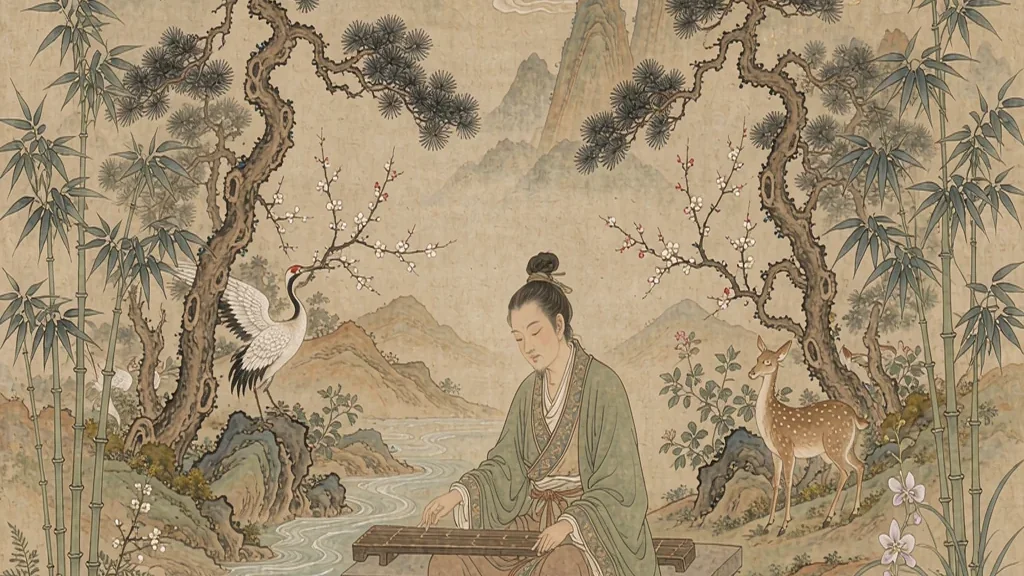
Chinese philosophers have always distrusted abstract argument. From Confucius, who said he would rather 'stop speaking' than explain the ultimate truths, to the Chan Buddhists who insisted that enlightenment could not be captured in words, Chinese thinkers have preferred to communicate through stories, images, and — above all — poetry. Philosophical poetry (哲理诗, zheli shi) is not a minor subgenre in China; it is nearly coextensive with the tradition itself. The greatest Chinese poets were also philosophers, and their poems are the places where the deepest questions about existence — life and death, time and eternity, knowledge and ignorance — are asked and answered in the language of the heart.
Confucian Poetry: The Moral Vision
Confucius placed poetry at the center of moral education. He famously told his disciples: 'If you do not study the Odes [Shijing], you will have nothing to say.' For Confucius, poetry was not self-expression but moral cultivation — a way of learning to feel the right emotions, to respond appropriately to situations, and to express oneself with elegance and restraint. The Shijing was studied as a manual of ethical sensibility: it taught the reader to love what was good, hate what was evil, and feel compassion for the suffering of others.
This Confucian understanding of poetry shaped the tradition profoundly. Poets from Du Fu to Bai Juyi saw their work as a form of moral testimony. Du Fu's poems about the An Lushan Rebellion are not only historical documents but also moral judgments — he shows us the suffering of ordinary people and implicitly condemns the rulers who allowed it. The Confucian poet does not withdraw from the world into aesthetic contemplation; he engages with the world, criticizes its injustices, and tries to make it better through the power of his words.
Daoist Poetry: The Natural Way
If Confucian poetry is about moral engagement, Daoist poetry is about letting go. The Daoist poets — from Tao Yuanming to Li Bai to Wang Wei — sought to align themselves with the Dao (道, the Way), the natural force that flows through all things. Daoist poetry values spontaneity, simplicity, and the dissolution of the ego into the larger currents of nature. The ideal Daoist poem seems to write itself, as effortlessly as a stream flows downhill or a bird sings in the morning.
The Daoist poet is suspicious of language, which it sees as a tool of separation and control. As Laozi says in the Daodejing: 'The Dao that can be spoken is not the eternal Dao.' Daoist poems often circle around this paradox, using words to point to what lies beyond words. A poem by Li Bai will describe a drunken night under the stars and then suddenly reveal the philosophical insight: the stars and the wine and the poet's body are all expressions of the same cosmic energy. The border between self and world dissolves.
Buddhist Poetry: Emptiness and Impermanence
Buddhism entered China around the first century CE and gradually transformed Chinese poetry. The Buddhist influence is most visible in the theme of impermanence (无常, wuchang): everything passes, everything changes, and attachment to anything leads to suffering. Wang Wei's Chan Buddhist poems are the supreme expression of this insight. His 'Alone in the Hills on a Winter Night' ends: 'In the deep hills, the snow is heavy — / the thatched hut is cold, the door half-open. / I do not dream of the world any longer; / the morning bell has awakened me.'
Buddhist poetry is full of images of transience: autumn leaves falling, dew evaporating in the morning sun, a candle guttering in the wind. But Buddhist poetry is not merely melancholy; it is also hopeful. The recognition of impermanence, in Buddhist thought, is the first step toward liberation. When we stop clinging to things that must pass, we are freed. The great Song poet Su Shi understood this deeply. After years of political exile, he wrote: 'Life is like a journey / with perfect and imperfect stops. / Wherever you end up, / there is the moon, the wind, the endless river.'
Su Shi: The Philosopher-Poet
Su Shi (苏轼, 1037–1101 CE), also known as Su Dongpo, is the greatest philosophical poet of the Song dynasty. A Confucian scholar-official who was deeply influenced by Daoism and Chan Buddhism, Su Shi wrote poems that range across the entire philosophical landscape. His famous 'Red Cliff' poems — written while in exile at Huangzhou — meditate on the transience of human achievement, using the ancient Battle of Red Cliff as a starting point for cosmic reflection: 'The river flows endlessly eastward, / washing away the heroes of a thousand years.'
What makes Su Shi's philosophical poetry so compelling is that he never turns away from suffering. He was exiled three times, lost a young son, saw his friends persecuted — and yet his poems maintain a quality of joyful acceptance that seems almost superhuman. In his 'Written on the Wall of the West Forest Temple,' he explains: 'From the side, a whole range; from the end, a single peak. / Far, near, low, high — no two parts alike. / I cannot tell the true shape of Mount Lu / because I am myself inside the mountain.' This is not just a landscape poem; it is a philosophical statement about the limits of perspective, the impossibility of objective knowledge, and the need to accept uncertainty.
The Enduring Appeal of Philosophical Poetry
Chinese philosophical poetry continues to speak to modern readers because it addresses the questions that never go away. What is a good life? How should we face death? Why is there suffering? Can we know the truth? These questions are as urgent today as they were in the Tang dynasty, and the Chinese poets who grappled with them did so in language of extraordinary beauty and directness.
In an age of information overload and spiritual confusion, the philosophical poetry of China offers something rare: a way of thinking that is also a way of feeling. A poem by Du Fu or Su Shi does not argue a position; it creates an experience of insight. When we read it, we do not merely understand the philosophy — we feel what it would be like to live by it. This is the deepest power of Chinese poetry: not to tell us what to think, but to show us how to be.
Paradox and the Limits of Language
A recurring move in Chinese philosophical verse is the paradox that undoes itself. The classic Daoist text says the Way that can be spoken is not the eternal Way, and poets from Zhuangzi's heirs to the meditative masters built on this, using words to point at what lies beyond words. A poem may describe a drunken night and then reveal that the stars, the wine, and the body are one current of energy, dissolving the border between self and world. The paradox is not confusion but method: by refusing a fixed statement, the poem invites the reader into direct seeing. This comfort with contradiction separates Chinese philosophical poetry from the Western habit of argument; the truth is approached by circling, not by line. The best examples leave a productive unease, a sense that the meaning was there and then slipped, which is exactly the point. Language is used to confess its own limit.
Knowledge, Perspective, and the Mountain
Few images carry more philosophical weight than the mountain seen from inside it. Su Shi's poem on the wall of the West Forest Temple notes that the same peak looks like a range from the side and a single crest from the end, near or far, low or high, never twice alike, and concludes that he cannot know the mountain's true shape because he stands within it. The poem is a compact treatise on the limits of perspective and the impossibility of objective knowledge, offered without jargon. It belongs to a wider habit of using landscape as a thought experiment, the river as transience, the moon as constancy, the mist as the unknown. Chinese philosophical poetry loves these portable figures because they make abstract epistemology feel like a walk. The lesson is not that knowledge is impossible but that it is situated, and that wisdom begins with admitting where one stands.
Feeling as a Form of Knowing
The deepest claim of Chinese philosophical poetry is that feeling and knowing are not opposites. A Du Fu or a Su Shi does not argue a position; he stages an insight the reader undergoes. When Du Fu writes of broken walls and spring grass, the moral judgment arrives as a pang, not a proposition, and when Su Shi accepts his exile with a line about the moon and the endless river, the philosophy is in the acceptance, not stated above it. This means the poem's work is experiential, a way of training the heart to respond as a sage would. The tradition thus treats emotion as a mode of understanding, the body's grasp of a truth too large for syllogism. Reading such verse, one does not merely learn a doctrine but rehearses a way of being. That is the special power the genre claims, to show how to live rather than only what to think, and to do so in language that lingers in the chest.
❓ Frequently Asked Questions
📝 Chinese Vocabulary
哲理诗 — : Philosophical poetry; verse that explores fundamental questions
苏轼 — : Su Shi (Su Dongpo); the great Song philosopher-poet
道 — : Dao; the Way — the ultimate principle of Daoist philosophy
无常 — : Wuchang; impermanence — a central Buddhist concept in poetry
孔子 — : Confucius; who placed the classic poetry collection at the center of moral education.
庄子 — : Zhuangzi; the Daoist sage whose parables and paradoxes shaped the poetic imagination.
禅 — : Chan; the meditative school whose stress on sudden, wordless insight shaped much Buddhist verse.
理 — : Principle; the Neo-Confucian concept of underlying order explored in some later philosophical verse.
🎉 Fun Facts
- Su Shi's poem about Mount Lu — 'I cannot tell the true shape of Mount Lu because I am myself inside the mountain' — is the most quoted philosophical couplet in Chinese poetry.
- The Daoist philosopher Zhuangzi is considered a major influence on Chinese poetry even though he wrote prose — his parables and paradoxes shaped the poetic imagination for two millennia.
- Du Fu's 'Climbing the Tower' contains the philosophical couplet: 'The empire may be broken, but the mountains and rivers remain; / spring in the city — the grass and trees grow deep.'
- The Neo-Confucian thinker Zhu Xi ranked Du Fu above Li Bai, fixing the Sage of Poetry reputation that still dominates classrooms.
- Meditative Buddhist poetry often uses a sudden sound, a bell, a falling leaf, a stone striking bamboo, as the trigger of enlightenment that a Wang Wei scene enacts.
- The Song reformer Wang Anshi wrote philosophical poems using cosmic diagrams and number symbolism drawn from his era's Neo-Confucian cosmology.