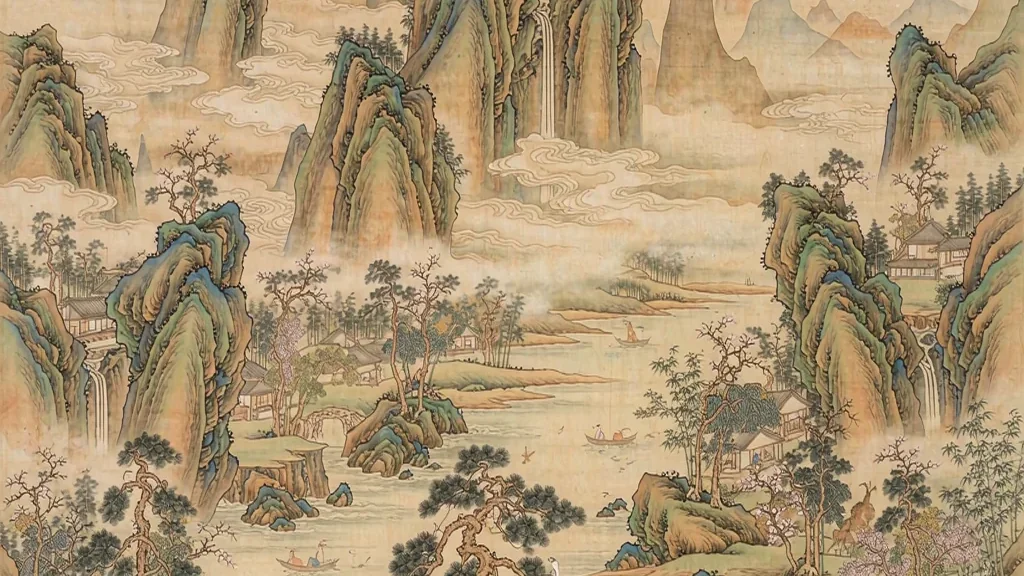
Chan Buddhism taught that enlightenment is not something to be achieved but something to be recognized — already present, like the Buddha-nature that shines in all things. Nature provided the Chan poet with the perfect language for this recognition. The mountain stream that flows without effort, the bird that sings without thought, the lotus that blooms without intention — these were not symbols of enlightenment but enlightenment itself, visible to anyone who learned to see. Nature-Chan poetry (自然禅诗, ziran chan shi) is the meeting point of Chinese landscape poetry and Buddhist spirituality.
The Philosophy of Naturalness (Ziran)
The Daoist concept of ziran (自然, 'naturalness' or 'spontaneity') was absorbed by Chan Buddhism and became the foundation of nature-Chan poetry. Ziran means following one's own nature without artifice or effort. The stream flows because it is in the nature of water to flow; the bird sings because it is in the nature of birds to sing. The enlightened person, likewise, acts without calculation, responds without premeditation, and lives without grasping. The Chan poet looked at nature not as a collection of objects but as a manifestation of this spontaneous, effortless reality.
The nature-Chan poet does not impose meaning on the landscape; he allows the landscape to reveal its own meaning. The poet empties himself of concepts and expectations and becomes a pure mirror that reflects what is. This is why Wang Wei's nature poems are so spare: they are the record of a mind that has stopped adding anything to experience. The mountain is just the mountain; the bird is just the bird. And this 'just this' is the teaching.
Wang Wei: The Chan Poet of Nature
Wang Wei (王维, 699–759 CE) is the supreme poet of nature-Chan. His Buddhist practice shaped every aspect of his poetry. His famous 'Deer Enclosure' — 'Empty mountain not seeing anyone, / only hearing echoes of people's voices. / Reflected light enters the deep forest, / again shining on the green moss' — is a Chan meditation in five-character lines. The empty mountain represents the mind emptied of conceptual clutter; the echoing voices are the sounds of the phenomenal world; the light on the moss is the sudden flash of insight.
Wang Wei's 'Bird-Singing Stream' is another perfect nature-Chan poem: 'Man at leisure, cassia-flowers fall; / the night still, spring mountains empty. / The moon rises, startling the mountain birds — / they sing for a while in the spring stream.' The poem moves from silence to sound, from emptiness to activity, and back again. The birds are startled by the moon, but their song is not disturbed; it is simply what birds do. The Chan poet does not grasp any one moment; he lets the whole process unfold.
Hanshan: The Wild Chan of Cold Mountain
Hanshan's nature-Chan poems are rougher and wilder than Wang Wei's. Wang Wei was a cultured gentleman-poet who practiced Chan in a country estate; Hanshan was a genuine hermit who lived in a cave. His nature poems are not meditations on carefully observed landscapes but cries from the heart of the wilderness: 'I climb Cold Mountain — the road is steep, / the cliffs are high, the streams are deep. / The moss is slippery, the rocks are jagged. / The pines are bent, the wind is cold. / There is no one on the road — / only the white clouds that do not speak.'
Hanshan's Cold Mountain is not a beautiful landscape; it is a demanding spiritual environment. The climb is hard, the cold is bitter, and the solitude is absolute. But this is precisely the point: the spiritual path is not comfortable. The nature that Hanshan describes is not the refined nature of a garden but the raw nature of the mountain, where the truth is not hidden but too stark to look at directly.
Nature-Chan in the Song Dynasty
Song dynasty poets continued the nature-Chan tradition, but with a different emphasis. Su Shi's nature-Chan poems often find enlightenment in ordinary activities. His 'Night Sailing on the Yangzi' describes the moment when the poet realizes that the distinction between motion and stillness is an illusion: 'The boat is not moving — the shore is moving. / We are both still, and both in motion.' The insight comes not from a mountain peak but from the everyday experience of traveling on a river.
The Song poet Yang Wanli (杨万里, 1127–1206 CE) wrote nature poems that are playful and full of surprise, often finding Chan insight in the most ordinary events. In one poem, he watches a spider web in the sunlight and suddenly understands the nature of attachment: 'The spider's thread is so thin / that the wind cannot break it. / But the wind does not need to break it — / it only needs to blow, and the web is gone.' The poem is funny, precise, and profound.
The Enduring Teaching of Nature-Chan
The nature-Chan tradition speaks directly to the ecological consciousness of the modern world. The idea that nature is not a resource to be exploited but a teacher to be attended to — that the world is already speaking, and we need only to learn how to listen — has never been more urgent. The nature-Chan poets of China anticipated many of the insights of deep ecology: the interconnectedness of all beings, the value of silence and attention, the critique of instrumental reason.
The nature-Chan tradition also offers a way of being in the world that is neither activist nor escapist. The Chan poet does not withdraw from nature into the monastery, nor does he try to control nature through technology. He simply attends to nature, allows it to teach him, and writes poems that might help others attend as well. In an age of environmental crisis, this practice of attention — this way of looking at a mountain until the mountain looks back — may be the most radical act of all.
Walking to Where the Water Ends
Wang Wei's couplet about walking until the stream runs out and then sitting to watch the rising clouds has become the emblem of nature-Chan ease. There is no goal and no disappointment at the end of the path; the turn from walking to sitting, from water to cloud, is itself the teaching. The line shows how Chan poetry turns a simple hike into a lesson in going with things as they are.
Clouds, Pines, and the Unattached Mind
The recurring objects of nature-Chan verse — cloud, pine, cold stream, empty mountain — form a small vocabulary of liberation. Each names a way of being that asks nothing and clings to nothing. The cloud drifts, the pine endures, the stream flows without choice. By dwelling on these, the poet trains the reader to notice a mind that mirrors nature's effortless motion.
Non-Duality in the Landscape
The deepest claim of nature-Chan is non-duality: that the person looking at the mountain and the mountain being looked at are not two. A poem enacts this not by stating it but by letting subject and scene merge until the boundary dissolves. The result is a verse that does not describe a view so much as invite the reader into one, where seeing and being seen are a single, quiet act.
❓ Frequently Asked Questions
📝 Chinese Vocabulary
自然禅诗 — : Nature-Chan poetry; landscape verse as spiritual teaching
自然 — : Ziran; naturalness, spontaneity, the way things are without interference
王维 — : Wang Wei; the greatest Chan poet of nature
空山 — : Empty mountain; a key image in nature-Chan poetry
行到水穷处 — : Walking until the water ends; a Wang Wei line on effortless wandering
云 — : Cloud; the drifting, unattached image favored by Chan poets
松 — : Pine; the evergreen that symbolizes steadfastness in nature-Chan verse
不二 — : Non-duality; the Chan dissolution of subject and object
🎉 Fun Facts
- Wang Wei's 'Deer Enclosure' is sometimes called the 'perfect Chan poem' because it follows the structure of a Chan meditation: entering emptiness, hearing sound, seeing the light.
- Hanshan was not widely read in China until the 20th century, when his translations by Gary Snyder made him a cult figure in the West.
- Yang Wanli was one of the most prolific Chinese poets, with over 4,000 surviving poems — many of them nature-Chan meditations on ordinary things.
- Wang Wei's line about walking until the stream runs out and then sitting to watch the rising clouds is often quoted as the perfect image of effortless, aimless Chan wandering.
- The pine, blossoming in winter when other trees are bare, became a Chan symbol of the mind that stays green through every season of change.
- The term for non-duality names the Chan insight that the seeing mind and the seen mountain are not two separate things.