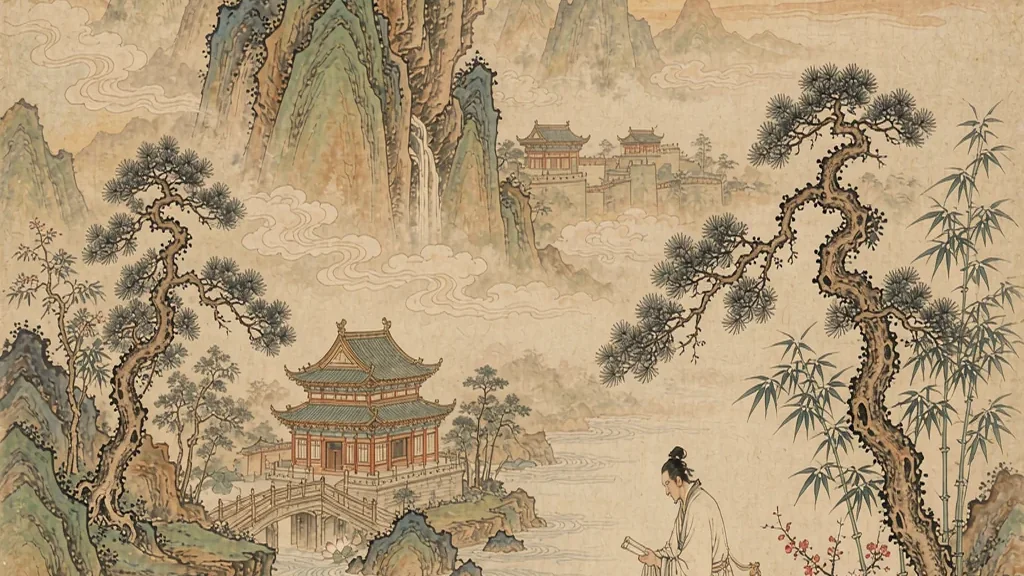
In China, poetry has never been a purely aesthetic pursuit. From its very beginnings, it has been entangled with politics — with the exercise of power, the critique of injustice, and the expression of the citizen's conscience. The earliest official in Chinese history, it was said, was the 'poetry collector,' a government agent who traveled the kingdoms gathering folk songs so that the ruler could hear the voice of the people. Political poetry (政治诗, zhengzhi shi) is not a niche in the Chinese tradition; it is central to the tradition's self-understanding. 'The poet,' wrote the Tang master Bai 'Juyi,' 'should not write for pleasure alone. Every poem must contain a judgment.'
The Shijing as Political Voice
The Shijing contains many poems that are explicitly political — soldiers' complaints about unjust wars, peasants' laments about excessive taxation, elegies for good rulers and satires of bad ones. The tradition held that the Zhou kings sent officials to collect these songs precisely to gauge popular opinion. A ruler who heard his people singing about suffering knew that he must reform his government. The Shijing established the principle that poetry is a form of political testimony — that the poet has a duty to speak truth to power.
The 'Major Odes' (大雅) of the Shijing include long historical poems that narrate the founding of the Zhou dynasty and the decline of its predecessor, the Shang. These poems are not neutral histories; they are moral judgments, showing how virtue leads to power and corruption leads to ruin. The lesson was clear: poetry teaches rulers how to govern by showing them the consequences of their actions. This 'praise and blame' (美刺) function of poetry became a cornerstone of Chinese literary theory.
Qu Yuan and the Tradition of Protest
Qu Yuan (屈原, 343–278 BCE) is the prototypical political poet in the Chinese tradition — the loyal minister who was wrongfully exiled and who chose death over compromise. His 'Li Sao' (Encountering Sorrow) is an allegorical account of his political journey: the poet seeks a worthy ruler, finds only corruption, and finally withdraws into a cosmic realm of his own making. The poem is dense with political symbolism: the fragrant herbs the poet cultivates are his moral virtues, the 'jealous women' who slander him are his political enemies, and the celestial journey he undertakes is a vision of what a just government might be.
Qu Yuan's suicide by drowning in the Miluo River made him a martyr for political integrity. The Dragon Boat Festival, which commemorates his death, is a reminder that the poet's sacrifice was also a political act. Qu Yuan established a powerful template: the poet as the conscience of the state, the one who speaks when others are silent, the one who would rather die than betray the truth.
Du Fu: The Poet-Historian
Du Fu (杜甫, 712–770 CE) is called the 'Poet-Historian' (诗史) because his poems are the most vivid record we have of the An Lushan Rebellion (755–763 CE), one of the most destructive civil wars in Chinese history. Du Fu did not write from a safe distance; he was caught in the war, separated from his family, reduced to near-starvation. His 'Three Officials' and 'Three Partings' series — six poems about conscription — are the most direct and devastating political poems in the language.
In 'The Pressgang at Shihao Village,' Du Fu describes a military recruiter who comes to a village at night and drags away the only remaining man — the elderly grandfather — because the village has already given all its young men to the war. The old woman pleads: 'My son is dead — / please let my husband stay.' But the recruiter takes the grandfather anyway. Du Fu does not comment; he simply records the scene. The poem's political power comes from its restraint, its refusal to moralize. Du Fu shows us suffering, and the showing is itself the judgment.
Bai Juyi and His 'New Yuefu' Social Critiques
Bai Juyi (白居易, 772–846 CE) took the political function of poetry further than any Tang poet before him. His 'New Yuefu' poems were deliberately written to be accessible to ordinary people — he boasted that an old peasant woman could understand them — and they targeted specific social injustices: the exploitation of coal miners, the confiscation of peasants' crops, the luxury of the court while the provinces starved. In 'The Red Parrot,' he uses the image of a caged bird to protest the silencing of dissent.
Bai Juyi's political poetry is often more explicit than Du Fu's. Where Du Fu shows and implies, Bai Juyi names and accuses. His poem 'The Charcoal Seller' names the crime: imperial agents stealing from an old man. Bai Juyi believed that poetry could change the world — that a well-written poem could move a ruler to reform. He was often disappointed, but he never stopped writing. His conviction that the poet is a moral actor in the political sphere remains one of the most inspiring aspects of the Chinese tradition.
Song Dynasty Political Poetry and Beyond
The Song dynasty continued the tradition of political poetry, though the context was different. Song poets like Wang Anshi, Su Shi, and Lu You wrote about the loss of northern China to the Khitan and Jurchen invaders, expressing both patriotic outrage and bitter frustration at the weakness of the Song court. Lu You's dying words, recorded in his poem 'Showing to My Sons' — 'When the day comes that the imperial army recovers the Central Plains, / do not forget to tell your father during the family sacrifice' — are the epitome of the politically engaged poet's loyalty.
The tradition of political poetry continued through the Ming and Qing dynasties and into the modern era. During the late Qing, poets like Gong Zizhen wrote fierce critiques of imperial decay. The Chinese political poetry tradition — stretching from the anonymous folk songs of the Zhou to the contemporary poems circulated on social media — proves that the poet's oldest duty, to speak truth to power, has never been abandoned.
Remonstrance and the Duty to Speak
In the Chinese political imagination, the poet could act as a remonstrator who warned the throne through verse. Officials presented poems that praised good rule and quietly blamed bad policy, trusting that a well-turned line might reach the emperor's ear when direct criticism could not. This 'soft remonstrance' was a recognized role: the poet spoke for the people without openly defying authority, and a ruler who heeded such poems was praised as wise. The practice grew from the Shijing belief that folk songs revealed the health of a state. Even when dangerous, the habit of couching political advice in poetry persisted for two millennia, because it let conscience survive inside hierarchy. The finest examples hide their protest so well that only later readers catch the edge, which is exactly the art: to say enough, and no more, and still be heard across the distance between subject and crown.
Poetry Under Surveillance
Because poetry could wound the powerful, it was also watched. The Tang censorate could open and read poems sent through the imperial postal system, and the Song 'Crow Terrace Poetry Case' showed how a poem's implied criticism could become a criminal charge, as it did for Su Shi. Rulers from the Qin to the Qing burned books and punished writers whose lines seemed seditious. Yet suppression often backfired, turning victims into martyrs and their lines into rallying cries. The very fact that so many rulers tried to control verse is the strongest proof of its political force. Censorship and poetry grew up together, each defining the other across Chinese history, and the poet who wrote against the grain always knew the risk he was running.
Political Verse After the Empire
After the fall of the empire in 1912, political poetry found new forms and causes. May Fourth writers used the vernacular to attack feudalism and call for reform, while exiles and dissidents turned to verse to record famine, war, and exile under the twentieth century's upheavals. Today the habit persists on social media, where a single couplet can circulate in hours and voice public anger that newspapers cannot print. The forms have changed from regulated Tang octets to free verse and short posts, but the core conviction remains: that the poet should speak truth to power. The tradition that began with anonymous Zhou songs is, in this sense, still alive, still arguing with authority in the only language that outlasts it.
❓ Frequently Asked Questions
📝 Chinese Vocabulary
政治诗 — : Political poetry; verse engaged with governance and social issues
诗史 — : 'Poet-Historian'; title for Du Fu for his historical documentation in verse
美刺 — : 'Praise and blame'; the dual function of political poetry
杜甫 — : Du Fu; the supreme political poet of the Tang dynasty
屈原 — : Qu Yuan; the prototypical political poet of China, a loyal minister who drowned himself in protest
离骚 — : Li Sao; Qu Yuan's long allegorical poem, 'Encountering Sorrow'
新乐府 — : New Yuefu; Bai Juyi's socially critical poems written in a plain, accessible style
采风 — : Cai feng; the Zhou practice of collecting local songs to gauge popular opinion and the ruler's virtue
🎉 Fun Facts
- Du Fu's 'Three Officials' poems are based on actual events he witnessed while fleeing south during the An Lushan Rebellion — he is reporting what he saw.
- The Tang dynasty postmaster-general had the authority to open and read all poems sent through the imperial postal system — a form of censorship.
- Qu Yuan's suicide in the Miluo River is commemorated every year by the Dragon Boat Festival, when races and rice dumplings recall his death.
- Bai Juyi boasted that even an old, unlettered woman in the marketplace could understand his New Yuefu poems.
- The Southern Song poet Lu You's dying poem asked his sons to tell him of the recovery of the central plains, a wish unfulfilled in his lifetime.
- The late-Qing poet Gong Zizhen wrote scathing satires of imperial decay that helped inspire the reform efforts of the nineteenth century.