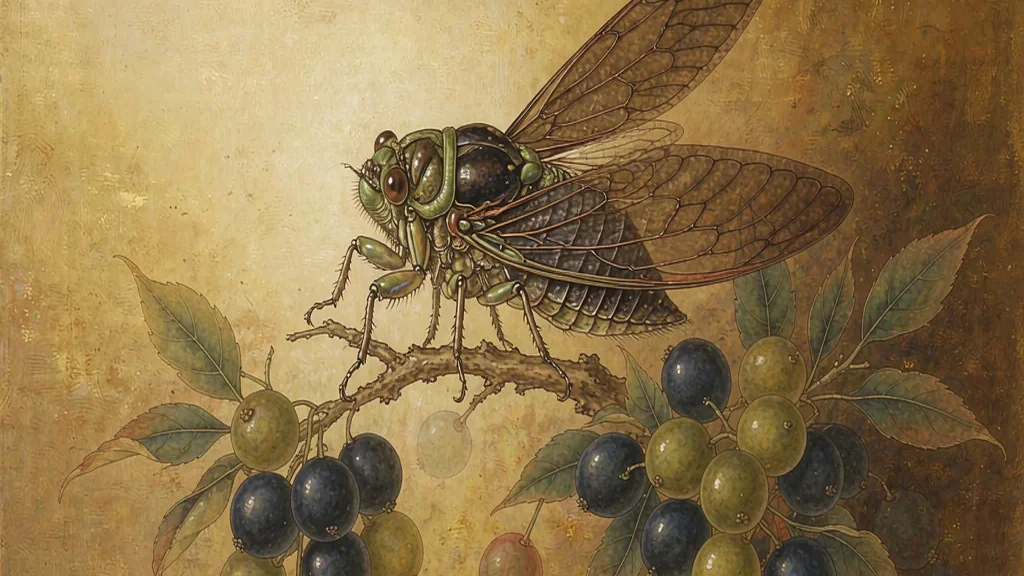
The cicada holds a special and slightly paradoxical place in Chinese poetry: it is at once the loudest voice of summer and the quietest emblem of the incorruptible man. Living high in the trees and said to drink only dew, the insect offered the poet a perfect figure for the gentleman who holds office without taking bribes, who speaks from a lofty station and needs no wind of patronage to carry his name. Yet the cicada's song also marks the turn of the year, and the cold cicada of autumn became one of the steadiest sounds of parting and grief. From the Tang poems that made the insect a test of character to the jade cicadas laid in tombs as tokens of the undying soul, this article follows the cicada through the major turns of its long poetic career.
The Cicada's Reputed Diet of Dew
The foundation of the cicada's moral career is a natural misreading. The insect was believed to live on dew and the clear air of the heights, taking nothing from the earth and owing nothing to anyone. This supposed diet made it the opposite of the worm and the mosquito, creatures of mud and blood, and gave the poet a clean creature to admire. Whether or not the belief was accurate, it organized a whole vocabulary of purity that the verse relies on without question.
The dew-drinking cicada also solved a practical problem for the official poet. To praise the cicada was to praise a kind of service that asked for nothing, and to compare oneself to the cicada was to claim exactly that modest, upright station. The image let a man assert his honesty in a court where honesty was dangerous, because the insect said the lesson without naming the speaker's enemies.
Yu Shinan and the Sound That Travels Far
The most quoted cicada poem is by Yu Shinan, a court poet of the early Tang, who wrote that the cicada drinks dew from the high tree and that its voice carries far not because the autumn wind borrows it strength but because it sits high. The closing couplet is a compact argument about merit: the worthy man is heard because he is lofty in virtue, not because he is pushed by fortune. The poem is short, but it became the textbook instance of how to turn an insect into an aphorism.
What makes the line durable is its quiet confidence. It does not lament neglect; it simply states that true height needs no wind. Later poets who felt overlooked could cite Yu Shinan and imply that their own silence proved their elevation, or could invert him and complain that the wind was lacking. The single poem thus generated two opposed postures, pride and grievance, each available to the next writer by allusion.
Luo Binwang and the Cicada in Prison
A darker use appears in the cicada poem written by Luo Binwang while he was imprisoned, in which the poet joins his own condition to the insect's, noting that the cicada's song and his own sigh answer each other across the bars. The poem turns the usual confidence upside down: here the lofty singer is confined, and the cicada's freedom only measures the man's bondage. The contrast between the free insect and the jailed poet is the emotional engine of the piece.
Luo Binwang's poem matters because it shows the cicada available to the unfortunate as well as the secure. The insect that Yu Shinan used to assert merit becomes, in a cell, a mirror of unjust suffering, its clear song a reproach to the corrupt judges. The same creature thus serves both the satisfied courtier and the wronged prisoner, a flexibility that explains its long life in the tradition.
Li Shangyin and the Cicada of Doubt
The late Tang master Li Shangyin wrote cicada poems that hover between admiration and self-pity, comparing the insect's thin diet of dew to his own poor official salary and wondering whether the creature's famous purity is any comfort against hunger. These poems are characteristic of Li Shangyin in their refusal to resolve: the cicada is noble and also ridiculous, free and also stranded, and the poet will not tell us which reading to keep. The ambiguity is the point.
In Li Shangyin's hand the cicada becomes a figure for the intellectual of limited means, the man who has chosen integrity and therefore eats lightly. The comic edge, that virtue does not pay, is unusual in a tradition prone to solemn praise, and it keeps the insect human. The cicada here is not a slogan but a colleague, singing on the same bare branch as the poet.
The Cold Cicada of Autumn
Beyond character, the cicada is above all a creature of the season's edge. As summer fails, the insect's note turns thin and cold, and the 寒蝉, the cold cicada, enters the poetry of parting as the sound that accompanies a friend's departure. The famous line about the cold cicada's mournful voice at a rain pavilion belongs to this current, where the insect's song and the traveler's sorrow are tuned to the same key.
The cold cicada works because its music is already dying. To hear it is to hear the year closing, and to part at that sound is to part in the knowledge that the warmth will not return. The insect thus doubles the human farewell with a natural one, the tree letting go its singer as the friend lets go his host, and the two leave-takings confirm each other's sadness.
The Cicada and the Soul
The cicada's habit of shedding its shell made it an image of transformation and survival, and in burial custom a small jade cicada was placed in the mouth of the dead as a token that the vital breath continued. Poetry picked up this association, using the empty shell as a figure for the body left behind and the singing self as the soul that rises. The insect's emergence from the ground after years underground also suggested return and renewal.
This mortuary cicada adds a metaphysical depth to the literary one. The same creature that figures the honest official also figures the undying breath, so that to praise the cicada is, faintly, to affirm life after death. The convergence shows how a single natural fact, the molt, could be read by two disciplines, poetry and ritual, and made to serve both the living and the dead.
The Cicada in Yuefu and Music
The cicada's song entered musical poetry as a stock sound of the southern summer and the northern border alike. Yuefu and later lyrics invoke the insect to set a scene of heat, of lonely watching, or of a woman listening indoors to the one note that will not stop. Because the cicada repeats without variation, it suited the obsessive mood of the love lyric, where the same thought returns like the same cry. The bird might vary its tune, but the cicada insists.
Composers of descriptive tunes used the cicada to paint stillness through sound: the more the insect sings, the more empty the afternoon feels. The paradox, that noise reveals quiet, is a favorite of the Chinese lyric, and the cicada is its perfect instrument. A poem full of cicada sound is often a poem about solitude, the singer alone with the one voice that answers no one.
The Cicada Against Other Insects
To understand the cicada's value one must see the company it kept. The tradition routinely contrasts it with the mosquito, the fly, and the wasp, creatures of blood and rot that stand for the slanderer and the parasite at court. The cicada's cleanliness by contrast is almost a political position. A poet weighing the insects is really weighing kinds of people, the selfless singer against the greedy bloodsucker, and asking the reader which he serves.
This bestiary of the garden gave the lyric a quiet satire. Without naming ministers, the poet could praise the cicada and let the reader supply the criticism of those who, unlike it, feed on the state. The insect thus becomes a small machine for saying what cannot be said, the safest possible way to attack the powerful by admiring the harmless.
The Cicada in Painting and the Literati Room
Like the plum and the orchid, the cicada passed into painting, where a few strokes of the insect on a leaf could stand for the whole summer and the whole argument about purity. The literati collector hung such pictures in the studio as a motto, the way a Western scholar might keep a motto on the wall. The painted cicada and the written one reinforced each other, and a poem inscribed on a cicada picture completed the triangle of arts.
In the late imperial age the cicada also appeared on the scholar's desk as a carved seal or a brush rest, so that the insect presided over the act of writing itself. To compose at such a desk was to write under the cicada's sign, and the poet who praised the dew-drinking singer was, in a sense, praising his own trade of clean and useless song.
The Cicada's Lasting Song
The cicada remains a living figure in modern Chinese verse, its double identity intact: the proud voice of the upright man and the thin music of the ending year. To hear the insect today is still, for a reader of the old poetry, to hear Yu Shinan's confidence and Li Shangyin's doubt at once. Few creatures have been asked to carry so much contradiction with so little complaint.
What the cicada finally gives the poet is a way to be heard without pushing. Its song travels because it is high, not because it is loud, and that lesson, that merit needs no wind, is the oldest gift of the insect to the Chinese verse. The cicada keeps singing from the tree of the page, and the reader, like the autumn traveler, stops to listen and to go.
❓ Frequently Asked Questions
Why is the cicada a symbol of purity?
It was believed to drink only dew high in the trees, taking nothing from the earth, so it figured the official who serves without taking bribes.
What does Yu Shinan's cicada line mean?
It says the cicada is heard far because it sits high, not because the wind carries it, arguing that true merit needs no patronage.
How did Luo Binwang use the cicada?
He wrote of it in prison, matching his sigh to the free insect's song so the creature's liberty measures his own confinement.
Why is the cold cicada linked to parting?
Its thin autumn song marks the year's close, accompanying farewells as a natural leave-taking that doubles the human one.
What is the jade cicada in burial?
A small jade cicada placed in the dead mouth, using the insect's molt as a token that the soul survives the shed body.
How did Li Shangyin treat the cicada?
He weighed its famous purity against hunger, noting that a dew diet is poor comfort, and left the contrast unresolved.