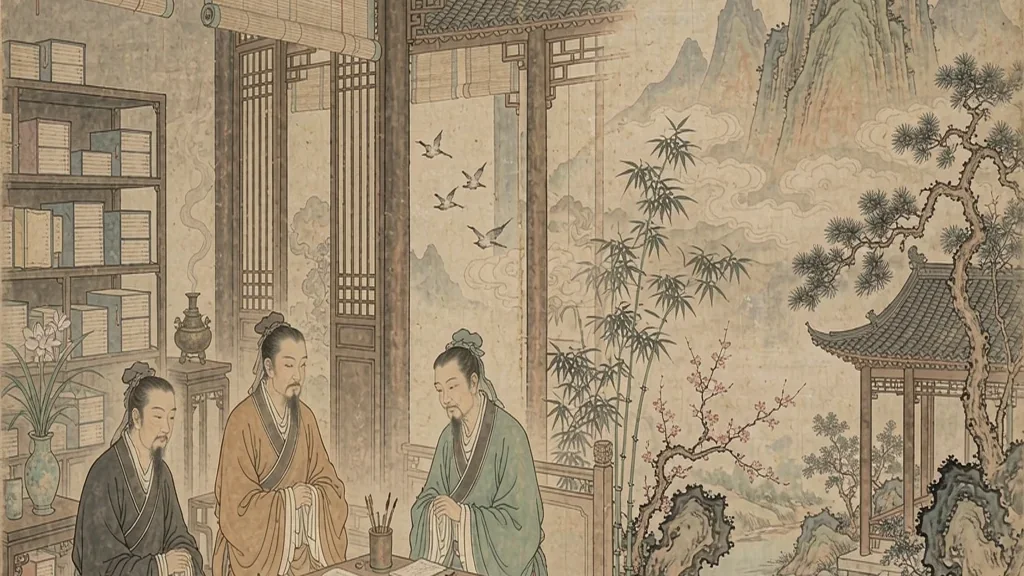
Chinese poets were also their own best critics. From the earliest theoretical reflections of the Six Dynasties to the elaborate poetics of the Qing dynasty, Chinese writers produced a vast body of criticism — not the dry, categorical kind that modern students dread, but a living, passionate conversation about what poetry is, what it should do, and how it can be perfected. Traditional Chinese poetry criticism (诗话, shihua, "poetry talk") is a genre of its own: anecdotal, personal, and unsystematic by Western standards, but rich with insight and experience.
The Earliest Criticism: The Great Preface and 'On Literature'
The earliest systematic statement of Chinese poetics is the 'Great Preface' (大序) to the Shijing, probably written during the Han dynasty. It defines poetry as the expression of intent: 'Poetry is where the intention goes. In the heart it is intention; when uttered, it is poetry.' This definition — poetic as xin zhi sui zhi, 'what the mind goes toward' — established the expressive theory of poetry that dominated Chinese criticism for two millennia. The Great Preface also articulated the 'praise and blame' function of poetry and the theory of the 'six principles' (六义): the three types of poems (feng, ya, song) and three techniques (fu, bi, xing).
Cao Pi's 'On Literature' (典论·论文) from the early third century was the first work of literary criticism by an individual author. He argued that literature was 'a great enterprise for governing the state' and that writers should be valued for their individual genius. He also identified the problem of 'mutual disparagement' among writers — a problem that his own court circle was famously plagued by. Cao Pi's work established that literature deserved serious critical attention and that the critic had a role in shaping literary standards.
Liu Xie and 'The Literary Mind and the Carving of Dragons'
Liu Xie (刘勰, ca. 465–522 CE) produced the single greatest work of traditional Chinese literary criticism: the 'Wenxin Diaolong' (文心雕龙, The Literary Mind and the Carving of Dragons). This remarkable work of fifty chapters systematically addresses every aspect of literary creation: the relationship between form and content, the classification of genres, the techniques of rhetoric, the psychology of the creative process, and the historical development of literature. Liu Xie wrote in elegant parallel prose, and his work is itself a literary masterpiece.
Liu Xie's central insight is that literature is an expression of the Dao — the cosmic principle that orders the universe. The writer must attune himself to the patterns (wen, 文) of nature and society, and then express those patterns through words. Good writing is not merely technically proficient; it is cosmically harmonious. Liu Xie's synthesis of Confucian moralism, Daoist naturalism, and Buddhist meditative practice made 'The Literary Mind' the most comprehensive and intellectually ambitious work of Chinese criticism ever written.
Sikong Tu and the 'Poetic Moods'
Sikong Tu (司空图, 837–908 CE), a late Tang poet and critic, wrote the 'Twenty-Four Poetic Moods' (二十四诗品), a series of twenty-four poems about poetry. Each poem describes a different aesthetic quality: 'vigor,' 'naturalness,' 'reserve,' 'grandeur,' 'subtlety,' and so on. The work is not analytical but evocative; Sikong Tu does not define the qualities but suggests them through imagery. For 'reserve' (含蓄), he writes: 'You don't drink the water of a thousand rivers; / you just let the source flow. / In the calm of a pale dawn, / you meet the autumn that is always there.'
Sikong Tu's work marked a shift in Chinese criticism from moral evaluation to aesthetic appreciation. He was less interested in whether a poem was morally edifying than in what kind of experience it created. His 'poetic moods' became a standard vocabulary for describing the subtle differences between poetic styles, and his influence can be seen in all later Chinese criticism. The shift from 'is this poem good for you?' to 'what does this poem feel like?' was one of the most important developments in Chinese literary theory.
Yan Yu and the 'Canglang Poetry Talks'
Yan Yu (严羽, ca. 1195–1245 CE) was a Song dynasty critic whose 'Canglang shihua' (沧浪诗话, Canglang's Poetry Talks) was a polemical work that argued for a return to the aesthetic standards of the High Tang. Yan Yu was reacting against what he saw as the excessive didacticism and philosophical abstraction of Song poetry. He argued that poetry should be judged by its 'poetic quality' (诗品), not its moral or philosophical content. The best poetry, for Yan Yu, was characterized by xingqu (兴趣), 'inspired interest' — a quality of spontaneous, effortless grace that could not be achieved by deliberate effort.
Yan Yu's famous analogy compares the best Tang poetry to 'antelope that hangs by its horns' — leaving no trace, impossible to track. The poem does not declare its meaning; it hovers just beyond the reach of paraphrase, inviting the reader into a space of indefinite suggestion. Yan Yu's emphasis on the irreducibility of poetic meaning — the idea that a poem cannot be translated into prose without losing something essential — was a profound contribution to critical thought.
Wang Guowei and the 'World of the Poem'
Wang Guowei (王国维, 1877–1927 CE) was the last great traditional Chinese critic and the first to synthesize Chinese and Western critical methods. His 'Renjian Cihua' (人间词话, Poetic Remarks in the Human World) applied concepts from German philosophy — especially Schopenhauer — to Chinese poetry. His most famous contribution is the theory of jingjie (境界, the 'world' or 'realm' of the poem). A poem with jingjie creates a world that the reader can enter; it transforms experience into art.
Wang Guowei distinguished between 'the world that has self' (有我之境) — where the poet's emotions are imposed on the scene — and 'the world that has no self' (无我之境) — where the poet merges with the scene so completely that no personal emotion remains. Wang Wei's landscape poems are examples of the selfless world; Li Bai's drinking poems are examples of the self-full world. Wang Guowei's criticism was the last great flowering of the traditional shihua genre, and it remains widely read today.
The Six Principles of the Great Preface
The Great Preface to the Classic of Poetry organized verse into six principles, a scheme that became the foundation of Chinese prosody. Three are generic categories — airs, odes, and hymns — and three are methods: direct narration, explicit comparison, and indirect evocation through image. For two millennia critics returned to these terms to explain how a poem moved a reader. The scheme is less a rulebook than a vocabulary for noticing what poems actually do.
Wind and Bone and the Ideal of Vigor
Among the most valued critical concepts is wind and bone, which Liu Xie championed as the sign of healthy, forceful writing. Wind is the inner energy that carries a poem; bone is the firm structure that holds it. A work rich in this quality moves the reader and stands upright under scrutiny, whereas ornate but empty verse lacks both. The term reveals how Chinese criticism judged style and character as one.
From Appreciation to Theory
Chinese poetry criticism long prized taste over system, offering a remembered line or a sharp analogy instead of a doctrine. This changed in the late nineteenth and early twentieth centuries, when figures like Wang Guowei read German philosophy against the native tradition of poetry talk. The result was a hybrid criticism that could speak of the realm of a poem and the sublime in the same breath, opening Chinese poetry to global conversation while preserving its distinctive ear.
❓ Frequently Asked Questions
📝 Chinese Vocabulary
诗话 — : Poetry talk; the genre of informal Chinese literary criticism
文心雕龙 — : 'The Literary Mind and the Carving of Dragons'; Liu Xie's masterpiece of criticism
境界 — : Jingjie; the 'world' or 'realm' of a poem
兴趣 — : Xingqu; 'inspired interest' — Yan Yu's term for the essential quality of good poetry
六义 — : The Six Principles of classical poetry: three poem categories and three compositional techniques
风骨 — : Wind and bone; a critical term for vigor and integrity of style
妙悟 — : Subtle awakening; a Song critical term for poetic intuition
以意逆志 — : Using one's own intent to meet the author's intent; a method of interpretation
🎉 Fun Facts
- Liu Xie wrote 'The Literary Mind' while living as a Buddhist monk in a temple, supporting himself by copying sutras.
- The 'Great Preface' to the Shijing is traditionally attributed to Zixia, a disciple of Confucius, though modern scholars date it to the Han dynasty.
- Wang Guowei committed suicide in 1927 by drowning himself in a lake in the Summer Palace in Beijing — a death that echoed the poet Qu Yuan's martyrdom.
- The genre of informal poetry talk was so popular that Qing dynasty scholars catalogued over a thousand separate works of it.
- The Twenty-Four Poetic Moods by Sikong Tu later influenced Japanese literary criticism and was much admired by Zen poets.
- The essay On Literature is the earliest known work of literary criticism by a single named author in China, and its author was an emperor.