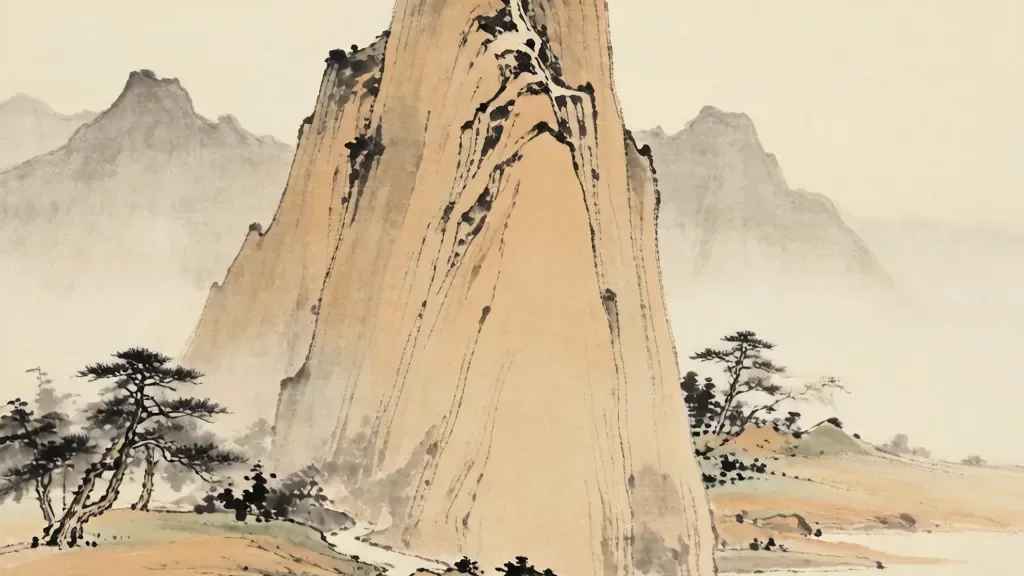
Mountains are the bones of the earth, and they are the bones of Chinese poetry. From the sacred peaks of the Five Great Mountains to the mist-wrapped ranges of the south, Chinese mountains have been climbed, painted, worshipped, and sung for as long as the Chinese people have written poetry. Mountain poetry (咏山诗, yongshan shi) is the tradition of verse that scales the heights — a poetry of ascent, of perspective, of the view from above that reveals the world in its true proportions.
Sacred Mountains: The Five Great Peaks
The Five Great Mountains (五岳) of China — Mount Tai in the east, Mount Hua in the west, Mount Heng in the south, Mount Heng (different character) in the north, and Mount Song in the center — have been objects of imperial pilgrimage since ancient times. The emperor would climb Mount Tai (泰山) to perform the fengshan sacrifice, announcing to heaven that he had ruled well. The poet Du Fu's 'Looking at Mount Tai' (望岳) captures the mountain's majesty: 'How is this great peak? / The lands of Qi and Lu are green forever. / The creative spirit has gathered its beauty here; / the yin and yang divide the dawn and dusk.'
The sacred mountains were also sites of religious practice. Daoist hermits built monasteries on their slopes; Buddhist pilgrims climbed them to visit temples. The Song poet Su Shi wrote of Mount Lu (庐山): 'From the side, a whole range; from the end, a single peak. / Far, near, low, high — no two parts alike. / I cannot tell the true shape of Mount Lu / because I am myself inside the mountain.' The mountain becomes a lesson in epistemology: truth depends on perspective.
Climbing and the Poetry of Ascent
The act of climbing a mountain — the physical effort, the changing view, the final attainment of the summit — is a central motif in Chinese poetry. The climb is a metaphor for moral and spiritual aspiration. The Tang poet Wang Zhihuan's 'Ascending the Stork Tower' makes this explicit: 'To see a thousand miles further, climb one more story.' The view from the height is not merely a visual reward; it is a spiritual achievement.
Li Bai's 'Climbing the North Tower of Xie Tiao at Xuanzhou' describes the view from a mountain pavilion: 'I climb the tower at Xuanzhou, / where Xie Tiao once wrote his poems. / A thousand years have passed — / but the mountains and rivers are still the same.' The climber stands where a previous poet stood, seeing the same landscape that inspired earlier poems. The act of climbing becomes an act of connection across time.
The Mountain Hermitage
The mountain recluse who lives in a small hut or temple on the slopes of a mountain is one of the most persistent images in Chinese poetry. The mountain is the place of withdrawal, of spiritual practice, of freedom from the demands of society. The Tang poet Jia Dao (贾岛, 779–843 CE) wrote of the hermit's life: 'I asked the boy beneath the pines: / he said the master had gone to gather herbs. / He is somewhere on the mountain — / so deep in the clouds I cannot find him.' The hermit is hidden, inaccessible, free.
The mountain hermitage is also the setting for Chan Buddhist poetry. The Chan monk-poet Hanshan lived in a cave on Cold Mountain, and his poems describe a life of extreme simplicity: 'I live on Cold Mountain, / with a stone for a pillow and the sky for a roof. / No one comes to visit — / only the moon and the wind are my guests.' The mountain is not a place to visit; it is a place to live, a place to become what one truly is.
Mountains of Exile
For poets banished from the capital, the mountains of the south were the geography of exile. The mountains of Hunan, Guangxi, and Guangdong — wild, misty, and unfamiliar — represented everything the poet had lost. Liu Zongyuan, exiled to Yongzhou in Hunan, wrote poems about the mountains that surrounded him: 'The mountains of Yongzhou are / like green jade hairpins / holding up the sky. / I climb them every day — / but they do not bring me closer to home.'
Han Yu, exiled to Chaozhou in Guangdong, wrote of the mountains that blocked his return: 'The clouds of Mount Heng cross the road; / the snow of the Blue Pass blocks the horse's progress. / You ask me where I am going: / the barbarian land of Zhang, beyond the eight passes.' The mountains that should be beautiful become barriers, walls that separate the exile from everything he loves.
The View from the Summit
The summit poem is a genre of its own. The poet who has reached the top looks out over the world and sees it whole. This is the moment of clarity, of perspective, of understanding. Li Bai's 'Ascending Mount Emei' describes the view: 'I climb the peak of Mount Emei; / at my feet, the autumn moon rises. / The thousands of peaks are like the sea; / the lights of a million houses flicker below.' The view from the summit is both literal and metaphorical: the poet sees the world in its true scale.
The summit poem often ends with a philosophical reflection. Su Shi, after climbing the Red Cliff, wrote: 'Life is like a dream — / how many times can we raise our cups to the moon?' The summit is the place where the distances of the world become visible, and where the poet confronts the distances of time and fate. The mountain does not answer the poet's questions; it simply gives him the view, and the view is enough.
Mountains as Dwellings of Immortals
In Daoist belief, mountains were the homes of immortals, beings who had refined their bodies past death and now roamed the cliffs. This gave climbing a spiritual aim: the poet might, like the seekers before him, encounter a transcendent being or at least breathe the transformed air. Many mountain poems therefore mix travelogue with quest, the summit approached as a threshold into another order of existence.
The Sea of Clouds
From a high ridge the world below dissolves into a sea of clouds, and poets seized this spectacle as an image of liberation from earthly cares. To stand above the cloud sea was to rise above the dust of the world, if only for an afternoon. The motif recurs from Tang inscriptions on Mount Tai to the later cult of Mount Huang, whose clouds became the supreme test of a landscape painter's brush.
Returning to the Mountains
The ideal of leaving office to live in the hills runs through Chinese poetry as a quiet form of protest and self-healing. Tao Yuanming's departure from court to farm life set the pattern: the mountain hermit chooses poverty and freedom over rank and constraint. Even poets who never retired wrote longing poems to the mountains, keeping the retreat as a permanent horizon of the imagination.
❓ Frequently Asked Questions
📝 Chinese Vocabulary
咏山诗 — : Mountain poetry; verses about peaks and ranges
泰山 — : Mount Tai; the most sacred of the Five Great Mountains
五岳 — : The Five Great Mountains of Chinese sacred geography
庐山 — : Mount Lu; the mountain of Su Shi's famous epistemological poem
望岳 — : Gazing at the Peaks; Du Fu's famous young poem on Mount Tai
仙 — : A transcendence-seeking immortal associated with mountains
云海 — : Sea of clouds; the misty expanse seen from high peaks
归隐 — : Returning to seclusion; the ideal of retreating to the mountains
🎉 Fun Facts
- Mount Tai has been climbed by emperors and poets for over three thousand years. The mountain is covered with stone inscriptions — poems and prayers carved into the rock.
- Du Fu's 'Looking at Mount Tai' was written when he was about 25 years old — before his life was transformed by exile and poverty.
- Mount Hua, the western sacred peak, is famous for the most dangerous hiking trail in China — a series of wooden planks bolted to a vertical cliff face.
- Mount Huang in Anhui, though not one of the Five Great Peaks, became the most painted mountain in later Chinese art and a favorite of poets for its sea of clouds.
- Daoist seekers believed mountains were the dwelling places of immortals who had escaped death, which is why so many poems speak of climbing to seek the way.
- The ideal of returning to the mountains was so respected that even powerful officials staged mountain retirements to gain moral prestige.