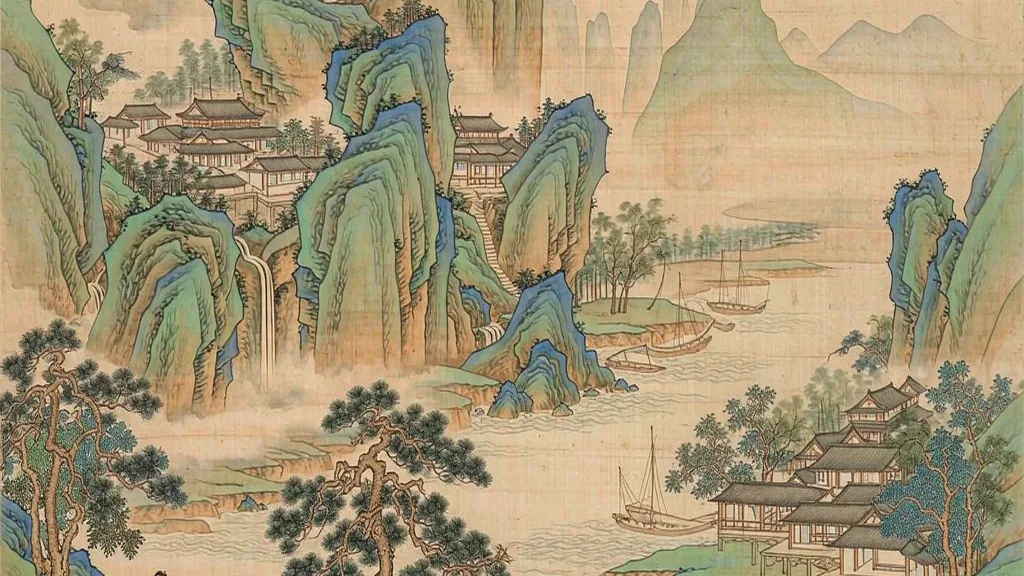
China is a civilization shaped by rivers — the Yellow River in the north, the Yangzi in the south, and the countless streams, canals, and tributaries that connect them. Chinese poets have celebrated rivers for over two thousand years, finding in their flow the image of time, in their depths the symbol of eternity, and in their banks the settings for love, war, and meditation. River poetry (咏江诗, yongjiang shi) is one of the most important traditions in Chinese literature, a poetry that moves as ceaselessly as the waters it describes.
The Yellow River: The Sorrow of China
The Yellow River (黄河, Huang He), the 'Mother River' of Chinese civilization, is also the most destructive. Its floods have killed millions; its course has shifted dramatically over the centuries. Chinese poets have written about the Yellow River with a mixture of reverence and terror. Li Bai's 'Bring in the Wine' opens with the most famous description: 'Do you not see the Yellow River's waters descending from heaven, / rushing to the sea, never to return?' The river is a cosmic force, indifferent to human fate.
The Yellow River was also a symbol of the nation's fate. When the river flooded, it was interpreted as a sign that the emperor had lost the Mandate of Heaven. When it flowed peacefully, it was a sign of good governance. The Song poet Wang Anshi wrote: 'The Yellow River is pure for a thousand years once; / but how many times is the ruler truly wise?' The river's turbid waters were a perpetual reminder of the gap between political reality and political ideal.
The Yangzi River: The Great River of Poetry
The Yangzi River (长江, Changjiang) is the true river of Chinese poetry. Its course from the glaciers of Tibet to the sea at Shanghai passes through the most famous poetic landscapes of China: the Three Gorges, the Red Cliff, Lake Dongting, the hills of Jiangnan. The Tang poet Wang Wei wrote of the Yangzi's majestic breadth: 'The river flows beyond heaven and earth; / the mountain colors, in and out of existence.' The Yangzi is the landscape of Chinese poetry embodied.
Su Shi's 'Red Cliff' poems — written while in exile at Huangzhou — meditate on the Yangzi as a witness to history. The Battle of Red Cliff (208 CE), fought on the Yangzi, was a turning point in Chinese history. Su Shi's poems use the river's endless flow to contrast the transience of human ambition: 'The great river flows eastward, / washing away the heroes of a thousand years.' The river endures; the heroes are gone. This is the fundamental insight of Chinese river poetry.
Rivers of Parting: The Farewell River
Rivers were natural settings for farewells. The traveler would cross the river, and the friend left behind would watch from the bank until the boat disappeared. The river was the boundary between the known world and the unknown. The Tang poet Meng Haoran's farewell to his friend on the Yangzi is one of the most beautiful: 'We parted at the eastern bank of the river; / your solitary sail disappeared into the blue sky. / I watch the long river flowing to the sea; / my heart, like the water, goes with you.'
The most famous river farewell scene in Chinese poetry is Li Bai's farewell to his friend Meng Haoran on the Yangzi: 'My old friend takes leave of the Yellow Crane Pavilion to the west; / in the third month, he goes down to Yangzhou amid the mist and flowers. / His solitary sail's distant shadow disappears into the blue sky; / only the long river is visible, flowing to the edge of heaven.' The disappearing sail and the endless river — the human presence fading, the natural presence persisting — is the perfect image of parting.
The River of Exile
For poets who had been banished to the southern frontiers, the rivers they traveled became the geography of exile. The Xiang River in Hunan, the Gan River in Jiangxi, and the Min River in Fujian were associated with the pain of separation from home. Du Fu, drifting on the Yangzi in his last years, wrote some of his most powerful poems on a boat: 'My old illness, / my lone boat, / are the only companions I have left / on this long river flowing east.'
The exiled poet on the river is one of the emblematic figures of Chinese poetry. He is between worlds — between north and south, between the court and the wilderness, between hope and despair. The river carries him forward, but he does not know where he is going. The river becomes the image of life itself: a journey with no fixed destination, a flow that is both liberation and loss.
Rivers and the Philosophy of Flow
The river's ceaseless flow made it a natural symbol for the passage of time. Confucius is said to have stood by a river and said: 'It passes like this, day and night, never ceasing.' The river does not stop, and neither does time. But the river also represents continuity: it is always changing and always the same, and the person who stands on its bank today is connected to everyone who has ever stood there before.
The Song philosopher Zhu Xi (朱熹, 1130–1200 CE) wrote a famous poem about the river as a source of philosophical insight: 'The source of the living water is everywhere — / the square pond is a mirror so clear / that the clouds and shadows wander across it. / Ask the water why it is so clear: / because it has a living source from which fresh water forever flows.' The river, in this Daoist-Confucian reading, is the image of the mind that is constantly renewed by its connection to the source of truth.
Confucius by the Stream
The single most quoted river image in Chinese thought comes from the Analects: Confucius, standing by moving water, sighs that it passes day and night without stopping. This brief moment turned the river into the emblem of time itself. Later poets, watching any current, could summon the Master's sigh to frame their own sense of lost years and unstoppable change.
The Tide at the River's Mouth
At the seaward end of great rivers, the tide reverses the flow and charges upstream as a towering bore, most famously at the Qiantang. Poets treated this returning wall of water as a force both majestic and menacing, fit for images of fate or of an army's advance. The tide thus gave river poetry a second rhythm, not the gentle downstream drift but the sudden upward surge.
The Floating Life
Chinese poets often called human existence the floating life, likening a person to a leaf or a boat carried by the current with no fixed shore. The image softens despair into acceptance: if life is a river, then drifting is simply what it is. Used in parting poems and exile poems alike, the floating life became a gentle philosophy for those the water had carried far from home.
❓ Frequently Asked Questions
📝 Chinese Vocabulary
咏江诗 — : River poetry; verses about great rivers
长江 — : The Yangzi River; China's longest river
黄河 — : The Yellow River; the 'Mother River' of Chinese civilization
大江东去 — : 'The great river flows east'; opening of Su Shi's Red Cliff poem
逝者如斯夫 — : It passes like this — Confucius' saying by the river about time
三峡 — : The Three Gorges; the famed Yangzi gorges of poetry
潮 — : The tide; the sea-bound surge often used in river and coastal verse
浮生 — : Floating life; the drifting existence likened to a river
🎉 Fun Facts
- The Yangzi River is the third-longest river in the world, flowing 6,300 km from Tibet to the East China Sea.
- The Three Gorges (三峡) on the Yangzi have been the subject of poems for over 1,500 years. The construction of the Three Gorges Dam in the 2000s submerged many of the sites described in classical poetry.
- Su Shi's 'Red Cliff' poems mistake the actual site of the battle — he was at a different red cliff on the Yangzi. But the poems are so great that nobody cares about the geography.
- Confucius is reported to have sighed by a river that it passes day and night without ceasing, making the flowing water a two-thousand-five-hundred-year-old image for time.
- The Qiantang tidal bore, where the sea rushes up the river mouth, inspired spectacular poems about the power of the advancing tide.
- The phrase floating life compares human existence to a leaf borne on the current, an image poets used when consoling friends adrift in exile.