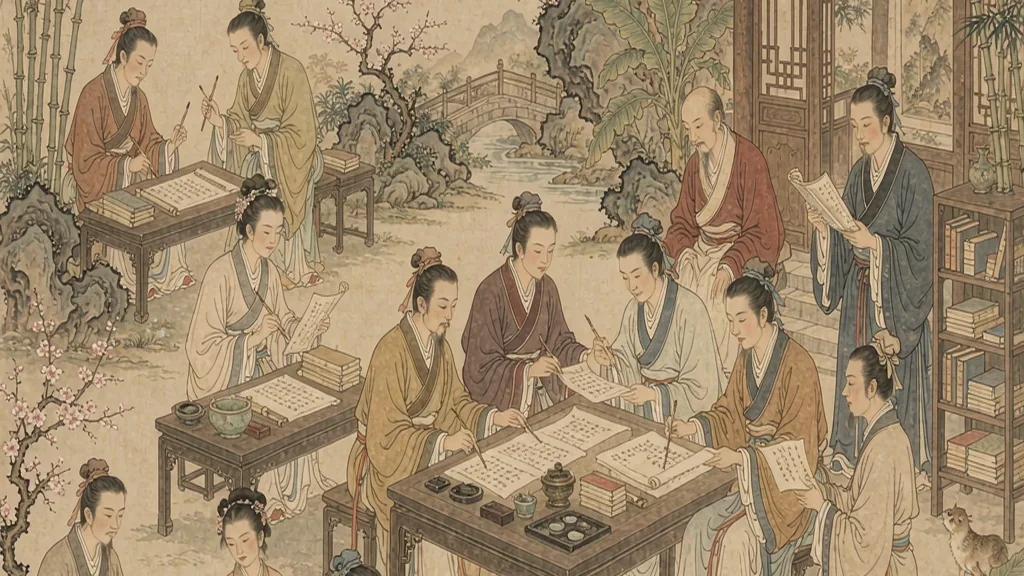
Poetry in China was never only a solitary act; it was also a profoundly social one, sustained by a dense fabric of associations, gatherings, and institutions that we may loosely call the poetry society. From the banquet exchanges of the aristocracy to the monastic verse circles of the Tang, from the literary coterie of the Late Tang to the vast registered poetry clubs of the Ming and Qing, Chinese poets wrote for one another, in answer to one another, and under rules set by one another. These societies shaped taste, trained newcomers, preserved reputations, and turned the writing of verse into a communal discipline. This essay surveys the major forms of poetic association across Chinese history, the practices they cultivated, and the cultural work they performed beyond the page.
Banquet and Court Circles
In the early imperial period, poetry was above all a performance at court and at the aristocratic banquet. Hosts would propose a topic or a rhyme, and guests would compose in turn, the best lines winning praise and the worst gentle ridicule. The Tang imperial court, especially under the early emperors, sponsored such gatherings, and the figure of the court poet who could produce a flawless occasional couplet on command was a recognized type. These circles valued fluency and wit as much as depth, and they established the norm that poetry should be shared aloud among peers rather than hoarded in private.
The banquet model also explains the many surviving poems addressed "to" or "answering" a friend, since the occasion of composition was often a specific social event. The poem was a gift, a reply, and a record of fellowship as much as a self-contained artwork.
The Monastic and Reclusive Circles
The Tang also saw the rise of verse circles centered on temples and on communities of retired or semi-retired literati. Monks who wrote poetry attracted lay visitors, and famous abbots exchanged verses with officials seeking spiritual counsel or simple escape from the capital. The poet Wang Wei and others moved easily between court and cloister, and the quiet of the temple garden became a favored site for small gatherings. These circles prized restraint and naturalness, offering an alternative to the competitive brilliance of the court.
Such associations were informal compared with later clubs, but they were no less important for the transmission of style. A young poet visiting a famous monk or elder could absorb a whole manner of composition through conversation and exchange, so the circle functioned as an informal academy.
The Late Tang Coterie and the "Fragrant Coterie"
A striking example of self-conscious poetic association is the group of poets around the end of the Tang known for their polished, sensuous courtly verse, sometimes gathered under the label of a "fragrant coterie" centered on the figure of Wen Tingyun and the early ci. These poets shared a taste for intricate diction and entertainment song, and their mutual influence helped define the emergent lyric. Though the label was partly a later construction, it reflects a real pattern: poets clustering around a style and a milieu, reinforcing one another's choices.
The phenomenon shows that societies could form around a genre as much as a place. The early ci poets constituted a society of manner before they had any institution, bound by shared musical and erotic sensibility.
Song Dynasty Literary Circles
The Song dynasty elevated the literary circle to a matter of intellectual identity. Great figures such as Ouyang Xiu, Su Shi, and Wang Anshi gathered disciples and friends in networks that were at once literary, philosophical, and political. To belong to Su Shi's circle was to share a posture toward life as well as a way of writing, and the exile of the master only spread his style further as students carried it to the provinces. These circles produced vast correspondence in verse, with poems answering poems across hundreds of miles.
The Song also developed the practice of the literary gathering recorded in a preface, where the occasion, the guests, and the wine are documented as seriously as the poems. The preface tradition, descended from the Orchid Pavilion model, turned the society's meetings into durable literary events.
The Poetry Club in the Late Imperial Age
By the Ming and Qing dynasties, poetry societies had become formal organizations with names, members, and regular meetings. During the late Ming, especially in the Jiangnan region, a profusion of such clubs brought together examination candidates, retired officials, and local gentry, who would convene to compose on assigned topics and critique one another's work. Some societies numbered in the hundreds and maintained published anthologies. The famous revivalist groups of the period explicitly set out to reform contemporary style through collective discipline, proving that the society could be a force in literary politics.
These clubs also served social and even political functions, providing networks of patronage and, in turbulent times, cover for dissent. The Qing state, wary of association, sometimes suppressed large societies, revealing how threatening a gathering of poets could seem to rulers.
Practices: Rhyme Games and Topics
The characteristic activities of the poetry society included the rhyme game, in which a fixed set of rhyme characters was distributed and each member had to compose using them in order, and the topic assignment, in which a flower, a season, or an object was given for all to treat. The "linked verse" or "cut-and-continue" game, in which one poet supplied a couplet and the next continued, tested collective agility and produced a single collaborative poem. Such practices trained technical control and quickness, and they made composition a sport as well as an art.
These games should not be dismissed as frivolous. They enforced the formal discipline that the tradition valued, and they built a shared competence so that members could appreciate one another's subtleties. The society was, in effect, a rehearsal space for public verse.
Women's Poetry Societies
An especially important but long-underrepresented facet is the women's poetry society, particularly in the late imperial period. Educated women of gentry families formed their own circles, often connected to male literary households but possessing a distinct voice, and they exchanged verse on domestic, seasonal, and emotional themes. The existence of these societies complicates the picture of poetry as a male court activity, showing that the associative habit reached across gender. Some women's collections survive, preserving a strand of the tradition that the mainstream anthologies long marginalized.
The recognition of women's circles has revised our sense of who the "poetry society" included. It reminds us that the communal writing of verse was a broad social practice, not confined to the examination hall or the capital.
Legacy and Modern Echoes
The poetry society did not vanish with the empire. In the modern period, literary magazines, salons, and online forums have assumed some of its functions, providing peers to answer, critique, and preserve one another's work. The classical-style poetry club, writing in regulated forms, still meets in parts of the Chinese-speaking world, treating the old social disciplines as living heritage. The underlying impulse, to write verse among friends under shared rules, remains recognizable across the gulf of form.
To study the poetry society is to see that Chinese poetry was a conversation conducted in public, a craft learned shoulder to shoulder. The solitary genius is the exception; the gathered circle is the norm, and the poems we treasure are often the residue of a night's friendly competition beneath the lamp.
❓ Frequently Asked Questions
Was Chinese poetry a social activity?
Strongly so; poets wrote for and in answer to one another under shared rules, making verse a communal discipline.
What did poetry societies do?
They met to compose on assigned topics, play rhyme games, critique work, and publish anthologies of members.
What is linked verse?
A collaborative game where one poet gives a couplet and the next continues, building a single joint poem.
Were there women's societies?
Yes, late imperial gentry women formed circles with a distinct voice, long marginalized by mainstream anthologies.
How formal were late imperial clubs?
Highly formal, with names, members, regular meetings, and sometimes hundreds of participants and printed collections.
Do poetry societies survive today?
Yes, classical-style clubs still meet, and modern magazines and forums carry on the peer-exchange function.