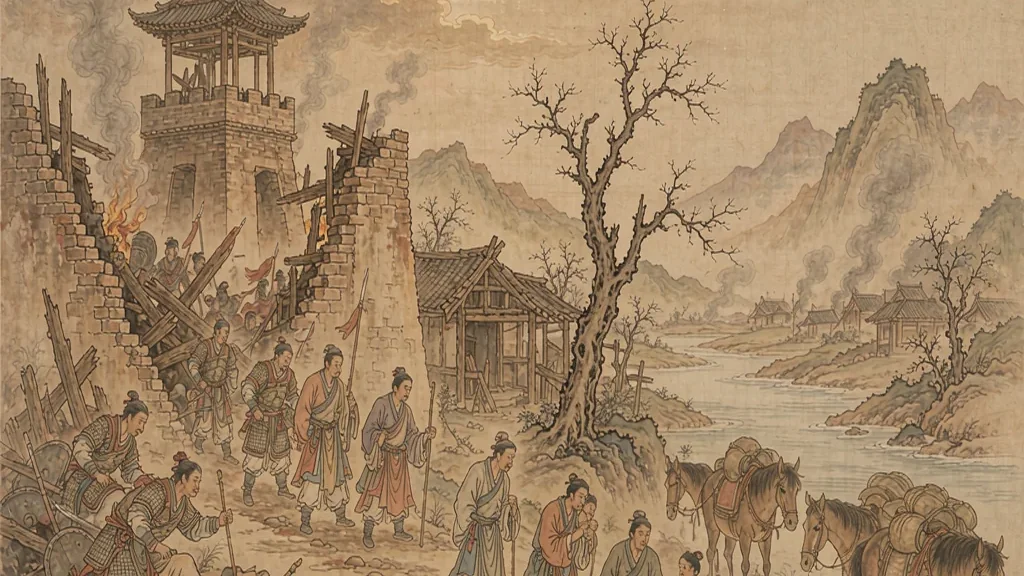
Chinese civilization has known war for as long as it has known peace. The earliest poems in the Shijing are soldiers' songs and homesick wives' laments. The great dynasties expanded and collapsed through military force. And through it all, Chinese poets have written about war — its heroism and its horror, its glory and its waste, the fellowship of arms and the loneliness of the survivor. War poetry (战争诗, zhanzheng shi) in the Chinese tradition is not a celebration of conquest but a meditation on suffering, a demand for justice, and a record of what human beings do to each other.
The Shijing and the Earliest War Poems
The Shijing contains many war poems, but they are not patriotic anthems. They are soldiers' songs. One of the most famous, 'The Plantain Gatherers,' describes troops marching to the sound of drums: 'Our soldiers beat the drums and raise a clamor; / we rise up and advance. / People of Cao and their troops / we challenge and respond. / We climb the walls and besiege them, / we cannot conquer them; / this grief has no end.' The poem is not about victory but about frustration and loss.
Another Shijing poem, 'Gathering Bracken' (采薇), describes a soldier fighting the Xianyun tribes on the northern frontier. The final stanza is one of the most poignant in all of Chinese poetry: 'I went on campaign; / the willows were softly spring. / I come back now; / the snow falls in a storm. / I walk slowly, hungry and thirsty; / my heart is sad. / No one knows my sorrow.' The contrast between the beauty of the willows when the soldier left and the snow when he returns captures the pathos of all wars.
The Han and the Frontier War Tradition
The Han dynasty's long wars against the Xiongnu produced a new body of war poetry, much of it in the yuefu style. The Han yuefu poems about war are notable for their unblinking depiction of suffering. 'The Battle South of the City Wall' describes a battlefield where 'the dead lie unburied, / their bones white in the sun. / The crows and kites feast.' There is no glory in these poems, only the brutal reality of death.
The frontier war tradition continued through the Tang, when poets like Wang Changling, Cen Shen, and Gao Shi wrote about the soldiers defending the northwestern passes. Their poems combine pride in the soldiers' courage with anger at the commanders who wasted their lives. 'Our generals have been defeated ten times, / but the dead men are not mourned. / Their blood has soaked the desert sand. / They lie where they fell.' The Chinese war poet is not a propagandist; he is a witness.
Du Fu and the An Lushan Rebellion
Du Fu's war poems from the An Lushan Rebellion are among the most powerful antiwar poems ever written. He was a refugee in his own country, separated from his family, and he saw the war not from the perspective of the commanders but from the perspective of the people who suffered most. 'The Pressgang at Shihao Village' describes a village where every man of military age has already been conscripted, yet the recruiters return to take an old man and his daughter-in-law.
Du Fu's famous poem 'Spring Prospect' — written while he was a prisoner in rebel-occupied Chang'an — uses the beauty of spring to sharpen the pain of war: 'The nation is broken, but the mountains and rivers remain. / Spring in the city — the grass and trees grow deep. / Grieving at the times, even flowers bring tears. / Hating separation, the birds' song startles the heart.' The flowers and birds are not indifferent to human suffering; they intensify it by reminding the poet of the peace that has been destroyed.
Li Bai and the Cost of Empire
Li Bai also wrote war poems, though in a different register. His 'Fighting South of the Ramparts' describes a battle in the context of imperial ambition: 'Last year we fought at the source of the Sanggan River; / this year we fight at the banks of the Cong River. / We have washed our swords in the waves of the Tianshan Mountains; / we have fed our horses to the grass beyond the sea.' The poem traces the widening arc of imperial war until it concludes with a devastating image: 'The desert sand has turned white with the bones of soldiers.'
Li Bai's 'Silk-Washing Stream' series includes poems from the home front — women washing silk while their husbands serve on distant frontiers. The women's labor continues, but their hearts are absent: 'My husband is fighting at the Phoenix Tower. / I go on washing silk as before. / But the silk is not as white as / the bones that lie under the desert snow.' The juxtaposition of domestic peace and distant slaughter is typical of Chinese war poetry's moral imagination.
War Poetry After the Tang
The Song dynasty, which faced constant military threats from the Khitan and Jurchen, produced its own war poetry, much of it suffused with a sense of loss. The Song had lost control of the northern heartland, and its war poets wrote not about glorious campaigns but about the territories that had been surrendered. Lu You dreams of the reconquest of the north in poem after poem, knowing he will never see it. Xin Qiji, a general who was never allowed to fight the war he wanted, wrote some of the most passionate military ci poems in the language.
In the twentieth century, Chinese war poetry took on new forms and subjects. The anti-Japanese war (1937–1945) produced a flood of patriotic verse, some in classical forms and some in the new vernacular. The Korean War produced poems that both celebrated and questioned the sacrifice of Chinese soldiers. Today, Chinese war poetry continues to wrestle with the same questions that the Shijing poets asked two and a half millennia ago: what is the cost of war, and who pays it?
The Boudoir Lament
War poetry is not only male and martial. The boudoir lament gives voice to the women whose husbands and sons marched to the frontier and did not return. Their poems speak of an untouched robe, a cold pillow, a willow planted at parting now grown old. Read beside the soldiers' songs, these laments complete the accounting of war, showing that every conscript leaves a silent household behind.
Out of the Pass: The Frontier Poem
The frontier, out of the pass, was where the Tang empire met the desert, and it generated a distinct kind of war verse. Poets like Wang Changling and Cen Shen evoked the glare of snow, the blare of military horns, and the fragility of a single life against the steppe. These poems honor courage yet question the commanders who spend soldiers like sand, holding glory and waste in the same breath.
The Beacon Fire and the Breaking of Peace
Along the northern frontier, a chain of beacon towers turned smoke by day and fire by night into the empire's alarm system, and the beacon fire became poetry's abrupt sign that peace has ended. When a poet names the beacon fire, the reader knows conscription, separation, and grief will follow. The single rising column thus carries the whole weight of the state's violence into a quiet line.
❓ Frequently Asked Questions
📝 Chinese Vocabulary
战争诗 — : War poetry; verse about military conflict
采薇 — : 'Gathering Bracken'; the most famous Shijing war poem
杜甫 — : Du Fu; the supreme poet of war's human cost
边塞诗 — : Frontier poetry; war poetry set on the borders
闺怨 — : Boudoir lament; poems of women waiting for soldiers who never return
出塞 — : Out of the Pass; the title pattern of frontier war poems
征人 — : The conscript; the drafted soldier of war poetry
烽火 — : Beacon fire; the signal that warned of invasion
🎉 Fun Facts
- The An Lushan Rebellion (755–763 CE) was one of the deadliest conflicts in human history, with an estimated 13 million deaths.
- Du Fu was captured by rebel forces in 756 and held prisoner in Chang'an for over a year. His poems from this period are his most powerful.
- The poem 'Gathering Bracken' from the Shijing is over 2,500 years old, yet its final lines remain the most quoted description of the soldier's fate in Chinese literature.
- The boudoir lament became a major subgenre in which women left at home voiced the silent cost of war while their husbands served on the frontier.
- Frontier poems often open with the phrase going out of the pass, naming the northwestern gateway where soldiers left the cultivated world for the desert.
- Beacon towers along the Great Wall relayed invasion news by smoke by day and fire by night, and the beacon fire appears as a sudden rupture in many war poems.