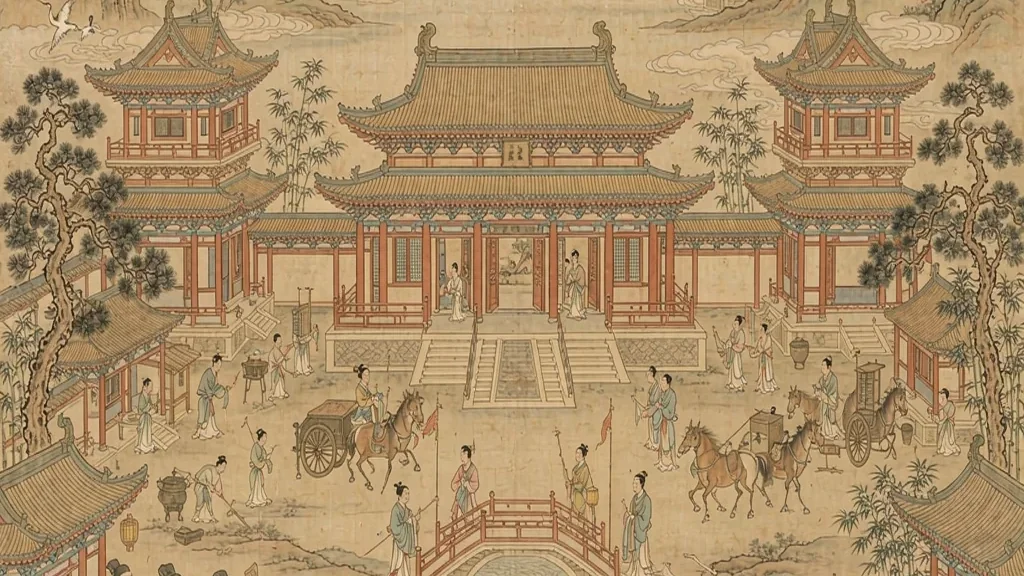
Chinese poetry is not all lyric brevity. Beside the compact intensities of the jueju and the lüshi stands a tradition that is expansive, ornate, and joyfully excessive — the fu (赋), often translated as "rhapsody" or "prose-poem." The fu is Chinese poetry let loose: it piles epithet on epithet, catalogues exhaustively, and describes its subject — a capital city, a hunt, a musical instrument, a landscape — with encyclopedic fullness. If the jueju is a diamond, the fu is a mural stretching across an entire palace wall. It was the first major poetic form developed after the Shijing and the Chuci, and it remained a prestigious literary mode for over a thousand years.
The Origins of Fu in the Han Dynasty
The fu emerged during the Han dynasty (206 BCE–220 CE) as a synthesis of two earlier traditions: the rhetorical prose of the Warring States diplomatic envoys and the extravagant imagery of the Songs of Chu. The word fu originally meant 'to present' or 'to recite' — a hint of the form's origins in oral performance. Early Han fu were written to be declaimed at court, and they served both to entertain the emperor and to display the poet's learning.
The greatest early master of the fu was Sima Xiangru (司马相如, 179–117 BCE), a Han court poet whose rhapsodies on the imperial hunting parks are masterpieces of verbal excess. His 'Rhapsody on the Imperial Park' (上林赋) describes the emperor's vast hunting preserve with a list of mountains, rivers, plants, animals, and supernatural beings that rolls on for pages. The poem is not so much about a place as it is about the sheer power of language to create worlds. Sima Xiangru's fu set the standard for all subsequent rhapsody writers.
The Rhetoric of Excess: Catalogues and Hyperbole
The fu is built on the principle of exhaustive description. If a poet is describing a city, he catalogues every type of building, every luxury good, every food, every garment, every musical instrument, and every attractive person in it. The rhetorical strategy is accumulation: the reader is overwhelmed by the sheer quantity of beautiful things, and this overwhelming becomes the poem's meaning. The fu does not tell you that the Han capital is magnificent; it buries you in magnificence until you cannot doubt it.
This technique of cataloguing was not naive display. Han dynasty fu poets were acutely aware of the moral dangers of luxury, and many rhapsodies contain a hidden critique. A typical fu structure is: first, a description of extravagant wealth and pleasure; second, a sudden turn in which the poet or the emperor recognizes the emptiness of such pleasures; third, a Confucian moral conclusion praising simplicity and good governance. The catalogue of excess is thus a form of moral demonstration: we must first understand the seduction of luxury before we can appreciate the virtue of rejecting it.
The Subgenres of Fu
Over the centuries, the fu developed into several distinct subgenres. The earliest and most spectacular was the jingdu fu (京都赋, 'capital rhapsody'), which described the imperial capital in all its splendor. Ban Gu (班固, 32–92 CE), the great Han historian, wrote a famous 'Rhapsody on the Two Capitals' (两都赋) comparing the merits of Luoyang and Chang'an. There were also wu fu (物赋, 'object rhapsodies') on particular things — musical instruments, plants, literary works — and qing fu (情赋, 'affective rhapsodies') on emotions like sorrow and longing.
A particularly significant subgenre was the shan fu (山赋, 'mountain rhapsody') and shui fu (水赋, 'water rhapsody'), which described natural landscapes with the same encyclopedic enthusiasm that earlier poets had devoted to imperial parks. These nature fu prepared the way for the landscape poetry of the Six Dynasties and Tang periods. The fu's descriptive techniques — its love of specific detail, its willingness to sustain a single subject across hundreds of lines — had a lasting influence on all subsequent Chinese nature writing.
The Transformation of Fu After the Han
After the Han dynasty, the fu underwent significant changes. The Six Dynasties period saw the rise of the pianfu (骈赋, 'parallel-style fu'), which married the descriptive ambition of the Han fu with the rhythmic elegance of parallel prose. Poets like Cao Zhi and Lu Ji wrote fu that were shorter, more lyrical, and more personal than the sprawling Han originals. The pianfu used balanced couplets and four-six rhythmic patterns that made the form more musical and less overwhelming.
During the Tang dynasty, the fu was incorporated into the civil service examination system. This led to the development of the lüfu (律赋, 'regulated fu'), which imposed strict rules of rhyme, tone, and length on the form. The lüfu is often considered the least artistically successful version of the fu — too constrained to achieve the ancient form's characteristic excess, but still burdened with the expectation of exhaustive description. Nevertheless, the regulated fu produced some interesting works and confirmed the fu's status as an essential part of the educated person's literary toolkit.
The Fu Legacy: Influence and Rediscovery
The fu's influence extended far beyond its own genre. Its descriptive techniques shaped Chinese nature poetry, travel writing, and eventually prose fiction. When Tang poets like Li Bai wrote their long, extravagant poems of imaginative flight — poems that seem to pile image on image without restraint — they were drawing on fu techniques. The fu's love of lists and catalogues also influenced the development of Chinese encyclopedias and the 'display of learning' (caixue, 才学) tradition in literature.
In the twentieth century, the fu was largely neglected by Western translators and modern Chinese critics, who favored the more accessible lyric forms. But recent scholarship has rediscovered the fu as a unique literary achievement — a form that, at its best, achieves a kind of sublime excess that no other Chinese genre can match. Reading a great fu is like walking through a palace built entirely of words, where each hall opens onto another still more magnificent. The form remains one of the most distinctive contributions of Chinese literature to the world's poetic traditions.
The Rhapsody and the Imperial Court
From the start the rhapsody belonged to the court. Early masters wrote to be declaimed before the throne, displaying learning while entertaining the ruler, and emperors themselves commissioned rhapsodies to mark victories, hunts, and new buildings. This patronage shaped the form's scale; a poem meant for a ruler had to be grand enough to match imperial majesty. Yet the court link also gave the rhapsody its critical edge, since the safe place to hint at excess was inside a dazzling description that the emperor had requested. The rhapsody thus became a strange hybrid, at once flattery and caution, spectacle and sermon. Its history shows how close praise and warning could sit in a monarchy where direct advice was risky. The form taught poets to argue by abundance, burying a moral point under so much beauty that the ruler arrived at it as if by his own taste.
Desire and the Goddess: Romantic and Allegorical Rhapsody
Some of the most influential rhapsodies are love poems in disguise. The famous rhapsody on the Gaotang goddess has a king dream of a woman who is herself the mountain's rain and cloud, a union of desire and landscape that later poets reused for centuries. Such works let the form explore longing, absence, and the meeting of human and divine, often with an allegorical undertow in which the goddess stands for a patron or a lost ideal. The romantic rhapsody proved that the genre's descriptive engine could serve intimacy as well as empire, piling detail on a body, a chamber, or a moment of parting. These poems bridged the public rhapsody and the private lyric, and their imagery of mist, dream, and distance fed straight into the love poetry and the palace-style verse of later ages. Desire, in the rhapsody, became a way to describe the ungraspable.
The Rhapsody in Modern Scholarship and Translation
For much of the twentieth century the rhapsody was a blind spot. Translators skipped its length, and literary historians treated it as a courtly curiosity beside the clean lyric. That judgment has reversed. Scholars now read the rhapsody as a key to Han imagination, a form that built worlds out of words and preserved the era's sense of scale, wonder, and moral anxiety. New translations and annotated editions have made the great Han and Six Dynasties examples available, and comparative work links the rhapsody to long descriptive poems elsewhere. The recovery matters because the form shaped later nature writing, travel prose, and even the habit of displaying learning through lists. To neglect the rhapsody is to miss the strand of Chinese literature most confident in language's power to create abundance, the strand that believes a poem can be a palace built entirely of sentences, room opening onto room.
❓ Frequently Asked Questions
📝 Chinese Vocabulary
赋 — : Rhapsody or prose-poem; a descriptive, often encyclopedic literary form
司马相如 — : Sima Xiangru; the greatest Han dynasty master of the fu
骈赋 — : Parallel-style fu; a Six Dynasties development using balanced couplets
京都赋 — : Capital rhapsody; fu describing the imperial capital
律赋 — : Regulated rhapsody; the examination form that imposed strict rhyme, tone, and length rules on the genre.
上林赋 — : Rhapsody on the Imperial Park; Sima Xiangru's sprawling masterwork describing the emperor's hunting preserve.
楚辞 — : Songs of Chu; the southern poetic tradition whose extravagant imagery helped shape the rhapsody.
两都赋 — : Rhapsody on the Two Capitals; Ban Gu's comparison of the merits of Luoyang and Chang'an.
🎉 Fun Facts
- Sima Xiangru was so poor before his career took off that his future father-in-law refused to let him marry his daughter — until the young couple eloped and opened a wine shop.
- The longest fu in Chinese literature is Zhang Heng's 'Rhapsody on the Western Capital,' which runs to over 5,000 characters.
- Tang dynasty civil service examinations required candidates to compose a lüfu (regulated fu) as part of the jinshi degree test.
- The rhapsody was so bound to the court that emperors sometimes commissioned one to celebrate a military victory or the building of a new palace.
- An early rhapsody by Mei Sheng, cast as a cure for a prince's boredom, shows the form's persuasive side and may be the first literary cure in Chinese.
- Some Han rhapsodies run to thousands of characters describing a single hunt, long enough that later readers complained they were exhausting to get through.