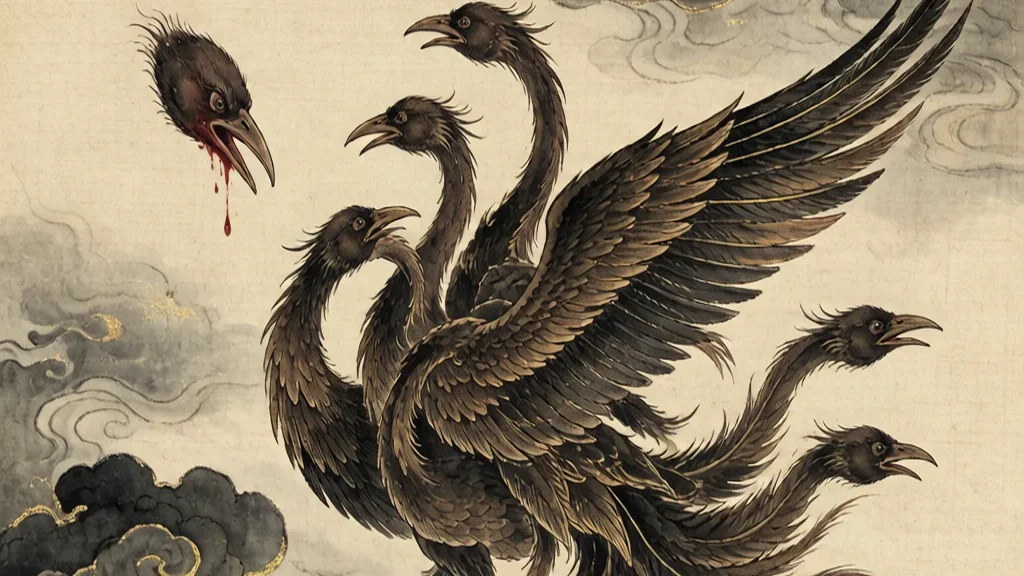
Jiutouniao, written with characters meaning "nine," "head," and "bird" and pronounced as a rolling three-syllable name, is one of the most uncanny omen birds in the Chinese bestiary, a creature of many heads whose appearance was read as a sign of misfortune. Its roots lie in the Shan Hai Jing, where a nine-headed phoenix-like being appears among the gods of the northern wilderness, and it later evolved in popular lore into the "ghost chariot" bird, a nine-headed (or nine-headed-with-one-lost) creature whose cry and falling blood marked it as a bringer of ill omen. To study the nine-headed bird is to trace how a mythic figure of the classic became a living proverb of warning, a winged emblem of the bad luck that the Chinese imagination liked to personify in the sky.
Origins in the Classic of Mountains and Seas
The earliest ancestor of the nine-headed bird is found in the Shan Hai Jing, which describes a nine-headed phoenix, sometimes rendered as a "nine-phoenix," in the accounts of the far north. This being is presented among the divine figures of the directional wilderness, a bird with many heads that marks the strange and sacred character of that quarter. The classic's compilers, layering geographical lore and shamanic invention, treated the multi-headed bird as a real if wondrous inhabitant of the mythic map, and its nine heads announced a creature of unusual and probably supernatural potency. From this sober classical entry the figure would, in later centuries, acquire a darker popular reputation.
The number nine, as so often in Chinese thought, signals fullness or multiplicity rather than a merely literal count, and a nine-headed bird thus reads as a bird of excess, a natural form pushed past its proper limit into the uncanny. The Shan Hai Jing's taste for such composites made the creature at home in its pages, where hybrid and multiplied bodies were the rule rather than the exception.
The Ghost Chariot Bird of Later Lore
In the popular tradition that grew after the classic, the nine-headed bird became known as the "ghost chariot," a nocturnal omen bird said to fly through the darkness with a sound like a passing cart and to drip blood from a wounded or missing head. One widespread version holds that the bird originally had ten heads, but one was cut off, and the wound never healed, so that it continually bleeds and cries. This gruesome detail transformed the classical wonder into a figure of dread, a bird whose very body told a story of injury and loss, and whose presence near a home was taken as a forecast of trouble or death.
The "ghost chariot" name captures the creature's eerie passage: like a silent cart rolling through the night, it moved unseen but heard, and the blood it shed was believed to bring curse or calamity to whatever it touched. Households that heard its cry might shutter their windows and guard against misfortune, turning the bird into a practical prompt for caution, much as other omen creatures did for fire or flood.
Appearance and Nine Heads
The defining trait of Jiutouniao is, of course, its multiple heads, most often given as nine, with the variant of a missing or wounded head in the ghost-chariot version. Descriptions sometimes clothe it in dark or variegated plumage suited to a night bird, and its cry is emphasized more than its colors, since the sound was the thing that alerted listeners to its passage. The image of many heads on one body is inherently unsettling, suggesting a creature that sees and speaks in all directions at once, impossible to evade and impossible to read as a single intention.
Artists who depicted the nine-headed bird, especially in illustrated editions of the strange-tale literature, faced the challenge of rendering so many heads without losing the sense of a bird, and they typically arranged the heads in a fan or crown around the neck, each beak open in a shared cry. The result is a memorable emblem of excess and omen, a creature that looks like a flock compressed into one body, and therefore like a portent rather than a natural animal.
Omen of Misfortune
The central role of Jiutouniao in belief was as a bearer of bad luck. Unlike the one-legged Bi Fang who warned of fire, the nine-headed bird warned of broader misfortune, illness, or death, and its cry was something to be feared rather than merely noted. The logic of the omen treated the bird as a messenger from the realm of the dead or the disordered, a being whose unnatural form signaled that the normal boundaries between worlds had thinned. To hear it was to be reminded that danger could arrive unlooked-for, and the reminder itself was the protective function of the belief.
As with other omens, the practical effect was vigilance. A society that personified misfortune as a bleeding night bird could transmit caution through story, teaching listeners toheed warnings and prepare for trouble. Whether or not people literally feared the creature, the tale trained attention on the fragility of fortune, a lesson with real survival value in hard times.
Relationship to the Nine-Phoenix
The classical nine-phoenix and the later ghost-chariot bird are best understood as branches of one tradition, the first a solemn divine being of the Shan Hai Jing and the second a fearful popular omen. The shift from revered to dreadful reflects how the same multiplied-body motif could be charged differently as it moved from the courtly geographic classic into the oral culture of the village. The nine-phoenix retained a place in the learned bestiary, while the nine-headed bird of the people became a byword for curse, and both survived side by side in the rich layered memory of Chinese myth.
This duality shows the flexibility of the bestiary, in which a figure could be at once a sacred wonder and a household bogeyman. The nine heads remained the constant; only the moral charge changed, from awe to alarm, as the creature migrated from one register of belief to another.
Role in Proverb and Folklore
The nine-headed bird entered Chinese proverb as a symbol of the inescapable or the all-seeing troublemaker, and regions such as Hubei famously adopted a self-deprecating saying that pairs the nine-headed bird with the local people, turning the omen into a mark of distinctive cleverness. Folk storytelling used the creature to warn children and to explain unexplained misfortune, attributing bad luck to the passing of the bird rather than to random chance. In this way Jiutouniao did cultural work, providing a face for anxiety and a story through which communities could name and thus partly master their fears.
The proverb tradition also kept the creature current long after the original classical context faded, so that even people who had never read the Shan Hai Jing knew the nine-headed bird as a figure of ill omen. Myth here functioned as shared language, a set of images everyone could deploy to talk about the uncertain turns of life.
Modern Cultural Memory
Today the nine-headed bird survives in illustrated mythologies, in regional identity sayings, and in modern media that draw on the classical bestiary for striking monsters. He appears in games and fiction as a multi-headed omen or boss creature, and his ghost-chariot variant lends gothic flavor to retellings of Chinese legend. Museums and books keep the Shan Hai Jing's nine-phoenix before the public, while folklore studies record the living proverbs that still invoke the bird in daily speech.
For modern readers, Jiutouniao offers a window into how the Chinese tradition handled fear: not by denying it but by giving it a shape, a cry, and a story, so that the unseen danger could be named and watched for. The nine heads remain a powerful image of excess and omen, a reminder that the Chinese cosmos, for all its order, always left room for the strange and the dread.
Variations Across Regions
The legend of the nine-headed bird shifted in detail from place to place, with some regions emphasizing the ghost-chariot night flight, others the wounded missing head and its dripping blood, and still others the classical nine-phoenix as a distinct, more dignified ancestor. These variations reflect the way oral tradition localizes a shared motif, attaching it to particular landscapes, dialects, and fears, so that the same creature could be a courtly wonder in one telling and a village bogeyman in another. The flexibility of the image helped it survive, since each community could reshape it to fit its own sense of omen.
Such regional diversity is a hallmark of Chinese folklore, in which a single mythic type circulates in many versions without losing its core identity. The nine heads remained the signature in every telling, a constant around which local color gathered, and the bird's endurance across regions testifies to the power of a striking visual idea to travel far and adapt widely.
❓ Frequently Asked Questions
What is Jiutouniao?
Jiutouniao is the nine-headed bird of Chinese myth, rooted in the Shan Hai Jing's nine-phoenix and later feared as an omen of misfortune.
Why is the nine-headed bird a bad omen?
Its unnatural many-head form and bleeding night cry marked it as a messenger of illness or calamity.
What is the ghost chariot?
It is the later popular name for the nine-headed bird, said to fly like a silent cart dripping blood.
Where is the bird first described?
A nine-headed phoenix ancestor appears in the Classic of Mountains and Seas among the northern gods.
How did the bird enter proverbs?
Folklore used it to name misfortune, and some regions turned it into a clever self-identifying saying.
Is the nine-headed bird still known?
Yes, it survives in myth books, regional sayings, and modern games as a striking omen creature.