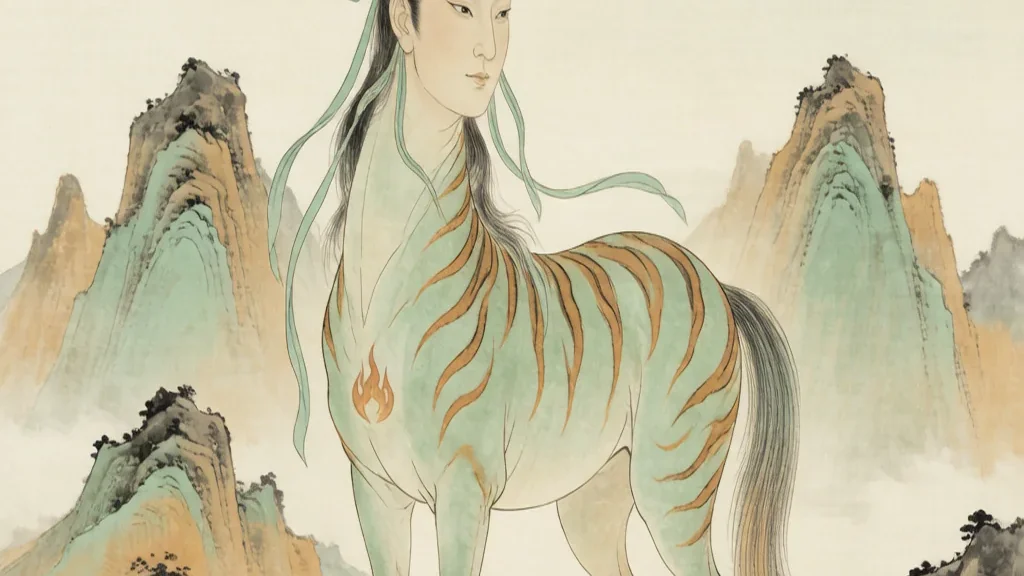
Yingzhao, written with characters suggesting "hero" and "summon" and pronounced as a bright two-syllable name, is one of the stranger and more beguiling beings in the classical Chinese bestiary. Recorded in the Shan Hai Jing, the Classic of Mountains and Seas, Yingzhao is a guardian spirit of the mythic Kunlun mountain, the axis of the world where the Queen Mother of the West and other divinities dwell. He is described as having the body of a horse, the face of a human, the stripes of a tiger, and the wings of a bird, a composite form that marks him as a creature of thresholds, able to move among the earthly, the bestial, and the celestial. To meet Yingzhao in the text is to glimpse the ancient Chinese taste for hybrid guardian figures who protect the sacred geography of the cosmos.
Source in the Classic of Mountains and Seas
The Shan Hai Jing is the principal source for Yingzhao, as it is for so many of the hybrid spirits of early Chinese myth. The text describes him as dwelling on the Kunlun mountain, the cosmic pillar and paradise-mountain where immortals and gods gathered, and names him as a servant or guardian attached to that sacred place. The compilation's layers accumulated over centuries, preserving local geographical lore, shamanic observation, and imaginative invention side by side, and Yingzhao's entry belongs to the sections that map the wondrous terrain of the mythical west. His role there is protective, a watchdog of the divine mountain rather than a free wanderer of the plains.
Because the Shan Hai Jing functioned as both wonder-tale and symbolic atlas, Yingzhao's description carried a double weight: it entertained the reader with a fantastical beast and it marked Kunlun as a place under solemn guard. The creature's very strangeness advertised the extraordinariness of the mountain he served, since only a landscape of supreme significance would require a guardian of such composite and uncanny make.
Composite Physical Description
Yingzhao's body is that of a horse, lending him stature, speed, and a noble carriage, while his face is human, granting him intelligence and a capacity to recognize and judge those who approach. Across this equine body run the stripes of a tiger, the beast of courage and the suppression of evil, and from his shoulders or flanks spring the wings of a bird, giving him the power of flight. The four elements of his form, human, horse, tiger, and bird, each contribute a virtue: reason, endurance, ferocity, and transcendence, together producing a guardian perfectly equipped to patrol the boundary between the mortal world and the divine mountain.
Artists illustrating the Shan Hai Jing have rendered Yingzhao in various ways, some emphasizing the equine body with a calm human face, others stressing the tiger stripes and the feathered wings to heighten the sense of the monstrous. What unites the depictions is the unmistakable message of hybrid vigilance: this is no ordinary animal but a constructed sentinel, assembled from the strengths of several creatures to perform a single duty of protection.
Guardian of the Kunlun Mountain
Kunlun stands at the center of Chinese mythic geography as the world-axis, the mountain that links earth to heaven and houses the gardens of the immortals. To guard its approaches was therefore a task of the highest importance, for Kunlun was the residence of powerful beings, including the Queen Mother of the West, and the source of rivers and cosmic order. Yingzhao's posting there marks him as a loyal servant of the divine administration, a gatekeeper who ensures that only the worthy or the summoned may draw near the seat of the gods. His presence turns the mountain's perimeter into a defended sanctuary.
The motif of the hybrid guardian at a sacred threshold recurs throughout world mythology, and Yingzhao fits comfortably within it. His mixed nature shows that the boundary he guards is itself a meeting point of realms, human and divine, earthly and skyward, and only a creature who partakes of both sides can stand effectively at the crossing. In guarding Kunlun, Yingzhao guards the very hinge of the universe.
Symbolism of the Hybrid Form
The Chinese mythical imagination loved composite creatures because each added part carried a meaning, allowing a single figure to express a compact philosophy. Yingzhao's human face speaks of awareness and moral discernment, his horse body of tireless service, his tiger stripes of the power to repel evil, and his wings of the freedom of the spirit. Read together, the parts declare that true guardianship requires intellect, stamina, courage, and the ability to rise above ordinary limits. The form is not random monstrosity but deliberate symbolism encoded in flesh.
This symbolic approach to body parts also appears in other Shan Hai Jing beings, where a human head on a beast body, or a beast head on a human body, signals a specific relationship between the human and the natural or the divine. Yingzhao's particular mix situates him among the benevolent servants of the cosmic order rather than the chaotic threats to it, a distinction the text maintains through the details of his appearance and his assigned post.
Comparison With Other Shan Hai Jing Beings
The Shan Hai Jing is populated with hybrid guardian and omen creatures, and Yingzhao belongs to the subgroup of loyal servants of sacred mountains and gods. Figures such as Lu Wu, another guardian of Kunlun described with a human face and a tiger's body and nine tails, share his function of protecting the divine realm, while others, like the one-legged Bi Fang, serve as omens rather than guards. Placing Yingzhao beside these companions reveals a coherent mythology of the west, in which the approaches to paradise are patrolled by a small staff of composite spirits, each with a defined duty.
Yet Yingzhao remains distinctive for his equine base and avian wings, a combination that emphasizes movement and surveillance across both ground and air. Where some guardians are rooted to a spot, Yingzhao can range, and this mobility suits a being charged with the wide perimeter of a mountain that is itself a pillar of the world.
Role in the Mythic Geography of the West
In the spatial logic of the Shan Hai Jing, the western reaches are the domain of the strange and the sacred, home to Kunlun and to the immortals who dwell there. Yingzhao's service in this region aligns him with the westward orientation of the classic's cosmic map, where the setting sun and the distant mountains mark the edge of the known world and the entrance to the otherworld. His guardianship therefore also marks a cultural boundary, the limit of ordinary human geography and the beginning of the terrain of the gods.
The west in Chinese myth is not simply a direction but a quality of place, associated with metal, with autumn, and with the abode of powers beyond the mortal. A guardian stationed there must himself partake of the uncanny, which is precisely why Yingzhao is assembled from so many unlike parts. He is, in form as in function, a creature of the boundary.
Modern Reception and Illustration
In the modern period, Yingzhao has found a home in illustrated editions of the Shan Hai Jing aimed at general readers, where his striking horse-tiger-bird form makes him a favorite subject for artists exploring the classical bestiary. He appears in exhibitions on Chinese myth and in digital art that reimagines the ancient creatures for new audiences. Though he lacks the widespread fame of the dragon or the phoenix, Yingzhao attracts admirers for his elegant weirdness and for what he reveals about the Chinese genius for symbolic hybridity.
Scholars of the Shan Hai Jing study figures like Yingzhao to reconstruct the shamanic and geographical worldview of early China, reading the guardian's form as a clue to how ancient people conceived the protectors of sacred space. His continuing presence in art and scholarship keeps the guarded mountain of Kunlun vivid in the cultural memory, a reminder that the Chinese cosmos was always watched over by beings both strange and dutiful.
Yingzhao in the Kunlun Pantheon
Within the divine court of Kunlun, Yingzhao was one among several attendants and guardians who served the higher gods, and his specific duty of patrolling the mountain's approaches placed him at the lower rung of a structured celestial administration. The Shan Hai Jing presents Kunlun as a guarded realm with gates, walls, and a staff of hybrid spirits, so that the mountain reads less like a wild peak than like a fortified sacred capital. Yingzhao's post at the perimeter marks him as a loyal subordinate, a sentinel whose mixed body suited the work of boundary defense.
This hierarchical framing is significant because it shows the early Chinese cosmos as administratively ordered, with duties assigned according to nature and form. A tiger-striped horse with wings was exactly the kind of being one would post at a threshold, and the text's confidence in assigning him that role reveals a worldview in which even the strange serves a function within a greater plan of guardianship.
❓ Frequently Asked Questions
What is Yingzhao?
Yingzhao is a hybrid guardian spirit of Kunlun mountain in the Shan Hai Jing, with a horse body, human face, tiger stripes, and bird wings.
What does Yingzhao guard?
He guards the sacred Kunlun mountain, the cosmic axis and dwelling place of divine beings.
Where is Yingzhao described?
His account appears in the Classic of Mountains and Seas, the ancient Chinese mythic geography.
What do his combined features mean?
Each part symbolizes a virtue: human reason, horse endurance, tiger courage, and bird transcendence.
Is Yingzhao a threat or a protector?
He is a loyal protector of the divine order, not a chaotic threat, serving the gods of Kunlun.
How is Yingzhao shown in modern art?
Illustrated editions of the Shan Hai Jing depict him as a striking equine bird-tiger figure favored by artists.