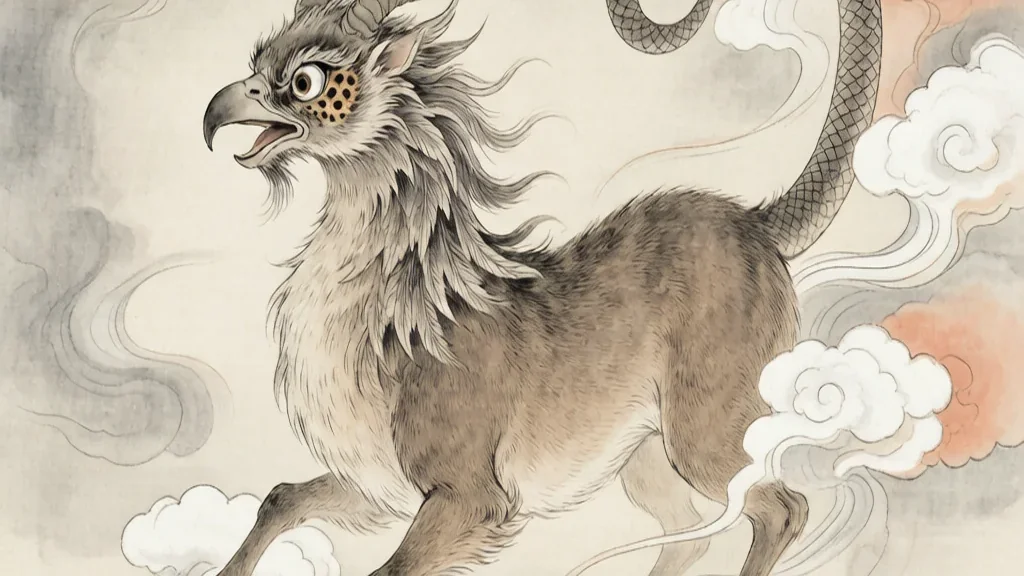
Feilian (飞廉) is the ancient Chinese wind deity, imagined not as a human but as a strange and beautiful hybrid beast with the body of a deer, the head of a bird, a pair of antlers, a snakelike tail, and the spotted eyes of a leopard. A servant and embodiment of the wind, Feilian rides the gales and heralds the coming of storms — one of the oldest weather spirits in the Chinese mythological repertoire, already well known more than two thousand years ago.
A Beast Built from the Wind
The classic description comes from the Eastern Han writer Ying Shao's Fengsu Tongyi and is echoed in the Huainanzi: Feilian has a deer's body, a bird's head, horns like a ram, a snake's tail, and leopard's spotted eyes. Each feature evokes wind — a bird's speed, a deer's lightness, a snake's twisting path, a leopard's far sight — so that the god's very shape is a portrait of a gust in motion.
This composite form marks Feilian as one of the "merged beasts" of early Chinese myth, creatures assembled from many animals to express a single natural force. Like the dragon or the qi-lin, Feilian is less a character in a story than a living symbol of a power of the world.
First Named in the Songs of Chu
Feilian's earliest literary appearance is in the Li Sao (离骚, "Encountering Sorrow"), the great poem of Qu Yuan from about the 3rd century BCE. There the poet sends the moon charioteer Wangshu ahead and commands "Feilian behind to run in attendance" (后飞廉使奔属) as the wind that speeds his spirit's flight through the heavens. This shows Feilian already a recognized wind spirit in the Chu culture of the south.
The same wind god recurs in other Chu Ci poems, always as the swift attendant of the storm. By the Han dynasty Feilian was firmly established in the vocabulary of wind, used by poets whenever they wanted to name the gale directly rather than by a plain word for "wind."
Wind God of the Early Cosmos
Feilian is the archaic, primal wind before the later, more bureaucratic deity Feng Bo (风伯, the "Earl of Wind") became standard. In the developed pantheon, Feng Bo is paired with Yu Shi (雨师, the "Master of Rain") as the official weather officials who stir up or calm storms at the command of the higher gods. Feilian is often simply identified with Feng Bo, the older name surviving as the creature's true form.
As a force of nature Feilian is neutral rather than morally good or evil: wind is neither, it is simply power in motion. Shamans and rulers alike sought to summon or still the wind through the wind god, depending on whether they needed rain, fair weather, or the speed of a messenger.
Storms, Battles, and the Yellow Emperor
Feilian belongs to the storm mythology of the legendary Battle of Zhuolu, where the wind-and-rain deities fought on one side of a cosmic war. In those accounts the wind and rain gods (often named Feng Bo and Yu Shi) unleashed tempests to aid the rebel Chi You, and the Yellow Emperor (黄帝) answered by sending the drought goddess Hanba and the winged dragon Yinglong to dry the skies and win the day.
Feilian, as the raw power of wind, is part of this same storm machinery. The wind god is also recorded in astronomical lore as a constellation — one of the "Central Palace" stars associated with wind — so that Feilian governed gusts both on earth and as a pattern in the sky.
From Deity to Namesake in Later Lore
A quirk of tradition: the name Feilian is also borne by a strong, cruel minister who served the last Shang king, Zhou (纣), alongside his son E Lai, in some historical and moralizing texts. This is a separate, human figure who happens to share the wind god's name; later storytellers occasionally blurred the two, but the mythological Feilian remains the beast of the gale, not the tyrannical official.
By the medieval period the popular image of the wind god had shifted to Feng Bo, frequently shown as an old man carrying a wind-bag or riding a tiger. Feilian's hybrid beast-form grew rarer in art even as his name stayed alive in poetry as a refined synonym for a strong wind.
Legacy in Art and Modern Culture
After the Han dynasty Feilian is seldom depicted as the bird-deer-snake beast; the standard wind deity image became the old man with the sack. Yet Feilian never vanished: he survives in classical poetry as a byword for the wind and in the names of places and things associated with gusts and swiftness.
In modern fantasy novels, games, and animated retellings of Chinese myth, Feilian has been rediscovered as a striking design — the antlered, bird-headed storm beast — and often appears among the host of minor deities serving the heavens. His strange, assembled body makes him a favorite subject for artists looking to render the wind as something you can almost see.
The Wind Star
In the twenty-eight mansion system, the Winnowing Basket mansion (Ji) was identified as the celestial seat of the wind, and Fei Lian was its divine personification. Court astronomers watched Ji for signs of unseasonable gales, tying the god to practical weather lore. Farmers likewise read the Basket mansion's brightness as a cue for winnowing, so Fei Lian connected the sky, the grain, and the storm in a single figure. When the Winnowing Basket shone clearly after the harvest, households knew the wind would come to separate chaff from grain, and they set their trays out accordingly. The same star that threatened ships with sudden squalls also promised bread, making Fei Lian a double-edged power. His duality as both helpful breeze and destructive gale is why early texts describe him as a creature at once deer, bird, and serpent, a shape as changeable as the wind he commands.
Fei Lian's Legacy
Fei Lian survived into later culture as both a meteorological god and a literary shorthand for speed. Han dynasty poets called a fast horse or a swift courier 'Fei Lian,' and the name was given to wind-themed pavilions and to an early imperial post relay system. Even today the term evokes rushing wind, showing how a Chu-ci mountain spirit became a permanent part of the Chinese vocabulary for motion. The Tang poet Li Bai invoked Fei Lian when he wanted to convey the rush of a waterfall or the flight of his own imagination, and painters of storms placed a small deer-bodied sprite in the clouds to signal the god's presence. Folk temples on windy passes sometimes kept a Fei Lian niche where travelers left offerings for safe passage. From state astronomy to poetry to roadside shrine, the wind god kept his many roles for two millennia.
❓ Frequently Asked Questions
📝 Chinese Vocabulary
飞廉 — : Feilian; the ancient wind god in beast form.
风伯 — : Feng Bo; the Earl of Wind, the later standard wind deity.
雨师 — : Yu Shi; the Master of Rain, paired with Feng Bo.
离骚 — : Li Sao; the Chu Ci poem that first names Feilian as wind.
风神 — : the god of wind
鹿身 — : deer body, part of Fei Lian's hybrid form
箕宿 — : the Winnowing Basket star, the celestial source of wind
飙 — : a sudden whirlwind
🎉 Fun Facts
- Feilian's name pairs characters meaning "to fly" and "incorruptible / pure," a fitting label for the clean, rushing wind.
- In Qu Yuan's Li Sao, Feilian runs behind the poet's chariot as the wind speeding his spirit's flight.
- The later wind god, Feng Bo, is often shown as an old man with a wind-bag rather than as Feilian's hybrid beast.
- Feilian shares its name with a ruthless minister of the last Shang king in some historical texts — a coincidence of naming, not the same being.
- Fei Lian is sometimes paired with the rain master Ping Yi, and together they stir the storms that test the legendary hero Hou Yi.
- As the star of the Winnowing Basket mansion, Fei Lian links the wind to the harvest, since winnowing grain depends on a steady breeze.