Of all the creatures in the Chinese symbolic universe, none embodies the concept of longevity more perfectly than the turtle (龟). Living for decades — and in some species, well over a century — the turtle has been a symbol of long life, stability, and cosmic order in China for at least four thousand years. But the turtle's significance goes far beyond mere longevity. It is one of the Four Symbols (四象) of Chinese cosmology, the source of the oracle bones that gave birth to Chinese writing, and the mythological bearer of the world itself. In the Chinese imagination, the turtle is not just an animal — it is a living diagram of the universe.
The turtle's symbolic power derives partly from its unique anatomy. Its domed upper shell was seen as a representation of the vault of heaven, while its flat lower shell represented the earth. Its body, moving between the two, represented humanity — the intermediary between cosmic forces. The turtle thus embodied the Chinese cosmological triad of Heaven, Earth, and Humanity (天地人), making it one of the most philosophically rich symbols in Chinese culture. The patterns on its shell were believed to contain the secrets of the universe, and it was from studying a turtle shell that the legendary sage Fu Xi (伏羲) was said to have devised the Eight Trigrams (八卦), the foundation of the I Ching and Chinese cosmology.
The Black Tortoise: Guardian of the North
In the system of the Four Symbols (四象), the four guardian creatures that rule the cardinal directions, the north is governed by the Black Tortoise (玄武) — also known as the Dark Warrior or the Black Tortoise-Serpent. Unlike the simple turtle of everyday observation, the Black Tortoise is a composite being: a turtle entwined with a snake, the two creatures locked in eternal embrace. This unusual pairing has multiple interpretations. Some see it as representing the union of yin and yang. Others interpret it as a symbol of the northern constellations, with the turtle's shell representing the constellation Dou (斗) and the snake representing Niu (牛).
The Black Tortoise is associated with the element of Water (水), the season of winter (冬), and the color black (黑). It is a guardian of tombs, temples, and the northern frontier. In Daoist practice, the Black Tortoise is associated with longevity practices, meditation, and inner alchemy — the turtle's ability to withdraw into its shell serving as a metaphor for the inward-turning contemplation that leads to spiritual immortality. The Black Tortoise is also the patron of the Northern Dipper (北斗) constellation, which in Daoist belief governs human destiny and lifespan.
Oracle Bones and the Birth of Chinese Writing
The turtle's most profound contribution to Chinese civilization may be its role in the development of writing. During the Shang Dynasty (1600–1046 BCE), diviners would inscribe questions onto turtle plastrons (the flat lower shell) and ox scapulae, then apply heat until the bones cracked. The pattern of cracks was interpreted as answers from the ancestors and gods, and the results — question, divination, and outcome — were inscribed onto the bone. These oracle bones (甲骨) are the earliest known examples of systematic Chinese writing, and they provide an extraordinary window into the concerns of the Shang court: warfare, agriculture, childbirth, illness, and the proper performance of rituals.
Over 150,000 oracle bone fragments have been discovered, primarily at the Shang capital of Anyang (安阳), bearing approximately 5,000 different characters — of which about 1,500 have been deciphered. Many of these characters are directly ancestral to modern Chinese writing, making the turtle shell not just a medium for divination but the very birthplace of one of the world's oldest continuously used writing systems. The turtle, in this sense, is the animal that gave China its written voice.
The World-Bearing Turtle
In Chinese mythology, as in many cultures around the world, the turtle plays the role of cosmic support. According to one creation myth, when the goddess Nüwa (女娲) repaired the broken heavens after a catastrophic battle between gods, she used the legs of a giant turtle to prop up the four corners of the sky. Another legend holds that the immortal islands of the Blessed — the paradises where Daoist immortals dwell — rest on the backs of giant turtles that swim through the Eastern Sea.
This world-bearing imagery appears in a more modest form in Chinese architecture. Stelae (碑) — tall stone tablets inscribed with important texts — are traditionally mounted on the backs of stone turtles known as Bixi (赑屃). The Bixi is one of the nine sons of the dragon, a turtle-like creature renowned for its strength. The most famous Bixi-supported stelae are found in the Confucian Temple in Qufu (曲阜孔庙) and at the Ming Tombs (明十三陵) outside Beijing. The image of the turtle bearing a heavy burden is a powerful metaphor for endurance, patience, and the weight of cultural tradition.
The Turtle in Art, Literature, and Daily Life
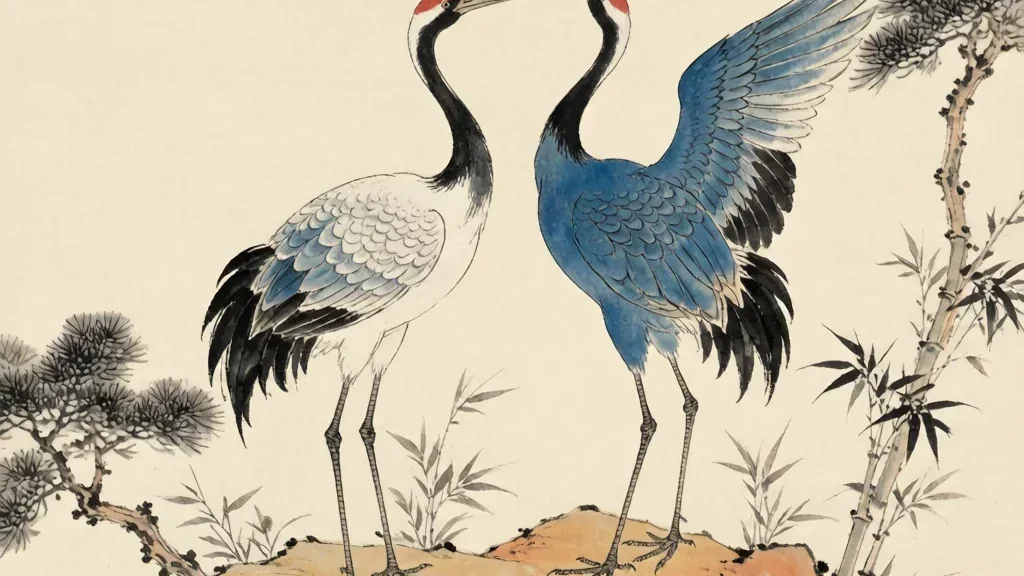
The turtle appears throughout Chinese art and literature as a symbol of longevity and wisdom. In traditional paintings, the turtle is often depicted with a crane (another symbol of long life), mushrooms of immortality, and pine trees — together forming a visual wish for "long life and eternal spring." The phrase "龟鹤遐寿" — "may you live as long as the turtle and the crane" — is a traditional birthday blessing.
In Chinese gardens, turtle-shaped rocks and turtle ponds are common features, their presence believed to bring stability and longevity to the household. The turtle also appears in the Chinese zodiac, though not as one of the twelve animals — rather, the turtle's shell is associated with the Heavenly Stems and Earthly Branches (天干地支) calendrical system, with the patterns on the shell said to represent the 24 solar terms of the agricultural calendar.
It is worth noting that the turtle's symbolism in Chinese culture is not entirely positive. The word "turtle" (龟) can be used as a vulgar insult, particularly when referring to a cuckold or a man whose wife is unfaithful — a usage that derives from the mistaken belief that female turtles mate with snakes rather than their own species. This unfortunate association has led some Chinese to avoid turtle imagery in personal contexts, even as the turtle's broader cultural significance as a symbol of longevity and cosmic order remains undiminished.
Turtle as Longevity Emblem
Because wild turtles live for many decades, the creature became the leading Chinese symbol of long life and was grouped with the crane and the pine as a 'longevity trio.' Birthday gifts for the elderly often show a turtle, and the 'Old Man of the South Pole' sometimes rides one. In medicine and alchemy the turtle shell was also valued as a cooling, strengthening substance. Painters paired the turtle with blooming peaches and a flying crane to wish a host a hundred years, and such scrolls hung at every major birthday banquet. The turtle's slow, unhurried pace was not a flaw but the very proof of its wisdom and endurance, the opposite of a hurried life cut short. Over centuries the animal moved from omen to everyday congratulation, a quiet wish for time itself on the side of the honored person.
The Spirit Turtle in Lore
Early texts rank the spirit turtle (ling gui) among the four intelligent beings, alongside the dragon, phoenix, and qilin, because it understands the will of heaven and can reveal hidden things. A turtle that appeared in a ruler's pond was taken as a sign of good government, and dream manuals treated a turtle as an omen of official rank. This esteem made the turtle a creature of court as much as of nature. The Book of Changes uses the turtle shell for milfoil-assisted divination, and the Guanzi advises princes to keep a spirit turtle as a counselor of last resort. When a turtle climbed out of a well to bow to a worthy official, historians recorded it as proof of his virtue. Such stories show the turtle functioning as a living oracle and moral witness, a role far above its humble, slow-moving appearance in the pond.
Turtles in Modern Symbolism
Although the turtle later gained a slang meaning of 'slow' or 'cuckold,' its classical role as a lucky, long-lived guardian survives in feng shui and folk art. Black turtle (Xuanwu) statues still guard northern walls, and turtle-and-snake imagery protects homes from fire. At New Year, turtle motifs appear on birthday banners, showing the ancient reverence remains part of everyday blessing. Aquariums in offices often feature a single turtle as a wealth-and-stability charm, and jade turtle pendants are gifted for health. Meanwhile conservationists invoke the turtle's great age to argue for protecting the few wild species left in Chinese rivers. The creature thus spans the sacred and the commercial, the classical and the slang, yet its core promise of endurance and quiet luck has never fully faded from the culture.
❓ Frequently Asked Questions
📝 Chinese Vocabulary
- 龟 (Guī) — The turtle or tortoise, a symbol of longevity, wisdom, and cosmic stability in Chinese culture.
- 玄武 (Xuán Wǔ) — The Black Tortoise (or Dark Warrior), guardian of the north in the Four Symbols, depicted as a turtle entwined with a snake.
- 甲骨 (Jiǎ Gǔ) — Oracle bones, turtle shells and animal bones used for divination during the Shang Dynasty, bearing the earliest examples of Chinese writing.
- 赑屃 (Bì Xì) — Bixi, one of the nine sons of the dragon, a turtle-like creature known for its strength, traditionally used to support heavy stone stelae.
- 八卦 (Bā Guà) — The Eight Trigrams, the foundation of the I Ching and Chinese cosmology, said to have been devised by Fu Xi after studying the patterns on a turtle's shell.
🎉 Fun Facts
- The earliest Chinese writing — oracle bone inscriptions from the Shang Dynasty — was carved onto turtle plastrons over 3,000 years ago, making the turtle the literal foundation of Chinese literacy.
- Some species of turtles found in China can live over 150 years, and in captivity, certain tortoises have exceeded 200 years — giving a biological basis to the turtle's symbolic association with extreme longevity.
- The stone turtles supporting stelae at the Ming Tombs weigh up to 30 tons each, yet they have borne their loads for over 600 years — a testament to both engineering skill and symbolic endurance.
- Tortoises can live beyond a century, which is why the turtle became China's foremost symbol of longevity and was often shown carrying the world or a mountain on its back.
- In the classic tale the turtle volunteers to plug the broken sky with its legs, becoming the four pillars that hold up heaven, a sacrifice remembered in myth.
- The spirit turtle is one of the Four Intelligent Creatures in early texts, ranked with the dragon, phoenix, and qilin as a bringer of good omens.