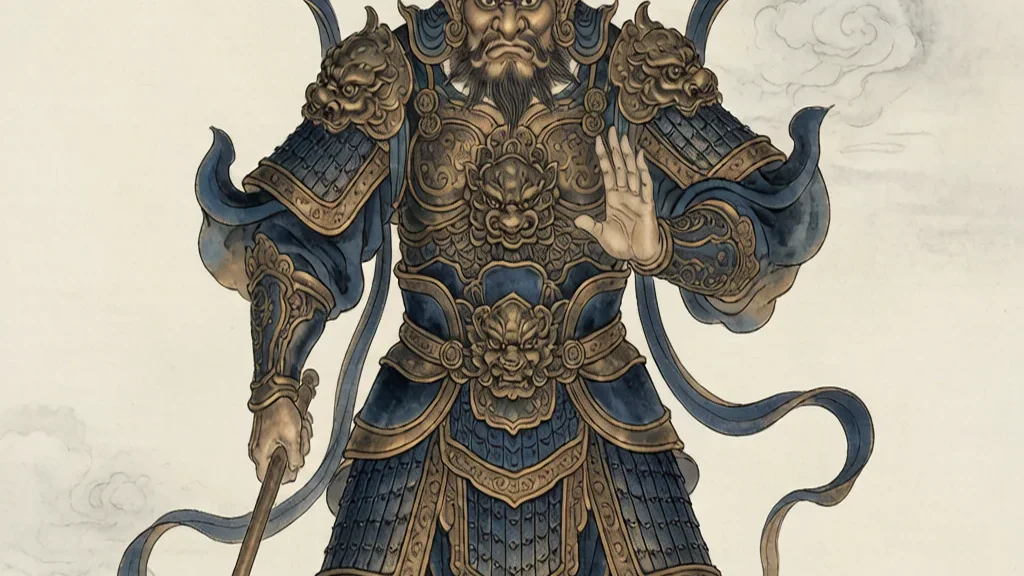
Chiyou (蚩尤) is one of the most complex figures in Chinese mythology—at once a fearsome warrior, the patron of metalworking, and, in many southern and ethnic-minority traditions, a revered ancestral hero. Best known from the legend of his epic war against the Yellow Emperor, Chiyou is depicted with a bronze-forehead, horns, and a body armored in metal, leading a host of brothers and monstrous allies. Depending on the tradition, he is the defeated rebel who unified China under the Yellow Emperor, or a proud culture hero who taught humanity the forging of weapons.
Origins and the Nine Li
Chiyou is traditionally said to have belonged to the Nine Li (Jiuli), a confederation of southern tribes often identified in later lore with the Miao and other non-Han peoples of the Yangzi region. His outsider status is central to how he is framed as both enemy and hero.
He is described as having dozens of brothers, often counted as eighty-one, each a formidable warrior, which suggests he led a large tribal league rather than acting alone. The number underscores the scale of the conflict he posed.
Some sources call him a descendant or minister of the Flame Emperor, tying his cause to the older Yandi line that the Yellow Emperor eventually absorbed, a detail that explains the rivalry as a succession struggle among ancient sovereigns.
Fearsome Appearance
Classical descriptions give Chiyou a bronze or iron forehead, horns on his head, and a body covered in scales or armor, with a bestial, formidable look intended to terrify enemies. He is the archetype of the armored war-god.
He is credited with inventing or mastering metal weapons—spears, halberds, and shields—forged from the ores of the mountains, which made his army uniquely deadly. This association earned him the title of patron of metalworkers and smiths.
In popular art he sometimes appears with multiple arms or a bestial visage, a visual language that marks him as a liminal being between human, demon, and deity.
The Battle Against the Yellow Emperor
The central myth is the war between Chiyou and the Yellow Emperor (Huangdi), joined at times by the Flame Emperor's side. The two armies met on the plains of Zhuolu in a prolonged, cataclysmic struggle that tested heaven and earth.
Chiyou is said to have summoned fog and storms to blind the emperor's troops, and to have commanded fierce beasts and wind-and-rain gods. The Yellow Emperor countered with the south-pointing chariot, devised to find direction in the mist, and with the help of celestial allies.
Eventually the emperor's forces prevailed, often with the aid of the drought goddess or the wind-clearer, and Chiyou was captured and executed, his body or blood giving rise to further landmarks and omens in the landscape.
Storms, Fog, and the South-Pointing Chariot
A striking element of the tale is Chiyou's control of weather: he raised dense fog for days so the enemy could not tell direction, a motif that turns a military disadvantage into a supernatural contest. The fog symbolizes the confusion of war itself.
The Yellow Emperor's answer, the south-pointing chariot—a carriage with a figure that always points south regardless of turning—is celebrated as an early feat of mechanical ingenuity. Whether or not such a device existed, the story credits the emperor with inventing navigation under adversity.
These episodes show the myth functioning as both a war story and a charter for technology: the heroes who win are also the inventors who tame chaos.
Chiyou as Patron of Metalworkers
Beyond the battlefield, Chiyou's reputation rests on his mastery of metal. He is honored in some regions as the first to smelt bronze and iron for tools and weapons, and smiths' guilds historically offered him reverence as their protective spirit.
This positive role complicates his image as a mere villain. A culture that depends on metal for farming and defense naturally respects the figure who unlocked it, even if that figure lost a legendary war.
In this capacity Chiyou parallels other civilizing tricksters who bring dangerous knowledge: the gift of metal is double-edged, enabling both production and destruction.
Southern and Ethnic Traditions
Among the Miao, Hmong, and related peoples, Chiyou is remembered not as a rebel but as a founding ancestor and national hero who resisted conquest and who carried the knowledge of agriculture and metal. Festivals and oral epics keep his memory alive.
In these traditions the victory of the Yellow Emperor is revisited as a loss to be mourned, and Chiyou's defeat becomes a symbol of resistance and cultural pride. His horns and armor become badges of identity rather than monstrosity.
This duality makes Chiyou a rare figure who is simultaneously a demon-king in the Han mainstream and a revered forefather in minority heritage, a testament to China's layered cultural memory.
Cult and Modern Revival
Historically, the imperial state sometimes included Chiyou in the roster of ancient worthies to be sacrificially acknowledged, recognizing that even a defeated rival contributed to the founding of order. Local temples in parts of Hunan and Guizhou venerate him.
In recent decades there has been a revival of interest in Chiyou as a shared ancestor across ethnic lines, with conferences and monuments affirming his place in the broader Chinese civilizational story.
His image now appears in literature, games, and films as the tragic, powerful warlord—proof that mythic villains can be rehabilitated when their virtues are reread.
The Beast Army and the Eighty-One Brothers
Beyond Chiyou himself, the legends people his host with extraordinary allies: the eighty-one horned brothers, each a fierce fighter, and a menagerie of fantastic beasts recruited to the cause. This bestial army reflects the southern tribes' reputation for jungle warfare and for using animals, mist, and terrain to their advantage against a foe from the central plains.
Among his helpers the texts name wind and rain masters—Fei Lian the wind earl and Bing Yi the rain lord—who whipped up storms to aid the attack. Their presence turns the battle into a clash of weather magic as much as of spears, and explains why the Yellow Emperor needed the south-pointing chariot and celestial help to prevail.
Reading the "brothers" as clans rather than literal siblings, the episode preserves a memory of a broad coalition that the emperor's side had to outmaneuver, which accounts for why the war was so hard-fought and so decisive for the political shape of the realm. The monstrous imagery is, in part, how the victors remembered a formidable enemy.
❓ Frequently Asked Questions
Who was Chiyou?
Chiyou was a warrior-king of the Nine Li tribes who fought the Yellow Emperor for supremacy in mythic antiquity and is also revered as the patron of metalworking and as an ancestor by some southern peoples.
How did the Yellow Emperor defeat Chiyou?
The emperor used the south-pointing chariot to navigate Chiyou's fog and received help from celestial allies such as the drought goddess, finally capturing and executing him.
Why is Chiyou both villain and hero?
Mainstream Han lore casts him as the defeated rebel who unified China under the Yellow Emperor, while southern and ethnic traditions honor him as a resistant ancestor and culture bringer.
What did Chiyou contribute to culture?
He is credited with mastering the smelting and forging of metal weapons and tools, making him the patron of metalworkers despite his martial defeat.
What is the south-pointing chariot?
It is a mythic carriage with a figure always pointing south, invented by the Yellow Emperor's side to keep direction inside Chiyou's magical fog.
Where is Chiyou honored today?
He is venerated in parts of Hunan and Guizhou and among Miao communities, and has seen renewed recognition as a shared ancestral figure in modern China.