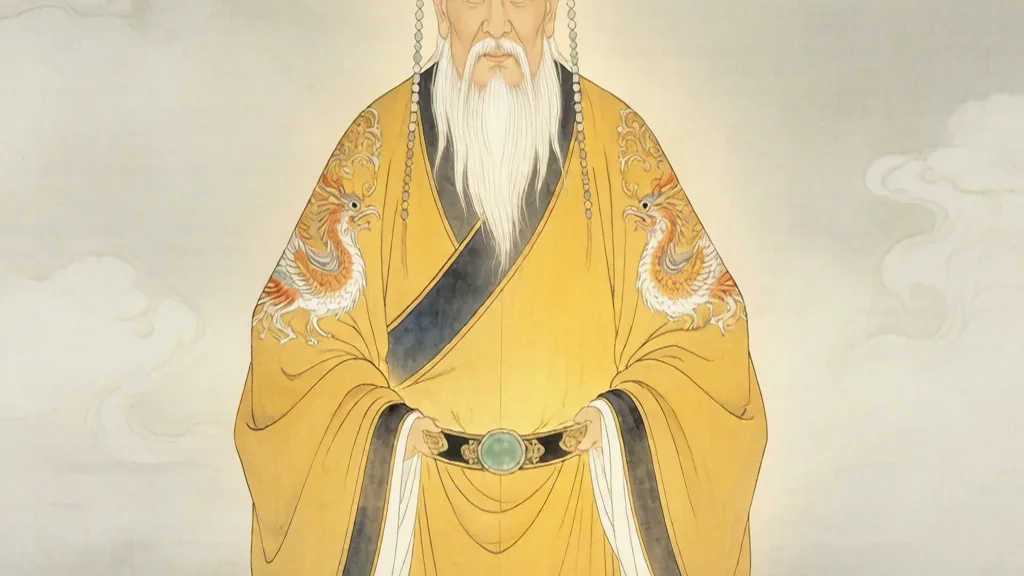
The Yellow Emperor, Huangdi (黄帝), is the most revered of China's mythic founding sovereigns—culture hero, unifier, and ancestor of the Chinese people. Credited with defeating the Flame Emperor and the warrior Chiyou, inventing writing, the calendar, medicine, and countless crafts, and establishing the first centralized order, Huangdi stands at the head of recorded antiquity. Along with Yandi he is styled a forefather of the nation, and his reign is remembered as a golden age of invention that lifted humanity from scattered tribes to civilized society.
Identity and the Yellow Earth
Huangdi's title "Yellow Emperor" connects him to the color yellow and the central, earth phase of the five-element system. As the central sovereign he balances the four directional rulers and embodies the soil that sustains all life.
His earth association also explains the symbolic link to the Yellow River basin and the loess highlands, the cradle of Chinese civilization. The yellow of his name is the yellow of fertile earth and of the Chinese heartland.
He is usually placed after the Three Sovereigns as the first of the Five Emperors, the sequence of sage-rulers who set the pattern for virtuous government.
Birth and Early Life
Legends give Huangdi a miraculous birth and a speedy attainment of wisdom, with some accounts describing him as the son of a celestial spirit or as emerging from a thunderclap. He is said to have spoken and governed with unusual clarity from a young age.
He is often portrayed as a model ruler who cared for his people, toured the realms, and surrounded himself with skilled ministers and artisans. His court becomes a laboratory of early civilization.
These biographical touches are mythic, designed to show that right rule flows from a ruler whose nature is itself harmonious with heaven and earth.
Wars of Unification
Huangdi's claim to supremacy rests on two great wars. First he contended with the Flame Emperor's line, and then he faced Chiyou, the horned warrior-king of the Nine Li, in the prolonged battle on the Zhuolu plains.
Against Chiyou's fog and storms, Huangdi used the south-pointing chariot and the aid of celestial allies such as the drought goddess to win. The victory unified the surrounding tribes under his rule.
These wars are remembered not as mere conquest but as the forging of a single people from rival groups, with Huangdi as the unifier whose order ended endemic strife.
Inventions and the Court of Sages
A striking feature of Huangdi's legend is the sheer number of inventions attributed to him and his ministers: writing (by his historian Cangjie), the calendar, the compass, boats and carts, bow and arrow, pottery, and the counting of time.
His wife Leizu is credited with discovering sericulture—the rearing of silkworms and the weaving of silk—a craft that became a pillar of Chinese economy and a hallmark of its culture for millennia.
The physician Qi Bo is said to have dialogued with him on medicine, producing the foundations of what became the Huangdi Neijing, the inner canon of classical Chinese medicine attributed to his name.
Huangdi and the Origins of Medicine
The Huangdi Neijing (Yellow Emperor's Inner Canon) is the cornerstone of traditional Chinese medicine, presented as a dialogue between the emperor and his medical advisor on the body, vital energy, and the cosmos.
Although compiled centuries after any historical Huangdi, the attribution shows how thoroughly he was regarded as the source of systematic knowledge about health and the natural world.
His medical patronage ties him to the Daoist ideal of long life and alignment with nature, and he is thus both a political founder and a master of the art of living well.
The Quest for Immortality
Later legends turn Huangdi into a seeker of transcendence. He is said to have studied with immortals, practiced breath and dietary cultivation, and finally ascended to heaven on a dragon, leaving behind only his robe and cap.
This apotheosis made him a patron of Daoist aspiration, the ruler who did not merely die but transformed, modeling the possibility of overcoming mortality through harmony with the Dao.
The dragon-flight ascent is a favorite subject of art, symbolizing the union of earthly rule and celestial liberation.
Cult, Tombs, and National Symbol
Huangdi is honored at major sites such as the Huangling tomb in Shaanxi, where annual state and civic ceremonies pay respect to the "First Ancestor." These rites reinforce his status as common forefather.
Imperial and modern governments alike have used his memory to express unity across regions and ethnic groups, presenting the Yellow Emperor as the shared root of Chinese identity.
His image appears in textbooks, monuments, and public ritual as the civilizing ancestor whose virtues—invention, justice, and care for the people—define the ideal ruler.
Legacy in Chinese Civilization
From the calendar to silk, from medicine to the ideal of centralized, virtuous rule, Huangdi's legacy touches nearly every pillar of traditional Chinese culture. He is less a single inventor than a symbol of collective ingenuity.
The phrase "descendants of Yandi and Huangdi" keeps his memory in daily language as a term of shared heritage, used by Chinese communities worldwide to express common origin.
Whether met as mythic king, medical patriarch, or immortal, the Yellow Emperor remains the figure against whom Chinese civilization measures its own beginnings and its enduring values.
In the modern era his name surfaces in science and culture as a mark of pedigree: research institutes, cultural festivals, and even space and medical programs invoke Huangdi to signal a continuity between ancient wisdom and contemporary achievement. The ancestor, it seems, still presides over the nation's self-image as both founder and enduring mirror of its values.
❓ Frequently Asked Questions
Who was the Yellow Emperor?
Huangdi is the mythic founding sovereign of China, credited with unifying the tribes, inventing key crafts, and establishing the model of virtuous rule; he is honored as a forefather of the Chinese people.
How did Huangdi defeat Chiyou?
He used the south-pointing chariot to navigate Chiyou's fog and received help from celestial allies, finally winning the battle on the Zhuolu plains.
What did Huangdi invent?
Tradition credits him and his court with writing, the calendar, the compass, carts and boats, medicine, and more; his wife Leizu discovered sericulture.
What is the Huangdi Neijing?
It is the foundational classic of Chinese medicine, framed as a dialogue between the Yellow Emperor and his advisor, though compiled long after his mythic era.
How is Huangdi linked to Daoism?
Later legends have him seek immortality and ascend to heaven on a dragon, making him a patron of Daoist cultivation and the art of long life.
Why is Huangdi important today?
He remains a national symbol of shared heritage, honored at the Huangling tomb and invoked as a common ancestor of Chinese communities worldwide.