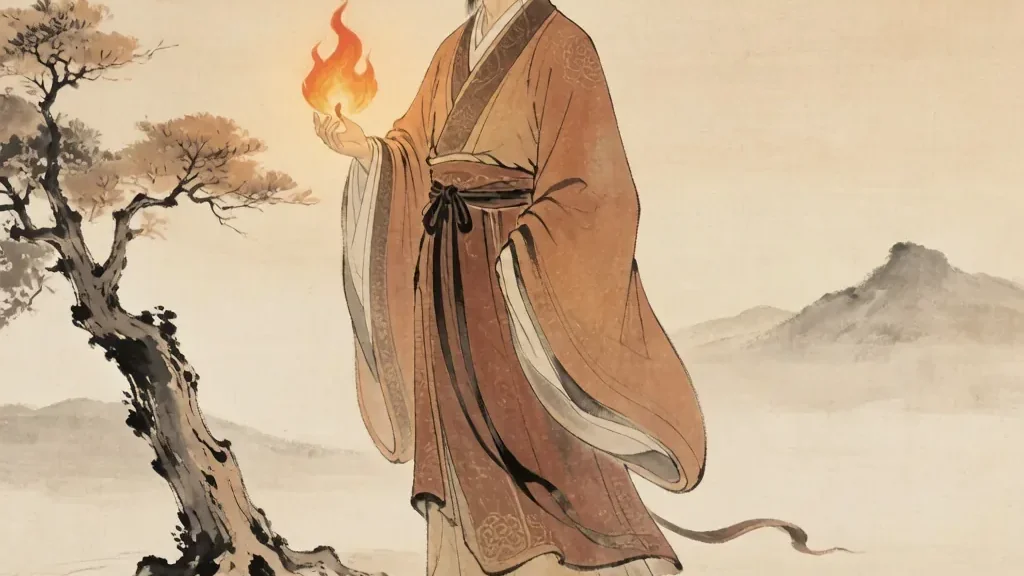
Zhurong (祝融) is the ancient Chinese god of fire, a culture hero who taught humanity to use flame for warmth, cooking, and craft, and who governed the elemental power of heat in the cosmic order. Often depicted with a fiery visage and associated with the south, the color red, and the summer season, Zhurong stands at the head of a long tradition of fire deities in Chinese religion. His name also belongs to a historical minister of the Yellow Emperor in some accounts, blending mythic god and legendary official into one enduring figure.
Origins as a Fire Official
In early texts Zhurong is described as a title or office—the "Master of Fire" appointed to oversee the use of flame, rather than purely a born deity. The holder of this office, sometimes named Li, was charged with controlling and distributing fire for the people's benefit.
This official origin reflects how Chinese myth often turns useful inventions into the deeds of a named sage. The "fire official" became personified as a god once his function was worshipped as a power in itself.
His appointment is usually placed under the Yellow Emperor or under a high sovereign, showing fire management as a pillar of civilized rule alongside agriculture and water control.
God of Fire and the South
In the correlative cosmology of the five phases (wuxing), Zhurong corresponds to fire, the south, the color red, and the summer season. He thus rules one quarter of the cosmos and one element among the cycling forces of nature.
As southern fire-god he is invoked in seasonal rites and in state ceremonies that honored the directions and elements. His red banner and warm domain made him a natural patron of vitality and growth.
The southern association also linked him to the Flame Emperor (Yandi) tradition, and the two fiery powers are sometimes merged in regional worship as kindred sources of heat and light.
Gifts of Fire to Humanity
Zhurong is credited with teaching people to make and keep fire, to cook food rather than eat it raw, and to use heat in metalworking and pottery. These uses transformed daily life and underwrote nearly every later craft.
By controlling fire, humans could ward off beasts, survive cold, soften grain, and smelt ore—steps that the myth folds into Zhurong's single beneficial office. He is, in effect, the mentor of technology.
His gentle, civilizing fire contrasts with the destructive blaze of mythic catastrophes, marking him as a god who tames rather than merely wields flame.
The Battle with Gonggong
One of Zhurong's defining myths is his conflict with Gonggong, the god of water. The two waged a cosmic war between fire and water, and Zhurong's victory affirmed the proper dominance of ordered fire over chaotic flood.
The defeated Gonggong, in rage, is said to have smashed his head against the cosmic pillar Mount Buzhou, toppling it and tilting the sky, an act that explains why the heavens lean and rivers flow eastward. Zhurong's triumph thus indirectly reshaped the world's geography.
This fire-versus-water duel is a vivid expression of the wuxing interplay, where elements contend and the balance of the cosmos is continually negotiated through conflict.
Zhurong and the Five Phases
Within the five-phase system, fire follows wood and produces earth, and it is conquered by water—relationships acted out in the Zhurong-Gonggong myth. The god therefore embodies a specific, governed role rather than absolute power.
His seasonal and directional assignments made him a routine presence in the imperial rites that maintained harmony between the human realm and the cycling elements. Neglect of fire rites risked cosmic imbalance in this worldview.
Later Daoist and popular religion absorbed these associations, so Zhurong appears in almanacs, exorcisms, and household protections against fire's dangers.
Cult and Place in the Pantheon
Zhurong received sacrificial honors both as a nature god and as an ancient worthy. Some traditions place his dwelling on a southern sacred mountain, and fire-related festivals acknowledged him at their heart.
Because fire was both necessary and dangerous, his worship carried a double tone: gratitude for warmth and cooked food, and propitiation against conflagration. Households and smiths alike sought his favor.
He sits comfortably among the elemental gods—with Lei Gong the thunder, Yu Shi the rain, and Feng Bo the wind—as part of the celestial bureaucracy that manages weather and the natural world.
Legacy in Culture
Zhurong's name survives in idioms, place names, and modern projects; China's Mars rover, for instance, was named Zhurong, linking the ancient fire-god to the planet associated with the element of fire in Western astrology.
In literature and art he appears as a red-clad, flaming figure who brings both comfort and awe, a reminder that the same power that cooks grain can consume cities. His duality is his teaching.
As a symbol of human mastery over nature's forces, Zhurong remains one of the clearest examples of how Chinese myth turns a physical element into a moral and cosmic order.
Zhurong and the Hearth
Because fire begins in the home, Zhurong's domain reaches the humble hearth as well as the cosmic blaze. The kitchen stove and the ancestral fireplace were treated as sacred nodes where his warmth sustained family life, and where small offerings kept the fire friendly and the household safe from accidental conflagration.
In household lore the hearth god (Zao Jun) can be seen as a deputy of Zhurong's fire, carrying the same double duty of nurture and danger into daily routine. Respect for the stove was, in effect, respect for fire's living presence at the center of the home.
This domestic face of Zhurong reminds us that the god of grand cosmic fire is also the quiet guardian of the nightly meal, the light against the dark, and the warmth that makes a house a home. From the imperial altar to the peasant's fireplace, his element is the same sustaining, and sometimes perilous, flame.
❓ Frequently Asked Questions
Who is Zhurong?
Zhurong is the ancient Chinese god of fire, originally the office of fire master, credited with teaching humanity to use flame for cooking, warmth, and craft.
What element and direction is Zhurong linked to?
He corresponds to the fire phase, the south, the color red, and the summer season in the five-phase cosmology.
What was Zhurong's conflict with Gonggong?
Zhurong fought and defeated Gonggong, the water god; in fury Gonggong smashed Mount Buzhou, tilting the sky and changing the rivers' flow.
Did Zhurong start as a god or a person?
He appears first as a fire official or minister in early texts, a historical-style role that was later personified and worshiped as a deity.
How is Zhurong honored?
He received sacrificial rites as both nature god and ancient worthy, and his fire associations appear in almanacs, exorcisms, and seasonal ceremonies.
Why name a Mars rover Zhurong?
Mars is the "fire planet" in Western tradition, so the fire-god's name was a fitting choice for China's Mars rover, linking myth to space exploration.