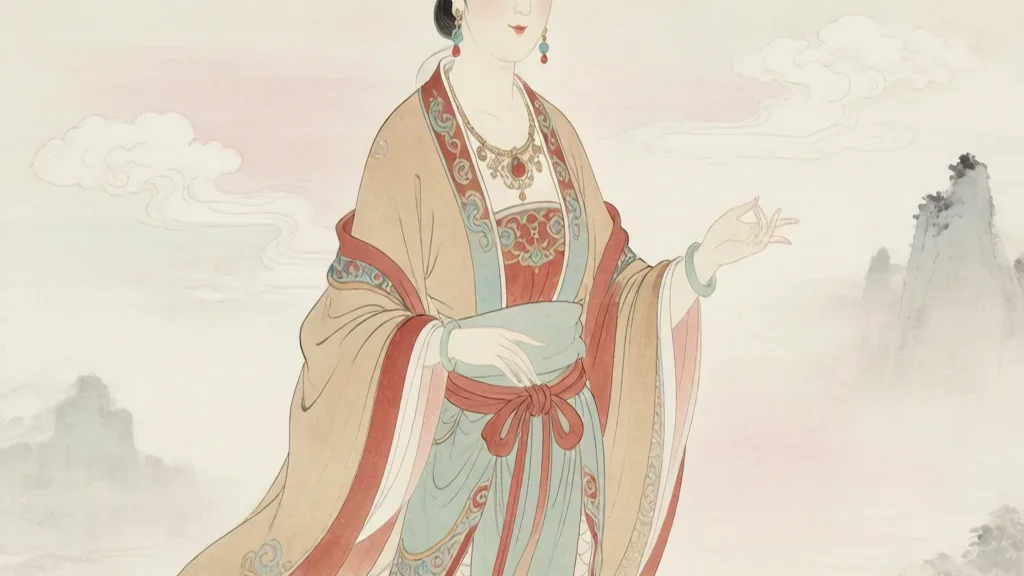
Nüwa is one of the oldest and most revered goddesses in Chinese mythology, the creatrix who shaped the first humans from yellow clay and, when the cosmos cracked, mended the broken sky. She appears in the earliest Chinese texts as a primal deity who brings order where there was chaos, giving humanity both its body and its protection. Unlike the distant supreme gods of later religion, Nüwa is a hands-on maker and repairer, a maternal figure whose work is intimate and physical. Her two great deeds — fashioning people and patching the heavens — make her the foundation on which the Chinese imaginary builds the relationship between humankind and the world.
Earliest Mentions
Nüwa is attested in writings from over two millennia ago, including philosophical and geographical texts of the Warring States and Han periods. Early sources already name her as a cosmic repairer and, in some accounts, the consort or counterpart of the creator-god Fuxi.
Her antiquity suggests roots in Neolithic goddess worship, though the written record is later and shaped by male-authored philosophy. Even so, she survived as a rare major goddess in a pantheon that grew increasingly male, a sign of how essential her stories were to Chinese identity.
Creating Humanity From Clay
The best-loved tale says Nüwa walked the empty earth and, lonely, scooped up yellow river clay and molded little figures in her own image. Breathing into them, she gave them life, and they became the first humans. Tired of making each by hand, she dipped a rope in mud and flicked it, and the scattered drops became common folk.
This charming origin explains a social distinction: those molded carefully by hand became the well-born, while those born of the flung rope became ordinary people. More deeply, it affirms a shared human kinship — all are Nüwa's clay, all bear her breath.
Repairing the Sky
A great cataclysm myth tells that the pillars of heaven broke and the sky tore open, flooding the world and letting monsters in. Nüwa melted five-colored stones to patch the rift, cut the legs off a giant turtle to prop up the heavens, and burned reeds to dam the flooding waters.
With the cosmos resealed, order returned and humanity was saved. The five-colored stones became a lasting image of her creative repair, and the tale explains natural features — the planets' colors, the compass directions — as traces of her world-mending work.
Nüwa and Fuxi
Many traditions pair Nüwa with Fuxi, her brother or consort, who taught humans tools, fire, and social order. In later art the two appear entwined with serpent tails, a famous motif showing the founders of civilization as half-human, half-dragon.
Together they represent creation and culture: she gives the human body and saves the world, he gives the arts of living. Their union frames the Chinese story of how a raw world became a human one, governed by both nature and invention.
Symbols and Iconography
Nüwa is often shown as a serpent-bodied goddess, human above the waist and dragon below, emphasizing her primal, chthonic power. When paired with Fuxi, the two hold a compass and a square, symbols of heaven's roundness and earth's squareness.
The five-colored stones, the turtle-leg pillars, and the mud-rope of creation are her recurring emblems. Each points to a different aspect of her care: beauty from brokenness, stability from collapse, and life from clay.
Role as a Protectress
Because she repaired the heavens, Nüwa is also a guardian against disaster. People appealed to her in times of flood, earthquake, or upheaval, trusting the goddess who had once fixed the very dome of the sky to intercede again.
Her maternal association made her a comforting figure for women, especially in matters of childbirth and family. Though later religion elevated bureaucratic gods, Nüwa kept a place as the original mother who had literally made and saved humankind.
Worship and Memory
Nüwa was honored at local shrines, particularly in parts of central and northern China tied to her myths. Rites asked for rain, for the healing of the world's ills, and for the safety of families, recalling her double work of making and mending.
Even where formal worship faded, her stories endured in festivals, rhymes, and the simple self-understanding of being "Nüwa's people." To be human in the Chinese mythic frame is to be clay she shaped and sky she sheltered.
Nüwa in Literature and Art
Poets and painters returned to Nüwa for images of creation and rescue. A famous Tang poem laments that the five-colored stones she melted were not enough to mend a broken heart, borrowing her cosmic repair for human grief.
In modern times she appears in novels, animation, and games as a symbol of nurture and resilience, proving that an ancient goddess can speak to contemporary longings for a world made whole. Her figure bridges myth and modern hope.
Cultural Meaning
Nüwa matters because she places a woman at the origin of humanity and at the repair of the cosmos — a rare and powerful stance in world mythology. She embodies the Chinese value of harmony achieved through patient, embodied work rather than through domination.
Her legacy is the quiet conviction that the world, though it may crack, can be mended by care. In clay and in stone, Nüwa remains the mother who made us and the hand that holds the sky together.
Modern Ecological Resonance
In recent years Nüwa has been read anew as a symbol of ecological care. Her repair of a broken sky speaks to contemporary anxiety about a damaged environment, and her clay-made humanity underscores the bond between people and the living earth they shape and depend upon. The goddess who once patched the heavens now speaks to those who would mend the climate.
Artists and educators invoke her image to argue that repairing the world is a shared, humble task — the same patient work she performed with stones and reeds. The ancient creatress thus gains fresh relevance as a patron of balance between humanity and nature, reminding a modern audience that the world, though cracked, remains worth mending.
❓ Frequently Asked Questions
Who is Nüwa?
She is the primal Chinese goddess who created humanity from clay and repaired the shattered sky.
How did she make people?
She molded figures from yellow mud in her image, then flicked a mud-dipped rope so the drops became common folk.
What was the sky-repair?
When heaven cracked and flooded the world, she melted five-colored stones to patch it and used a turtle's legs as pillars.
How is she linked to Fuxi?
They are often paired as brother-consort founders of civilization, shown with entwined serpent tails.
Why is she important?
She places a woman at the origin of humankind and the repair of the cosmos, a rare stance in world myth.
Is she still remembered?
Yes; her stories survive in festivals, literature, and modern media as symbols of nurture and resilience.