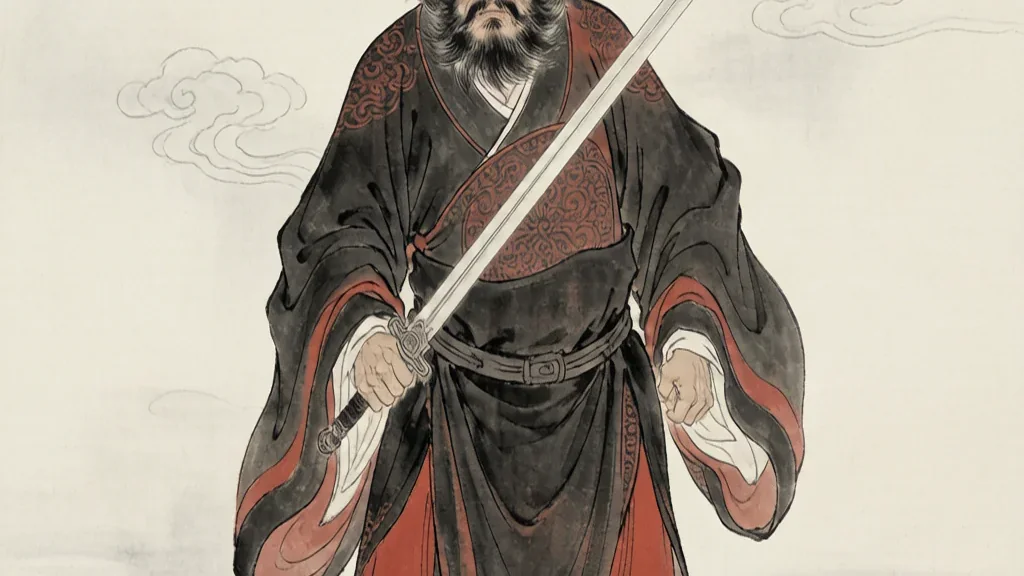
Zhong Kui (钟馗) is the bushy-bearded demon queller of Chinese folklore, a terrifying yet benevolent figure who hunts and subdues malevolent spirits. Portrayed with a fierce scowl, wild eyes, and often a sword or a bat, he is both a protector of the home and a popular subject of New Year and fifth-day-of-the-fifth-month artwork. His legend blends a tragic scholar's tale with the enduring human wish to turn fear into comic, controllable form.
The Legend of the Wronged Scholar
The most beloved story of Zhong Kui comes from the Tang dynasty. It tells of a gifted scholar who traveled to the capital to sit the imperial examination. He placed first in the palace exam, yet was denied the top honor because the emperor found his appearance shockingly ugly. Humiliated and enraged, Zhong Kui dashed his head against the palace steps and died.
Moved by guilt, the emperor granted him a grand funeral and posthumous title. Zhong Kui's ghost, rather than turning vengeful, pledged to rid the world of demons that preyed on the living. This transformation from rejected candidate to celestial exorcist is the emotional core of his cult.
Zhong Kui in the Tang Court Dream
A well-known variant ties Zhong Kui to Emperor Xuanzong of Tang. The emperor fell gravely ill and dreamed of a small demon stealing his concubine's slipper and a pouch. A giant specter appeared, seized the thief, tore him apart, and introduced himself as Zhong Kui, a failed examinee sworn to devour evil spirits.
Upon waking, the emperor recovered and commissioned the painter Wu Daozi to depict the dream. The resulting image spread through the realm, establishing Zhong Kui as a standard protective figure hung above doors and beds to ward off plague and ghosts.
Roles: Exorcist, Judge, and Matchmaker
Zhong Kui is best known as an exorcist, but folklore gives him a richer portfolio. In some tales he is a judge of the underworld who sentences unjust ghosts. In others, paradoxically, he acts as a matchmaker who finds husbands for his sisters, blending the grotesque with domestic warmth.
This multiplicity shows how Chinese folk religion humanizes its guardians. Even a demon-slayer has family ties and a sense of duty, making him approachable. The frightening face is a tool, not the whole personality.
Visual Depictions and Symbolism
Artists love Zhong Kui for his expressive potential. He is drawn with tangled beard, bulging eyes, and a robe flung open — sometimes drunk, sometimes mid-leap. A bat (蝠, fú, a pun on fortune) often flutters near him, signaling that his scary form actually delivers good luck.
New Year prints and the fifth-month festival artwork show him brandishing a sword or leading a troop of lesser ghosts in chains. The imagery is meant less to frighten the household than to frighten the household's enemies, visible and invisible alike.
Zhong Kui in Seasonal Custom
Zhong Kui images are displayed at two main times. At the lunar New Year they guard the entrance; around the Dragon Boat Festival (fifth day of the fifth month) they are posted to repel summer illness and insects. Both moments are thresholds of the year when boundaries between worlds feel thin.
In some regions people burn Zhong Kui charms or float them on water to carry away disease. The figure thus moves between paper, paint, and ritual action, always with the same job: keep harm outside.
Opera, Drama, and Stage Zhong Kui
Chinese opera has long featured Zhong Kui roles, where a performer in heavy makeup and a tall hat sings of his vow and his hunts. The "Return of Zhong Kui" type plays were performed at New Year for good fortune, mixing entertainment with blessing.
On stage his ferocity is stylized and even comic, reminding audiences that the demon queller is also a familiar household guest. The make-up codes let viewers read his mood at a glance — a fine example of Chinese theatrical symbolism.
Comparison with Other Guardians
Zhong Kui overlaps with the Door Gods (门神) and with Zhong Kui-like judges of hell, yet he is distinct. The Door Gods stand silent at the gate; Zhong Kui actively roams and fights. He is a hunter, not a sentinel, and his ugliness is his weapon rather than a warning label.
He also differs from gentle deities of fortune. Where the God of Wealth invites prosperity, Zhong Kui removes the obstacles — the demons and diseases — that block it. Together they form a practical division of spiritual labor.
Modern Appearances
Today Zhong Kui appears in comic books, animated shorts, and horror-comedies, often recast as a bumbling but effective monster cop. Tourist sites sell Zhong Kui masks and prints, and his image still hangs in many rural homes at New Year.
The endurance of Zhong Kui speaks to a cultural comfort with the monstrous when it is on our side. A face designed to terrify becomes, through story and repetition, a face we trust to guard the door.
Zhong Kui in New Year Prints
Woodblock New Year prints of Zhong Kui were mass-produced in workshops across north and central China, each region giving him a slightly different face — some comically drunk, some sternly martial. Families chose the version that suited their taste for the coming year.
These prints were pasted not only on doors but also inside, near the bedroom or storeroom, extending his guard from threshold to hearth. The cheap, bright images made the demon queller a household constant rather than a rare temple figure.
Collectors today prize the old blocks for their bold lines and humor. Through them Zhong Kui remains one of the most reproduced faces in Chinese folk art, a scarecrow who, over centuries, became a cherished guest.
❓ Frequently Asked Questions
Who was Zhong Kui?
Zhong Kui is a legendary scholar who, after being denied his exam honors because of his ugliness and dying by his own hand, became a spirit sworn to hunt demons and protect the living.
Why does Zhong Kui look so frightening?
His fierce face and wild beard are meant to terrify evil spirits, not people. Folk belief holds that a scary guardian is an effective one, and his image actually brings safety and fortune.
When are Zhong Kui images displayed?
Mainly at the lunar New Year to guard the door, and around the Dragon Boat Festival to repel summer illness and pests — both times when the spirit world feels close.
Is Zhong Kui a god or a ghost?
He is a posthumous spirit elevated to a protective office. In stories he operates between the worlds of the living and the dead, judging and exorcising ghosts.
What does the bat near him mean?
The bat (蝠, fú) is a pun on the word for fortune (福). Its presence signals that Zhong Kui's fearsome form delivers good luck rather than harm.
How is Zhong Kui different from the Door Gods?
The Door Gods stand as silent sentinels at the gate, while Zhong Kui actively roams and fights demons. He is a hunter of spirits rather than a stationary guard.