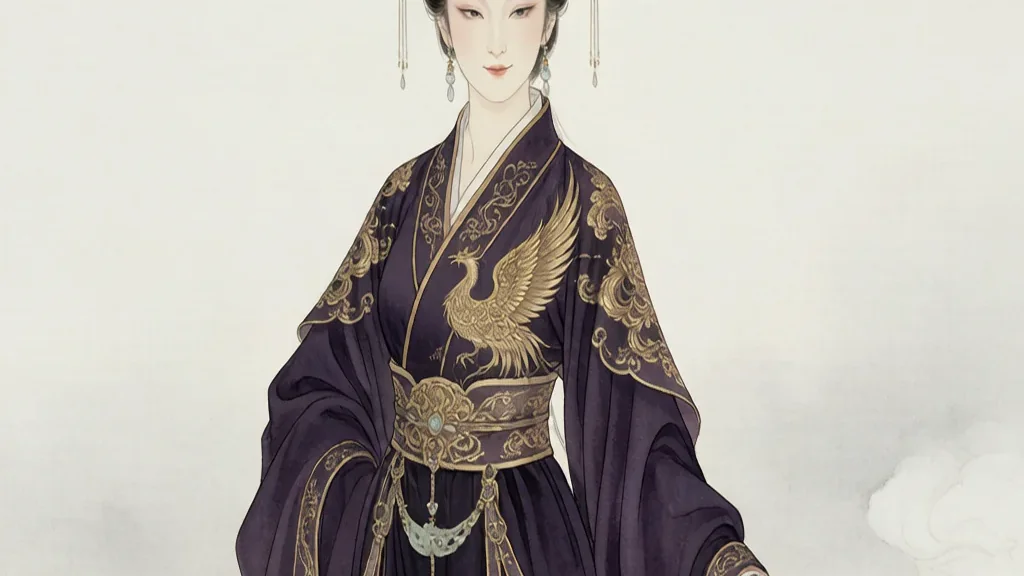
Xuan Nü (玄女), the Mysterious (or Dark) Maiden, is a celestial goddess of war, strategy, and esoteric knowledge in Chinese mythology and Daoist lore. She descends from heaven to aid the Yellow Emperor in his war against Chiyou, granting him the secret arts of battle and the tactics that win the day. Over time Xuan Nü evolved from a martial patron into a broader figure of divine instruction, associated with thunder rites, sexual and internal alchemy, and the transmission of hidden teachings, making her one of the more mystical deities in the Chinese pantheon.
Origins as a Heavenly Maiden
Xuan Nü first appears in early texts as a celestial maiden who serves the highest heavens and possesses secret wisdom unavailable to ordinary mortals. Her name, "Mysterious Maiden," signals her link to the hidden, the dark, and the unknowable.
She belongs to a class of sky-born female emissaries who mediate between the divine court and human heroes, delivering knowledge at moments of crisis. Her descent is always purposeful and tactical.
In the oldest strata she is less a goddess with a cult than a personified channel of heavenly strategy, a voice through which heaven guides the worthy ruler.
Aid to the Yellow Emperor
The defining episode of Xuan Nü's myth is her intervention in the Yellow Emperor's war with Chiyou. When the emperor was trapped in Chiyou's fog and could not prevail, Xuan Nü descended to teach him the methods of warfare.
She is said to have given him formations, the use of the drums and war flags, and the supernatural tactics needed to break the enemy's weather magic. With her instruction the emperor turned the tide and won.
This role makes her the patron of just warfare and of the strategist, the unseen counselor whose wisdom decides battles more than brute force does.
Goddess of War and Strategy
As a war goddess, Xuan Nü sits apart from the brutal fighters of myth; her weapon is method. She embodies the ideal that victory comes from alignment with cosmic principle and clever formation rather than mere strength.
Her teachings are associated with the art of the "mysterious" or "cloud" formations, and with the use of sound and signal to command troops—early principles of military science wrapped in divine authority.
Later martial temples and secret societies adopted her as a protectress, and her name lent prestige to manuals of strategy and boxing that claimed heavenly origin.
Daoist and Esoteric Associations
In Daoism Xuan Nü became a revealer of esoteric arts. She is linked to thunder rites (leifa), the thunderous magic used to purge evil, and to transmissions of internal alchemy concerning the conservation and circulation of vital energy.
Some strands connect her to teachings on the "yellow and mysterious" chamber and to practices of sexual alchemy aimed at longevity, though these esoteric currents are advanced and not part of popular worship.
Her dual character—martial on the outside, contemplative within—made her attractive to Daoist adepts who valued both protection and hidden knowledge.
Link to Thunder and the Feminine Mysterious
Xuan Nü's "mysterious" (xuan) quality ties her to the dark, receptive, feminine principle that nevertheless commands the loud, active force of thunder. She thus bridges yin stillness and yang power.
In thunder-magic traditions she is counted among the goddesses who authorize the practitioner to call storms and strike demons, a role that fuses her warlike and ritual identities.
This combination explains why she could be both the emperor's battle tutor and a Daoist mistress of occult technique without contradiction.
Xuan Nü in Later Folklore
Across later tales Xuan Nü sometimes appears as a bestower of scriptures and skills upon worthy mortals, a fairy godmother of the martial and spiritual arts. Novels and operas feature her granting swords, manuals, or warnings.
She is occasionally paired or confused with the Queen Mother of the West and with other celestial ladies, reflecting the crowded field of sky-goddesses in Chinese religion.
In popular imagination she remains the elegant, stern maiden of the clouds who appears when a hero most needs counsel, then vanishes back to heaven.
Cultural Legacy
Xuan Nü's influence runs through Chinese martial arts lore, where styles and secret manuals invoke her name as a mark of authenticity and heavenly sanction. Her image decorates certain sect altars.
She also appears in modern fiction, games, and films as a cool, powerful mystic, a fitting avatar for the idea that true strength is strategic, disciplined, and quietly cosmic.
Though never as widely worshiped as household gods, Xuan Nü endures as the emblem of concealed wisdom and the heavenly guide who turns the course of history through knowledge.
Contemporary games and fantasy serials have embraced her as a cool, enigmatic warrior-mage, often depicted descending in clouds to grant the protagonist a decisive technique at the climax. This modern afterlife shows how readily her ancient role—the hidden counselor who changes fate—fits the storytelling of any age.
Xuan Nü in Popular Novels
Xuan Nü enjoys a lively career in later vernacular fiction, most famously in the Fengshen Yanyi (Investiture of the Gods) and the legends of the Tang general Xue Rengui, where she appears to grant magical weapons, secret manuals, and timely warnings to the destined hero.
In these tales she is the archetypal immortal patroness: she tests the worthy, rewards the humble, and vanishes once her task is done, leaving the mortal to fulfill the destiny she has unlocked. Her restraint makes the gift feel earned rather than given.
Such stories cemented her image as the celestial mistress of hidden arts in popular imagination, bridging the scholarly Daoist goddess and the household tale of the fairy godmother who aids the rightful underdog. Her cameo roles also let novelists explain a hero's sudden mastery of strategy or magic as a heavenly gift rather than mere talent, a device that kept the gods close to the affairs of mortals on the battlefield and at the court.
❓ Frequently Asked Questions
Who is Xuan Nü?
Xuan Nü, the Mysterious Maiden, is a celestial goddess of war, strategy, and esoteric Daoist knowledge who descends to aid worthy heroes with hidden teachings.
How did Xuan Nü help the Yellow Emperor?
She taught him military formations, the use of drums and flags, and supernatural tactics that broke Chiyou's fog and secured his victory.
What does "Xuan" mean in her name?
"Xuan" means mysterious, dark, or hidden, pointing to her role as a conduit of concealed, heavenly wisdom rather than open force.
Is Xuan Nü a Daoist figure?
Yes; she is woven into Daoism as a revealer of thunder rites and internal alchemy, though she originates in earlier myth as a martial patron.
Why is she called a goddess of war?
Her warfare is strategic and methodical; she grants the knowledge of formation and command, making her patron of the strategist more than the warrior.
Where does Xuan Nü appear today?
She survives in martial-arts lore, sect altars, and modern fantasy as the elegant mystic who guides heroes with secret, cosmic instruction.