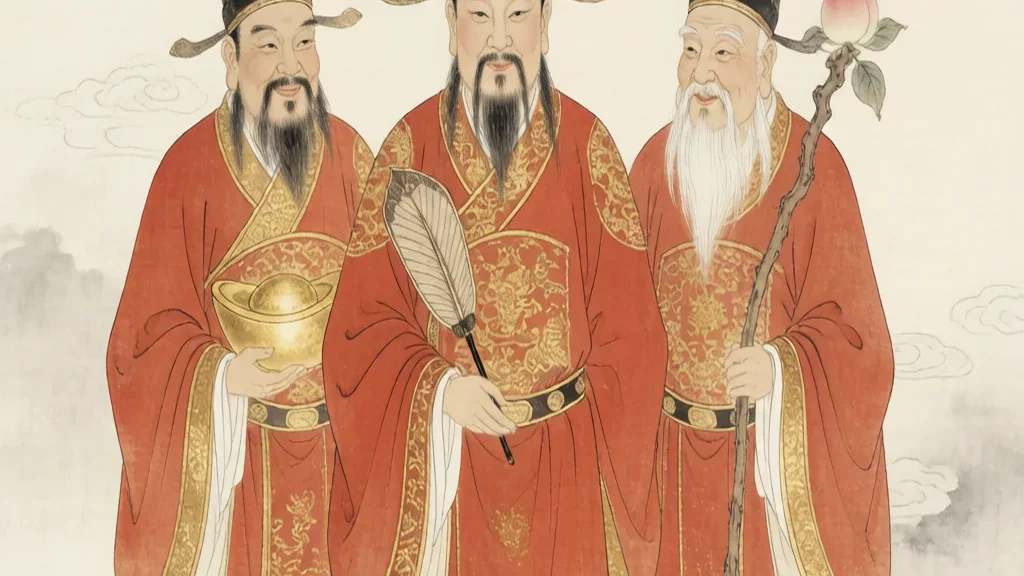
Fu, Lu, and Shou (福禄寿) are the Three Stars of good fortune in Chinese folk religion, a cheerful trio who personify the three great blessings: happiness (Fu), prosperity or rank (Lu), and longevity (Shou). Usually shown together as three smiling old men — or as star-symbols in New Year art — they are among the most beloved images in Chinese homes, wished upon at births, weddings, and especially the lunar New Year. Their simplicity hides a deep cultural map of what a good life contains.
The Meaning of Each Star
Fu (福) is happiness, blessing, and good fortune in its widest sense — health, harmony, and favorable fate. Lu (禄) is official salary, rank, and material prosperity, the reward of career success. Shou (寿) is long life, the foundation on which the other two can be enjoyed.
Together they answer a single question: what do people want? Not one thing but three — joy, means, and time. The trio's endurance shows how Chinese culture balanced emotional, social, and biological well-being as one package.
Fu, the Star of Happiness
Fu is often shown as a distinguished figure in court dress, sometimes with a bat (蝠, fú — a pun) flying above him, or holding a child. He may carry a scroll or be accompanied by symbols of family joy. His presence alone is considered auspicious.
The character 福 is so charged that it is pasted upside down (倒, dào, punning on "arrive," 到) at New Year, inviting happiness to "arrive." Fu thus straddles deity, character, and charm in one compact sign.
Lu, the Star of Prosperity and Rank
Lu appears as a scholar-official in a mandarin's robe, often holding a ru-yi scepter or a symbol of office, sometimes with a deer (鹿, lù — another pun) at his side. He represents not crude wealth but earned station and steady income.
In imperial times Lu specifically meant the salary of rank, tying fortune to public service and merit. His inclusion reminds us that prosperity was ideally respectable, linked to learning and office rather than mere money.
Shou, the Star of Longevity
Shou is the most visually distinct: a tall, bald, laughing elder with a high domed forehead, white brows, and often a peach or a staff with a gourd. He may be accompanied by a crane or a deer, both symbols of long life.
Longevity was the highest personal aspiration in a culture that honored elders. To live long was to be blessed and to become a source of blessing; Shou thus crowns the trio as the condition that lets the others matter.
Origins and Star Worship
Like many Chinese deities, the Three Stars began as astral objects — three constellations associated with fortune, rank, and length of days. Daoist and popular religion personified them as immortals, blending star-lore with the cult of the Eight Immortals and other celestial beings.
By the Ming and Qing periods the trio was a standard of folk art, printed, carved, and painted for every household. Their star origin explains why they are called "Stars" (星) even in fully human form.
Place in the Home and Festival
Images of Fu Lu Shou hang in living rooms and ancestral halls, often above the main furniture, facing the door to receive blessing. At New Year they feature on prints, paper-cuts, and gift wrappers, and are invoked in toasts and greetings.
They also appear at birthday celebrations for the elderly, where Shou takes the lead, and at family gatherings wishing for happiness and success. The trio is the default iconography of Chinese good wishes.
Comparison with Cai Shen
Cai Shen, the God of Wealth, overlaps with Lu but is narrower — purely money. Fu Lu Shou offer a broader, more balanced fortune that includes joy and years, not just coins. Homes may display both, but the trio represents the fuller ideal.
This contrast reveals a cultural preference: wealth alone is welcome but incomplete. A life worth wishing for also needs happiness and time to enjoy it, a quietly wise hierarchy embedded in decorative art.
Modern Survival
Today Fu Lu Shou appear on everything from red envelopes to corporate logos, and their images remain staples of Chinese New Year design worldwide. They translate easily across dialects and regions, a universal visual language of blessing.
Even secular, overseas Chinese households keep a Fu Lu Shou picture as cultural identity more than active worship. The three smiling stars have become shorthand for "the good life" itself — portable, friendly, and timeless.
Fu Lu Shou in the Arts
The trio is a favorite subject of folk painters, who show the three stars amid symbols of their gifts — Fu with a child, Lu with a deer, Shou with a crane and peach. Such scrolls hung in the main hall as a compact blessing on the whole household.
They also appear in embroidery, porcelain, and paper-cuts, especially on birthday and New Year goods. A single design could carry all three meanings at once, making the image a kind of visual greeting card for good fortune exchanged between families.
In opera and storytelling they sometimes descend to reward the virtuous, turning abstract blessings into characters who applaud a happy ending. Their cheerful, repeated presence across media is why Fu Lu Shou remain the most recognizable deities of everyday Chinese wish-making.
Their trio also features in birthday operas, where the three descend to congratulate an elder, turning theology into theatre and blessing into performance. Audiences received the visit as a personal wish for long, happy, prosperous years.
Because the three blessings are universal, Fu Lu Shou cross dialects and regions without translation. A smiling trio on a wall needs no caption; everyone recognizes the good life they promise.
❓ Frequently Asked Questions
Who are Fu Lu Shou?
They are the Three Stars of good fortune: Fu (happiness), Lu (prosperity/rank), and Shou (longevity). Together they represent the three great blessings wished for in a good life.
What does each star mean?
Fu is happiness and blessing; Lu is official rank and material prosperity; Shou is long life. Their combination balances joy, means, and time to enjoy them.
Why are they called "Stars"?
They originated as three fortunate constellations in astral lore, later personified as immortal old men in Daoist and popular religion, keeping the "Star" title even in human form.
How are they shown?
Usually as three smiling elders: Fu in court dress with a bat, Lu as a mandarin with a deer or scepter, and Shou as a bald laughing sage with a peach, crane, or staff.
What is the upside-down Fu?
Pasting the character 福 upside down (倒) puns on "arrive" (到), so the sign reads as "fortune arrives." It is a classic New Year charm.
How do they differ from Cai Shen?
Cai Shen is narrowly the God of Wealth, while Fu Lu Shou offer a broader fortune of happiness and longevity too, representing a more complete ideal of the good life.