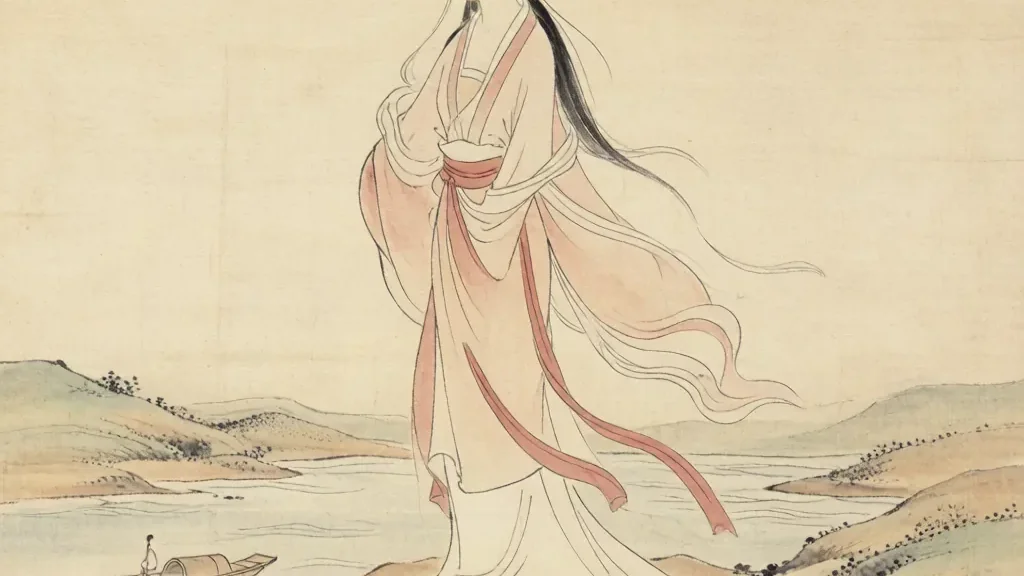
The Luo Wu Fairy is a regional protective spirit found in the local folk religion of parts of southern China, where she is honored as a benevolent female deity associated with water, fertility, and the well-being of her community. Like many local "fairies" (xian or yao) of Chinese village tradition, she belongs to a layer of belief that sits beneath the great national gods such as the Jade Emperor, yet remains deeply important to the people who venerate her. Her worship reflects the Chinese pattern in which a particular mountain, river, or locality is guarded by its own tutelary spirit, approached for rain, health, and the safe growth of children.
Local Deities in Chinese Religion
Chinese popular religion has always been layered. Above the imperial pantheon of heaven exist countless local gods and goddesses tied to a single stream, cliff, or market town. These "earthly immortals" are usually remembered in oral tradition rather than in great scriptures, and their stories travel by village tale and temple festival.
The Luo Wu Fairy fits this pattern. She is not a figure of nationwide liturgy but a neighborhood guardian whose power is felt most strongly near her own sacred site. For her devotees, however, her closeness makes her more responsive than distant high gods, and they turn to her for the practical needs of daily life.
Association With Water
Many regional fairies are linked to water, because rivers and springs were both the givers of life and the source of floods. A water fairy was asked to send timely rain for the fields and to keep the currents calm. Offerings were made at the water's edge, and women sometimes came to pray for the fertility of their households as well as their land.
Water in Chinese symbolism also connects to the feminine and to the moon, so a female water spirit naturally gathered associations with motherhood and the gentle nurturing of a community. The Luo Wu Fairy's identity as a "fairy" (a being of refined, otherworldly virtue) marks her as kindly rather than fearsome.
Role as a Tutelary Spirit
As a tutelary, or place-guarding, deity, the Luo Wu Fairy is thought to watch over the boundaries of her district, protecting residents from illness, misfortune, and malicious influences. Villagers might consult her through spirit-mediums or by drawing lots at her shrine when facing hard choices.
Such local gods often began, in legend, as a virtuous woman of the area who after death was felt to remain near, aiding her neighbors. Whether or not a historical person lies behind the tale, the devotion expresses a community's gratitude and its hope that goodness does not end with death.
Festivals and Offerings
The fairy's festival, held on a fixed day in the lunar calendar, brings villagers to her small temple with incense, fruit, and cooked rice. In some places a troupe may perform a local opera in her honor, turning the occasion into a community gathering as much as a rite.
Women have often been the main bearers of such worship, appealing to a fellow female spirit for family harmony and children's health. The informal, domestic character of the devotion distinguishes it from the grand state ceremonies addressed to heaven, yet it is no less heartfelt.
Iconography and Shrines
Local fairy shrines are typically modest: a stone niche, a small wooden image, or a painted tablet set in a hillside cave or by a stream. The Luo Wu Fairy is depicted as a serene lady in traditional dress, sometimes holding a lotus or a vessel of water, echoing the gentle symbols used for other compassionate goddesses.
Because her cult is local, the artistic style varies from place to place, shaped by regional craft rather than by any canonical rule. The essential message of the image — calm protection — stays constant even where the details differ.
Relationship to Greater Goddesses
Local fairies are frequently "absorbed" into the worship of larger goddesses. A village may come to call its spirit an emanation or a servant of Guanyin or of the Queen Mother of the West, blending grassroots belief with mainstream devotion. This flexible blending is a hallmark of Chinese religion.
In this way the Luo Wu Fairy can be both herself and a local face of a wider merciful power. Devotees rarely see a conflict; the greater goddess lends dignity to the local one, while the local one gives the greater goddess a familiar, nearby presence.
Continuity and Change
Like many local cults, the worship of the Luo Wu Fairy has ebbed and flowed with the times. Periods of turmoil or official suppression pushed her rites into the private sphere, while revival moments brought the shrine back to public life with renewed processions.
Today such traditions are often valued as cultural heritage as much as living faith. Elders pass the stories to the young, and a festival may double as a celebration of local identity, keeping the fairy relevant even as the village around her changes.
Why Local Fairies Matter
The study of figures like the Luo Wu Fairy reveals how ordinary Chinese experienced the sacred — not only through distant imperial heavens but through immediate, place-bound spirits who shared their landscape. These deities anchored people to their homeland and to one another.
In a culture that prizes harmony between heaven, earth, and humanity, the humble local fairy plays a quiet but essential part, reminding us that Chinese religion was always lived as much in the village as in the cosmos.
Stories and Oral Tradition
The Luo Wu Fairy lives chiefly in spoken memory. Elders recount her acts of kindness — calming a flood, curing a child, guiding a lost traveler home — in the dialect of the place, and these tales are the scripture of a cult without written canon. Each telling adapts her to the listener's moment, so the figure stays alive rather than frozen in a fixed text.
Such storytelling binds generations: a grandmother's tale becomes a grandchild's piety, and the fairy's gentle deeds become a local model of how neighbors should treat one another. In this way oral tradition does the work that sacred books do elsewhere, carrying moral shape through voice rather than page and keeping the spirit close to the people who name her.
❓ Frequently Asked Questions
What is the Luo Wu Fairy?
She is a regional protective spirit of southern Chinese folk religion, associated with water, fertility, and local well-being.
Is she a major national deity?
No; she is a local tutelary goddess honored mainly in her own district rather than across the whole country.
Why is she connected to water?
Many village fairies guard rivers and springs, asked for timely rain and protection from floods.
How is she worshipped?
Devotees offer incense and food at her shrine, often on a fixed festival day in the lunar calendar.
How does she relate to Guanyin?
Local fairies are often seen as local faces of greater goddesses, blending folk and mainstream devotion.
Are such local cults still alive?
Yes; many survive as living worship and as celebrated parts of local cultural heritage.