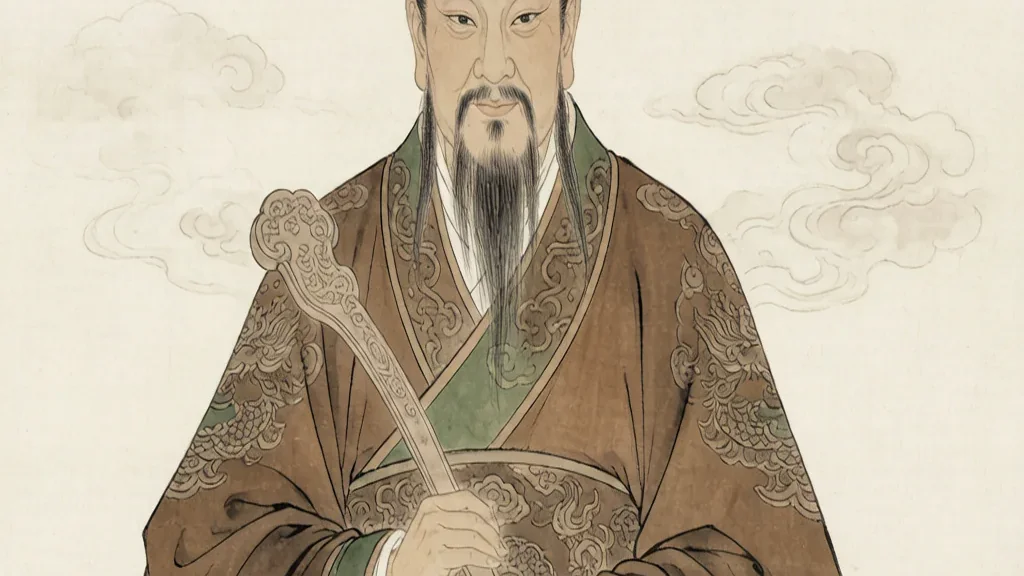
Tudi Gong, often called Tu Di Gong or the Earth God, is the humble local deity who guards a single plot of land — a village, a field, a street, or even a single shop. He is perhaps the most widespread and intimate god in Chinese folk religion, a grassroots figure whom everyone from farmers to city merchants honors with a daily stick of incense. Unlike the majestic Jade Emperor who rules from afar, Tudi Gong lives next door, a white-bearded old man who keeps the neighborhood peaceful, the harvest steady, and the accounts of the locality in order. His small shrines dot the Chinese landscape, a reminder that the sacred is as close as the soil beneath one's feet.
What "Tudi Gong" Means
The name breaks into "tu di" (earth, soil, land) and "gong" (lord, grandfather, a respectful term for an old man). He is thus "the Lord of the Earth" or "Grandfather Earth" — a kindly elder of the ground rather than a lofty cosmic ruler. The title reflects both reverence and familiarity.
Every locality was thought to have its own Tudi Gong, just as every place had its own elders. Two nearby villages might each have a different Earth God with a different name and history, yet all shared the same basic role as the soil's guardian and the community's first line of spiritual defense.
Origins and Social Roots
The worship of local earth spirits is ancient in China, reaching back to early agrarian rites in which the soil that fed the people was honored as a power in itself. Over time these diffuse spirits were personified as aged, virtuous men — often a worthy local worthy who after death became the guardian of his hometown.
This "posthumous promotion" pattern is common: a just official, a loyal steward, or a benevolent elder is remembered after death as the area's Tudi Gong. The belief turns respect for community elders into a lasting spiritual office, binding the living to their ancestors and their place.
Appearance and Shrine
Tudi Gong is usually shown as a smiling old man with a long white beard, wearing the plain robes of a village elder and often seated. He may be flanked by his attendants, a clerk who records births and deaths and a messenger who runs errands to higher gods.
His shrines range from a carved stone niche by a field to a small wooden cabinet in a shop. In the countryside a Tudi Gong shrine might mark the edge of a settlement, politely informing passing spirits that this land is under protection. The modesty of the shrine matches the modesty of the god.
Duties and Powers
Tudi Gong's job is local stewardship. He protects the harvest from pests and drought, keeps the village free of misfortune, and maintains the moral register of the place — noting who behaved well and who did not. When a higher god such as the City God needs news of a district, the Earth God reports upward.
Because he is "first responder" of the spirit world, people approach him for everyday worries: a lost ox, a sick child, a disputed boundary. His closeness makes him approachable, and devotees treat him almost like a trusted neighborhood official who knows everyone by name.
Relationship With the City God
In the celestial hierarchy, Tudi Gong sits at the bottom, reporting to the Chenghuang, the City God who governs the walled town above him. The City God judges the dead and maintains order for a whole city, while the Earth God handles the granular life of a single ward.
This chain — Earth God beneath City God beneath the heavenly court — mirrors the imperial administration of districts and prefectures. Petitions and souls ascend through it, so that even the smallest village is connected, through its Tudi Gong, to the great order of heaven.
Festivals and Worship
The second day of the second lunar month is widely observed as Tudi Gong's birthday, when villagers stage a small fair, offer food, and hire a opera troupe to entertain him. Similar rites mark his "ascension day" at the end of the year, when he reports to heaven.
In daily life, households and shopkeepers light incense at his shrine each morning, asking for peace and trade. A new business may first "invite" the local Earth God to witness its opening, and a family moving house might inform him, since he oversees the land they leave and the land they enter.
Role in Daily Life
Beyond prayer, Tudi Gong functioned as a kind of community identity. The boundaries of his jurisdiction often matched the social boundaries people actually lived by — the hamlet, the market street, the clan settlement. To know "our Tudi Gong" was to know where one belonged.
In times of trouble — plague, banditry, flood — the Earth God's shrine became a focus of collective action, a place to pray and to organize mutual aid. His small altar thus anchored both devotion and neighborly solidarity.
Tudi Gong in the Modern World
In cities, the Earth God often survives inside shops, apartments, and temples tucked between high-rises. Business owners keep a small image for prosperity and protection, continuing a practice carried from the village into the metropolis.
Overseas Chinese communities brought Tudi Gong with them, planting his shrines in Chinatowns and clan halls abroad. Wherever Chinese settled, the gentle Lord of the Earth traveled too, a portable homeland god who made strange soil feel like home.
Cultural Meaning
Tudi Gong embodies a distinctly Chinese way of locating the sacred in the everyday and the local. He teaches that greatness in the spirit world is not only about supreme power but about faithful care for a small patch of the world and the people who live on it.
In a culture that values rootedness and filial respect for elders, the white-bearded Earth God is both a deity and a grandfather-figure, the living expression of the tie between people, their ancestors, and the land that sustains them.
❓ Frequently Asked Questions
Who is Tudi Gong?
He is the Earth God, a local deity who guards a single village, field, street, or shop in Chinese folk religion.
How is he different from the Jade Emperor?
He is a humble, local guardian next door, while the Jade Emperor rules the whole heavenly bureaucracy from afar.
What does he do?
He protects the harvest, keeps the neighborhood safe, and records the moral conduct of local residents.
Who is above him?
The City God (Chenghuang) of the walled town, to whom he reports on district affairs.
How do people worship him?
They offer daily incense at a small shrine and hold a fair on his birthday in the second lunar month.
Why is he so popular?
His closeness and kindness make him approachable for everyday worries, and he anchors local community identity.