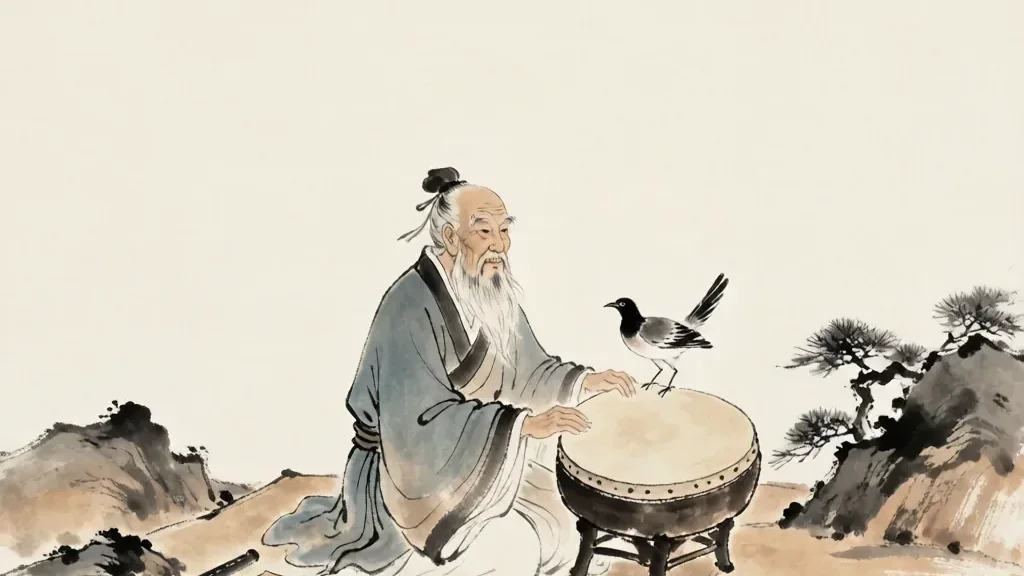
Fuxi (伏羲), often honored as the "First of the Three Sovereigns," is one of the most important culture heroes in Chinese mythology. Revered as the ancestor who lifted early humanity out of a primitive, beast-like existence, he is credited with inventing fundamental skills of civilization—fishing, hunting with nets, animal husbandry, music, and the eight trigrams that later became the foundation of Chinese cosmology and divination. Usually portrayed with a human head and a serpent's body, Fuxi appears alongside his sister and consort Nüwa, and his legacy runs through thousands of years of Chinese thought as the symbolic founder of ordered society.
Origins and Early Legends
The earliest references to Fuxi appear in Warring States and Han dynasty texts, where he is described as a descendant of the thunder god who was born after a cosmological catastrophe. According to later folklore, he and Nüwa survived a great flood that destroyed the rest of humankind and then married to repopulate the earth, a myth that explains both the origin of humanity and the brother-sister unions found in many creation stories.
Classical sources place his birthplace at Chengji, in the region of what is now western Gansu or eastern Shaanxi, and say he established his capital at Chen, in present-day Henan. These geographical associations helped localize his cult and gave later dynasties concrete sites to honor with temples and sacrifices.
Over time Fuxi merged with other primordial ruler figures, and by the Han period he was firmly listed as the first of the Three Sovereigns (Sanhuang), preceding the Fire Emperor and the Yellow Emperor in the received sequence of ancient sage-kings.
The Serpent-Bodied Ancestor
Visual representations of Fuxi from Han dynasty stone carvings and tomb paintings show him with a human upper body and the coiled lower body of a snake, frequently intertwined with Nüwa in a double-helix pose. In their hands they hold tools of civilization: Fuxi often carries a ruler or set-square, while Nüwa holds a compass, together symbolizing the measurement and ordering of the world.
This serpent form connects Fuxi to the dragon, an animal with which Chinese rulers and ancestors were increasingly identified. The imagery reinforced the idea that the imperial line and the Chinese people themselves descended from dragon-bodied progenitors.
The intertwined pose also became a popular apotropaic image painted on tombs, intended to protect the dead and secure rebirth, showing how a creation myth doubled as a guarantee of continuity beyond death.
Invention of the Eight Trigrams
Fuxi's most celebrated intellectual achievement is the creation of the bagua, the eight trigrams. Legend holds that he observed the patterns of heaven and earth, the markings on a dragon-horse that emerged from the Luo River, and the natural order of birds, beasts, and landscapes, then condensed these observations into eight symbols of three broken or unbroken lines.
Each trigram represents a fundamental force or phenomenon—heaven, earth, thunder, water, mountain, wind, fire, and lake—and their combinations form sixty-four hexagrams used in the classic Yijing (Book of Changes). In this tradition Fuxi is thus the original source of Chinese correlative cosmology.
Although the historical Yijing developed over many centuries, attributing its seed to Fuxi gave Chinese divination and state ritual a single venerable founding figure, and his trigrams remain central to fengshui, medicine, and martial arts philosophy today.
Gifts of Survival: Nets, Traps, and Fire
Before Fuxi, people were said to forage and gather like animals. He taught them to twist hemp and silk into cordage and to weave nets for fishing and for catching birds and beasts, replacing random hunting with a repeatable, planned method of obtaining food. This innovation marks, in mythic terms, the transition from passive gathering to productive economy.
He is also credited with instructing people in the domestication of animals, an early form of pastoralism that stabilized food supply and reduced dependence on the hunt. Some accounts add that he taught the proper cooking of food and the use of fire for warmth and preparation.
These "gifts" are less literal inventions than a cultural memory of the Neolithic revolution, projected backward onto a single wise ancestor who embodies the moment humans began to control nature rather than merely fear it.
Music, Writing, and Governance
Fuxi is traditionally said to have fashioned the se, a plucked string instrument, and to have used music to cultivate harmony between people and to civilize the emotions. Music in early China was never mere entertainment; it was a tool of moral and cosmic order, and its attribution to Fuxi places him at the root of refined culture.
He is further honored as a precursor to writing, having reportedly devised knotted cords to record affairs before true script existed, and as the founder of marriage rites, replacing casual union with formalized bonds and thereby establishing the family as the cell of society.
As a ruler he is described as setting up officials, dividing the people into groups, and instituting the rudiments of law and administration—again a mythical condensation of the invention of the state.
Fuxi and Nüwa: The Archetypal Pair
The brother-sister marriage of Fuxi and Nüwa is one of the most widespread Chinese legends. After the flood they reasoned that, being the only survivors, they must marry to renew humankind, yet they were ashamed; they prayed to heaven, and heaven approved the union by making mist and cloud join them.
Nüwa, in separate tradition, is the goddess who molded the first humans from yellow clay and repaired the broken sky with melted stones, so the pair together cover both the creation of humanity and the restoration of cosmic order. Their joint worship reflects the complementary male-female principle at the heart of Chinese cosmology.
In art and festival they are frequently invoked together as the original ancestors of all Chinese, and many surnames and lineages trace a symbolic descent to this primordial couple.
Cult Centers and Temple Worship
The principal center of Fuxi veneration grew up at Tianshui in Gansu, which local tradition identifies as his birthplace and which still hosts the large Fuxi Temple, also called the "Temple of the First Sage." There, annual rites are performed, especially around his traditional birthday.
At Huaiyang in Henan, on the site of the ancient capital Chen, the Taihao Mausoleum complex honors Fuxi under the title Taihao, and draws large pilgrimage crowds. These sites became nodes of regional identity and of state recognition across dynasties.
Imperial sacrifices to Fuxi were standardized in the ritual codes, and Confucian scholars included him among the ancient sage-kings whose virtue legitimated the moral order of the realm.
Fuxi in the Three Sovereigns
The "Three Sovereigns and Five Emperors" framework organizes China's mythical antiquity into a progressive sequence of virtuous rulers. Fuxi usually leads the Three Sovereigns, followed by the Fire (Yan) Emperor and the Yellow (Huang) Emperor, each associated with a different contribution to civilization.
This schema served a political purpose: by tracing the dynasty's authority back to culture heroes who taught survival, writing, and order, later states claimed a mandate rooted in beneficent invention rather than mere conquest. Fuxi's position at the head made him the fountain of that legitimacy.
Different texts vary the membership of the Three Sovereigns, but Fuxi's place is remarkably stable, a sign of how deeply his image was fixed as primal ancestor.
Symbolism of the Dragon-Horse and River Charts
A recurring motif in Fuxi lore is the appearance of a dragon-horse bearing a chart on its back from the Yellow River, and a tortoise bearing a writing from the Luo River. From these "river charts" Fuxi is said to have derived the trigrams, linking his wisdom to a direct cosmic revelation.
This motif became a cornerstone of Chinese numerology and state ritual, where the "He tu" and "Luo shu" diagrams were studied as keys to the structure of the universe. The dragon-horse itself became an auspicious symbol of genius and good omens.
By binding Fuxi's knowledge to river spirits, the myth places human civilization within the larger rhythm of nature and the mandate of heaven, rather than as a purely human achievement.
Legacy in Later Culture
Fuxi's influence extends into folk religion, where he is worshiped as an ancestor-god, into Confucian historiography as the model sage-king, and into popular art as the serpent-bodied progenitor. His trigrams survive in daily practice through fengshui and the Yijing.
In the modern era he has been reinterpreted as a national symbol of Chinese unity and antiquity, invoked in discussions of shared heritage across Chinese-speaking communities. Temples and festivals keep his memory active at the local level.
Though the historical Fuxi is certainly a mythological construct, the values projected onto him—ingenuity, harmony with nature, and the civilizing of human society—remain central to how Chinese culture understands its own origins.
❓ Frequently Asked Questions
Who was Fuxi in Chinese mythology?
Fuxi is the primal culture hero and first of the Three Sovereigns, credited with teaching humanity fishing, net-making, animal keeping, music, and the eight trigrams that underlie Chinese cosmology.
What is Fuxi's relationship to Nüwa?
Nüwa is both his sister and his consort; together they survived a great flood and repopulated the earth, and they are jointly honored as the primordial ancestors of humanity.
What are the eight trigrams?
The bagua are eight three-line symbols representing fundamental forces like heaven, earth, fire, and water, which Fuxi is said to have devised after observing nature and a cosmic river chart.
Where is Fuxi worshiped today?
Major cult centers include the Fuxi Temple at Tianshui in Gansu and the Taihao Mausoleum at Huaiyang in Henan, both of which hold annual rites.
Why is Fuxi shown with a snake body?
The serpent form links him to the dragon and signals his status as a primordial, semi-divine ancestor rather than an ordinary human ruler.
Is Fuxi a historical person?
No; Fuxi is a mythological figure whose stories encode memories of the Neolithic transition to farming, fishing, and organized society rather than a documented individual.