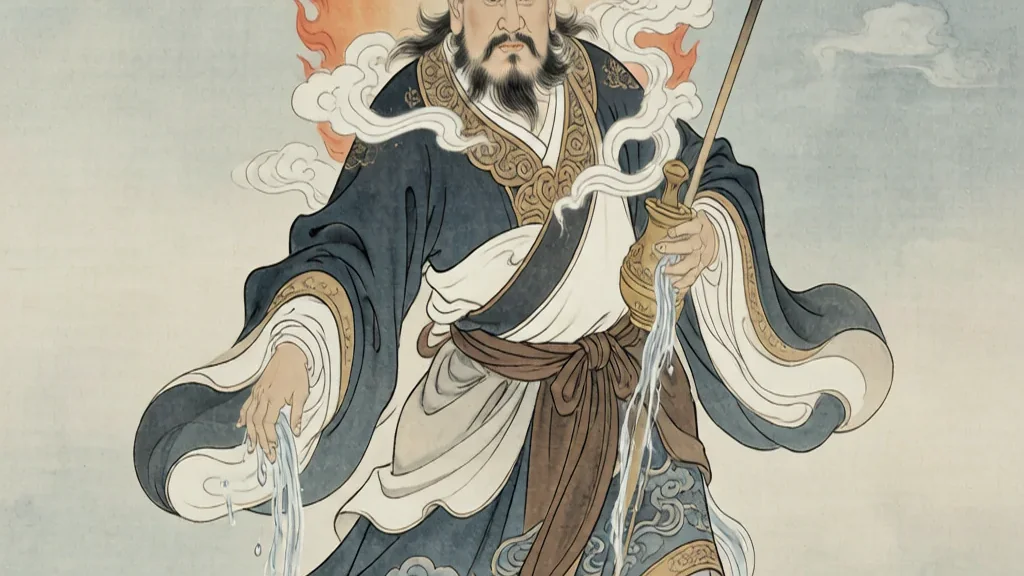
Yu Shi (雨师), the Rain Master, is the deity who commands rainfall in Chinese mythology. Alongside the Thunder God, Lightning Mother, and Wind Duke, he belongs to the storm pantheon that early agricultural societies depended on for survival. To pray to Yu Shi was to ask the sky for the water that meant full granaries or, failing that, for the restraint that prevented floods. His cult reveals how intimately weather and worship were bound in old China.
Identity and Early Mentions
Yu Shi appears in some of the oldest Chinese texts, including the "Chu Ci" (Songs of Chu) and later commentaries, where he is named among the spirits serving the supreme god or accompanying the wind and thunder. In several accounts he is linked with a figure named Ping Yi (屏翳) or with the winds, showing how fluid these nature deities were in early legend.
Unlike the sharply drawn gods of later popular religion, Yu Shi began as a somewhat abstract "master of rain" — a personification of the rains rather than a fully biographical character. His job was clear even when his life story was not.
Yu Shi in the Storm Pantheon
Chinese weather magic pictured the sky as a team. Feng Bo (Wind Duke) stirred the air; Lei Gong (Thunder God) produced the crashes; Dian Mu (Lightning Mother) flashed the light; and Yu Shi released the falling water. Together they formed a coordinated celestial weather bureau.
This division of labor made prayer practical. A drought called for appealing to Yu Shi directly, while a violent storm might require soothing Lei Gong or binding Feng Bo. Each deity had a specialty, and farmers learned which one to address for which need.
Myths of Rainmaking
Many regional tales describe Yu Shi as a servant or subordinate who could be summoned by greater gods or by culture heroes. In some versions he is a mortal rainmaker who mastered the art of calling clouds, blurring the line between deity and skilled technician of the weather.
These stories fed a real tradition of state rainmaking rituals, where officials would fast, pray, and perform ceremonies at altars during drought. The Rain Master was the addressee of last resort when the fields cracked and the rivers shrank.
State and Local Rain Rituals
Throughout imperial history, praying for rain was a duty of government. When drought threatened, the emperor or local magistrates performed solemn rites to Yu Shi and related deities, sometimes confessing their own failings as a cause of heavenly displeasure.
At the village level, communities staged dragon dances, carried effigies, or dammed streams in mimicry of rain, all aimed at persuading Yu Shi to open the skies. Such communal rites doubled as social bonding during hard times.
Symbolism of Rain in Chinese Culture
Rain is deeply symbolic in Chinese thought. Timely rain (甘霖, sweet dew) is a metaphor for benevolent rule and good fortune; excessive or absent rain signals cosmic imbalance. Yu Shi therefore stands at the hinge of the human and natural orders.
In poetry, rain evokes both renewal and melancholy. The Rain Master's gift is never merely meteorological — it is a comment on the health of the realm, the virtue of its rulers, and the mood of the heavens.
Comparison with the Dragon Kings
Over time the Dragon Kings (龙王) came to overshadow Yu Shi as the main rain-givers, especially in popular temple worship. Where Yu Shi is an older, more literary storm-deity, the Dragon Kings are local, approachable lords of rivers and seas who directly control rainfall by region.
Yu Shi did not disappear but receded into the classical and ceremonial register, while the Dragon Kings took over daily devotional rain prayer. The two layers show how Chinese religion kept older gods even as newer ones rose to prominence.
Legacy in Art and Festival
Yu Shi rarely appears alone in art; he is usually shown with the other weather gods in temple murals of the thunder ministry. He may hold a bowl or gourd from which water streams, a compact visual of his function.
In folk performance and opera, weather gods appear in plague- or drought-themed plays, reminding audiences of the old dependence on skies they could only petition. The Rain Master thus survives as part of a larger storm tableau rather than as a solitary star.
Yu Shi in Classical Literature
The Rain Master also appears in poetry and prose as a figure the poet invokes when fields parch or, conversely, when relieved clouds finally break. Early anthologies pair his name with the wind and thunder as the visible court of heaven, summoned in lines that are half prayer, half weather report.
In the "Book of Documents" and later agricultural manuals, timely rain sent through him signals a virtuous reign, while drought warns of disorder. Rulers were expected to read weather as a report card, and Yu Shi was the hand that delivered the grade to a negligent court.
Such literary use kept the Rain Master in the learned imagination as well as the peasant's. He is less a character with a biography than a recurring weather-voice in Chinese writing — the sky's answerable officer whenever the pen turned to the rain.
This literary afterlife also meant the Rain Master could be gently mocked. Humorous poems blame him for soaking scholars or hiding the moon, proof that even a weather god was fair game for the playful later pen.
Across the centuries Yu Shi moved between altar and anthology, equally at home in a farmer's prayer and a poet's complaint, never confined by Chinese imagination to a single register of reverence.
❓ Frequently Asked Questions
Who is Yu Shi?
Yu Shi, the Rain Master, is the Chinese deity who controls rainfall. He is one of the oldest named weather gods, appearing in early texts such as the Songs of Chu.
What company does the Rain Master keep?
He is part of a storm pantheon with Feng Bo (Wind Duke), Lei Gong (Thunder God), and Dian Mu (Lightning Mother), each handling one aspect of a weather event.
How did people pray to Yu Shi?
Both commoners and officials performed rainmaking rites — fasting, prayer at altars, processions, and even dragon dances — especially during drought, often with magistrates leading.
Is Yu Shi the same as the Dragon King?
No. Yu Shi is an older, more literary rain deity, while the Dragon Kings became the popular local rain-givers in later folk religion. The Dragon Kings largely took over daily rain worship.
Why was rain so symbolic?
Timely rain stood for benevolent rule and good fortune; its absence or excess signaled cosmic or political imbalance. Weather was read as a verdict on the realm's health.
Does Yu Shi appear in art?
Usually within temple murals of the thunder ministry alongside other weather gods, often depicted with a vessel pouring water, rather than as a solitary subject.