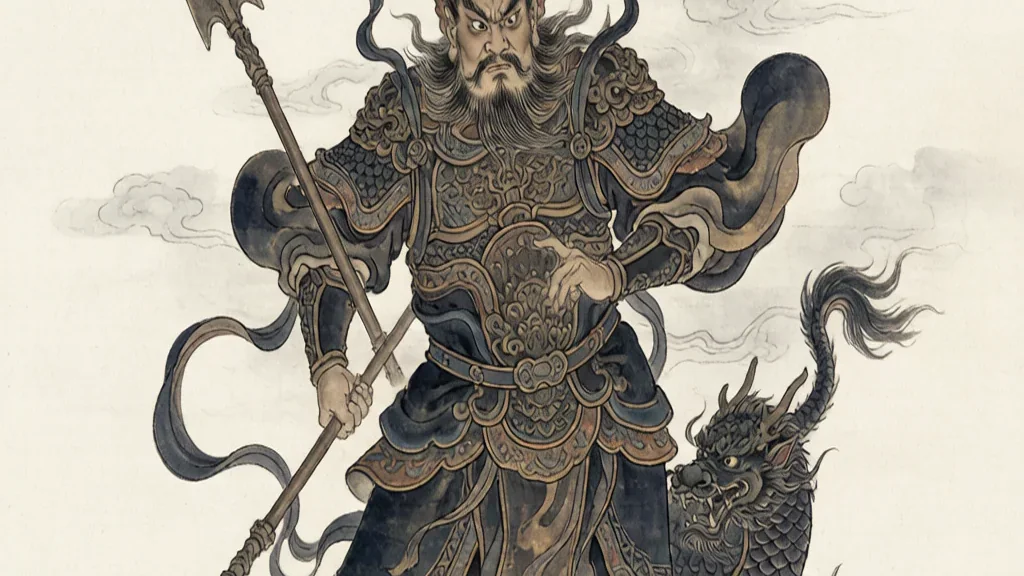
Lei Gong (雷公), the Thunder God, is one of the most ancient and feared figures in Chinese mythology. Portrayed as a winged, beak-nosed, hammer-wielding being who drums up thunder across the sky, he punishes wrongdoers, exposes hidden evil, and signals the coming of life-giving storms. Equal parts judge and weather-maker, Lei Gong sits at the head of the Thunder Department, a vast celestial bureau that later Daoism organized with military precision.
Ancient Roots and the Thunder Ritual
Reverence for thunder is among the oldest strands of Chinese religion. Oracle-bone inscriptions of the Shang dynasty already record rituals to the sound of thunder as a powerful spirit. Early people heard in thunder the voice of heaven's authority — sudden, overwhelming, and morally charged.
From this awe grew a personified god. By the Warring States and Han periods, Lei Gong appears in literature as a distinct divine agent who not only makes weather but enforces heavenly law, striking the guilty and the impious.
Appearance and Iconography
Lei Gong is rarely handsome. He is typically drawn with a blue or red face, a bird-like beak, claws, and wings, carrying a mallet and a drum or chisel. The beak and wings mark him as a thunderbird-like creature, linking sky-storm to avian power.
In his hands he holds the tools of his trade: a drum to beat out the rolling thunder and a chisel or axe to "cut" the bolt. Temple murals place him amid the thunder generals, a busy, martial figure at the center of the weather machine.
The Thunder Department Bureaucracy
Later Daoist and popular cosmology turned Lei Gong into the chief of the Thunder Department (雷部), a hierarchy of generals, runners, and attendants — including Dian Mu the Lightning Mother — who together manage storms and punishments. He became a celestial official with a staff.
This bureaucratization reflects a broader Chinese habit of imagining heaven as a mirror of the imperial state. Just as the emperor had ministries, so did the gods, and thunder was administered by a proper office with ranks and reports.
Thunder as Moral Punishment
A central belief is that Lei Gong strikes those who commit secret sins: unfilial children, false witnesses, corrupt officials, and especially those who wrong others without witnesses. The thunderbolt is heaven's audit, arriving where human justice cannot see.
Stories abound of thunder splitting trees to reveal a hidden murderer's guilt, or of Lei Gong sparing the innocent while destroying the wicked. The god thus embodies the comforting idea that no evil escapes ultimate account.
Relationship with Dian Mu
Lei Gong works in tandem with Dian Mu, the Lightning Mother. While he provides the sound and the strike, she provides the revealing flash. In several tales she lights the scene so he aims true, preventing innocent deaths — a cooperative check on his force.
Their pairing is a classic yin-yang duo: his thunderous yang energy balanced by her illuminating yin light. Together they personify the full sensory experience of a storm as a moral event.
Thunder in Agriculture and Rain
Beyond punishment, Lei Gong is a rain-bringer. His drums awaken the spring and call the clouds; farmers welcomed early thunder as a sign of coming fertility. The same power that destroys can also nourish, depending on heaven's mood.
This dual nature made him ambivalent — respected and feared at once. Communities performed rites to the thunder ministry during both drought (to summon rain) and flood (to calm the skies), negotiating with the same god for opposite ends.
Regional Cults and Folk Tales
Local cults built small thunder shrines, and many villages told of Lei Gong capturing "thunder ghosts" or of mortals who briefly visited his court. Some tales describe a boy nephew, Lei Zhenzi, who aids him — a later embellishment popular in fiction.
In southeast China especially, thunder worship remained lively, tied to typhoon seasons and rice cycles. The god's reach was both cosmic and daily, a neighbor whose mood shaped the harvest.
Survival in Modern Culture
Lei Gong persists in opera, shadow puppetry, and modern fantasy media as the gruff enforcer of heaven. His image — beak, wings, hammer — is instantly readable as "thunder" even to those who no longer fear his bolt.
Though few pray to him today for vengeance, the phrase "struck by thunder" (被雷劈) still lingers as a curse for the deserving wicked, proof that the Thunder God's moral thunder still echoes in the language.
Lei Gong in Local Temple Life
In villages of south China, small thunder shrines sat at the edge of town, tended by those who blamed or thanked the god for the season's storms. Offerings were modest — incense, a little wine, and a paper replica of his drum left smoldering at the altar.
During the typhoon season, communities held placating rites asking Lei Gong to moderate his hand, while in drought they urged him to roll the clouds. The same deity was petitioned for opposite ends as the weather demanded, a flexible neighbor more than a distant judge.
These local cults gave the cosmic Thunder God a familiar, nearby face. He was not only the punisher of secret sinners but the weather upstairs whom villagers knew by name and bargained with, year after year, at the field's edge.
Stories also credit Lei Gong with forging the world's metals, his thunderclaps likened to a cosmic smith's hammer. This made him a patron of smiths and founders, who sometimes left offerings lest their furnaces anger him.
Such side roles show how a single weather god branched into many crafts and fears. The Thunder God was never only sound in the sky; he was also the clang of human industry under heaven's watch.
❓ Frequently Asked Questions
Who is Lei Gong?
Lei Gong is the Thunder God of Chinese myth, an ancient deity who makes thunder and lightning and punishes hidden wrongdoing. He later became chief of the celestial Thunder Department.
What does Lei Gong look like?
He is typically shown with a beak-like face, wings, claws, and a fierce expression, carrying a drum and a chisel or hammer — a thunderbird-like figure of the storm.
Why is he associated with punishment?
Thunder was heard as heaven's moral voice. Belief holds that Lei Gong strikes secret sinners — the unfilial, the corrupt, the false — where human justice cannot reach, acting as a cosmic audit.
How is Lei Gong linked to Dian Mu?
Dian Mu, the Lightning Mother, flashes light so he can aim true, preventing innocent deaths. Their yin-yang pairing balances sound and light in the storm.
Was Lei Gong only a punisher?
No. He was also a rain-bringer whose drums awakened spring and called clouds. Farmers both feared and welcomed him depending on the season's need.
Is Lei Gong still part of culture?
Yes, in opera, puppetry, and fantasy media as heaven's enforcer, and in the lingering phrase "struck by thunder" used of the wicked — his moral thunder survives in speech.